

The Rogers Centre was electric, a cauldron of anticipation and rivalry as the Toronto Blue Jays and New York Yankees battled through a tense, low-scoring affair. The bottom of the sixth inning arrived with the scoreboard reading 1-0 in favor of the visitors, and the home crowd was growing restless, desperate for a spark. With runners on first and second and one out, the matchup between George Springer and Yankees ace Gerrit Cole felt like the moment the game would turn. The tension was palpable, the crisp crack of the bat a sudden explosion of sound as Springer rolled over on a fastball, sending a weak, tumbling grounder toward third base. Yankees’ third baseman Ryan McMahon charged in aggressively, fielded the ball cleanly, stepped on third to force out Nathan Lukes, and whipped a throw across the diamond to first base, hoping to complete the inning-ending double play. But baseball is a fickle game, and the play was destined to unravel in spectacular and frightening fashion. McMahon’s throw skipped in the dirt, and first baseman Luis Garcia Jr., lunging to make the catch, watched in horror as his glove popped off his hand, the leather mitt flying into the infield as the ball squirted away into no man’s land. It was a moment of pure chaos, a cascade of errors and misfortune that turned a routine out into a circus.
Vladimir Guerrero Jr., ever the savvy base runner with an innate baseball IQ, saw the pandemonium unfold before him and seized the opportunity, rounding first base and sprinting hard toward third. Garcia scrambled to recover, scooping the ball up with his bare hand, and fired a desperate, hurried bullet toward third base in a frantic attempt to catch the Blue Jays’ slugger. But in that moment of panic, the Yankees’ defensive alignment was completely askew. No one was covering the bag. Shortstop George Lombard Jr., a young infielder caught in the swirl of a chaotic play, was a couple of paces off the base, watching the sequence unfold. Garcia’s throw, meant to be a crisp strike to a waiting glove, sailed into foul territory, an errant rocket that seemed destined for the seats. Lombard Jr., reacting on pure instinct, sprinted toward the ball to try to cut it off and make a play. His eyes were locked on the projectile, his body hurtling forward at full speed, completely unaware of the massive, 245-pound base runner barreling toward the same patch of grass. The collision was immediate and sickening. Lombard Jr.’s knee connected directly with the side of Guerrero’s head, a brutal, accidental blindside hit that snapped the veteran’s helmet off his skull, sending it spinning across the dirt like a discarded toy. The crowd gasped in unison, a collective wave of horror washing over the stadium as the star player crumpled to the ground, dazed and disoriented.
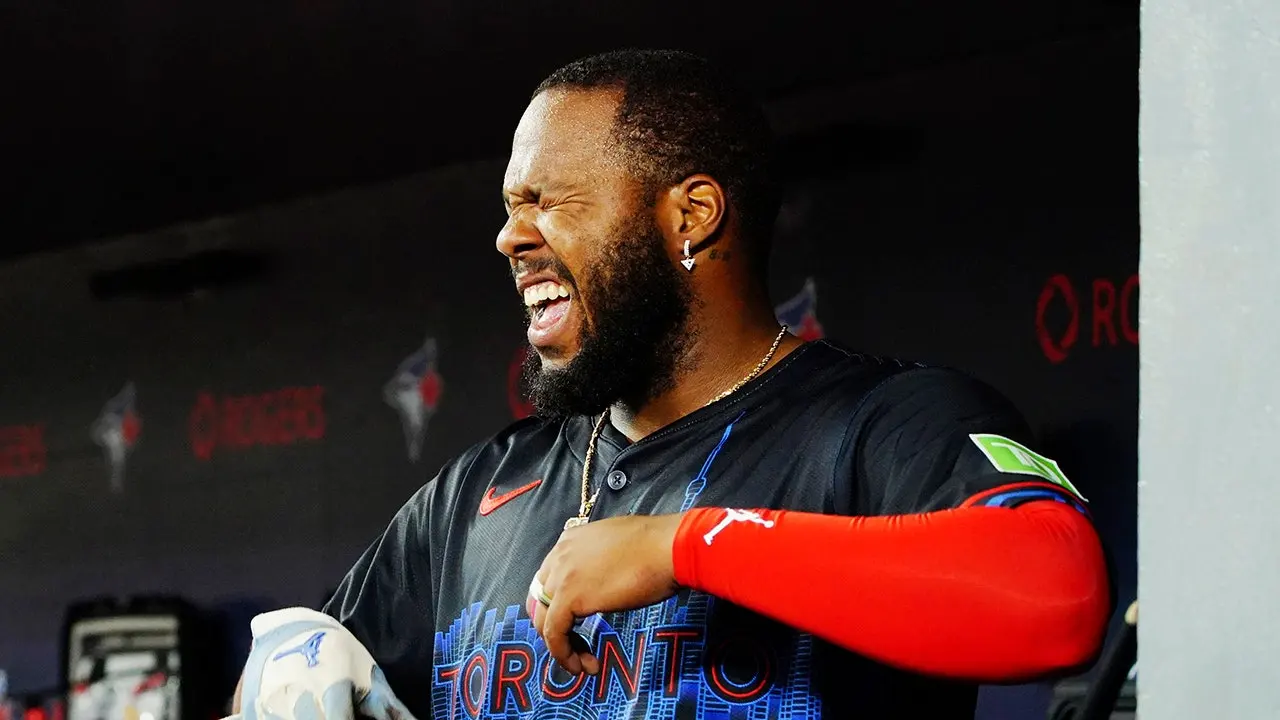
Despite the violent impact that left him visibly shaken and wobbling, Guerrero Jr. displayed the grit and determination that has defined his career. He scrambled to his feet, still clearly out of sorts, and managed to scamper home, touching the plate to tie the game at 1-1 before his equilibrium gave way. As he crossed home plate, his legs looked heavy, his movements unsteady, and he bent over at the waist, his hands on his knees, trying to gather himself as the world spun around him. His teammates rushed to his side immediately, their faces a mixture of relief that he was upright and deep concern for their franchise cornerstone. With gentle, guiding hands, they helped him shuffle toward the dugout, shielding him from the cameras and the noise, treating him like a fragile piece of glass. The sight of Guerrero, usually an imposing, powerful figure, looking so vulnerable and fragile was a stark reminder that even the most elite athletes are human. The dugout was a flurry of activity as trainers and medical staff swarmed around him. It became clear almost instantly that he would not be returning to the field. The game continued, but the energy had shifted—what should have been a moment of jubilant base-running brilliance had been marred by a terrifying, freak accident that left everyone holding their breath.
The aftermath of the bizarre play left both teams and the broadcast booth scrambling to make sense of what had transpired. It was a sequence that would live on in highlight reels for all the wrong reasons, a comedy of errors that escalated into a genuine medical scare. Blue Jays manager John Schneider, his voice laced with visible worry and relief, addressed the media after the game. “A little bit of a headache,” he said, acknowledging the obvious concern over any injury to the head. Schneider immediately emphasized caution, stating that they removed Guerrero as a precautionary measure. “Kind of precautionary right now,” he explained, “We’ll see how he is tomorrow.” Those words hung heavy in the air, a reminder that in the world of professional baseball, a simple headache can be a terrifying harbinger of a concussion. The opposing players were also left shaking their heads at the absurdity of it all. Ryan McMahon, the third baseman whose initial error started the domino effect, was bluntly honest about his involvement. “Just didn’t work out, man,” he admitted, referencing the entire chaotic sequence that ultimately led to two runs crossing the plate for Toronto and the injury of a future Hall of Famer. The missed double play, the flying glove, the throw to an empty bag, and the brutal knee to the head all felt like a fever dream, a reminder that despite the immense skill and precision of Major League Baseball, moments of sheer, unfiltered chaos can always break through.
For Guerrero Jr., this latest incident is a cruel addition to what has been an immensely frustrating and personally difficult season. Just last year, he inked a massive, record-shattering 14-year, $500 million contract extension with the Blue Jays, a deal that cemented his status as the face of the franchise and placed enormous expectations on his broad shoulders. But 2025 has not been kind to the superstar. His batting average sits at a dismal .263, and his power numbers have plummeted to a shocking low, with only seven home runs and 46 RBI to his name. The lack of pop is nothing short of astounding for a player who has hit at least 23 home runs in every full season of his career, a player renowned for his incredible bat speed and the ability to launch moonshots into the upper deck. The most confounding statistic is that he has yet to hit a home run at the Rogers Centre all year, a staggering drought for a player who used to feast on opposing pitching in his home ballpark. This slump is a heavy psychological burden. Every at-bat is scrutinized, every groundout is analyzed, and every swing is criticized as he tries to live up to the massive contract while battling his own mechanics and confidence. He looks like a man swinging a wet newspaper at times, the effortless power that once terrorized pitchers now replaced with a tight, desperate aggression. This collision is the last thing he needed, a physical insult to the emotional and mental injury he’s already been dealing with all season long.
The stakes extend far beyond Guerrero’s personal stats, however, and the entire Blue Jays organization is holding its collective breath. Toronto entered this series with a 60-64 record, clinging desperately to the final wild-card spot in a brutally competitive American League. They are a team teetering on the edge of relevance, fighting to salvage a season that has consistently underperformed expectations. Guerrero is the engine that drives the lineup; even in a down year, he commands respect from opposing pitchers, draws walks, and protects the hitters around him. Losing him for any extended period would be a catastrophic blow—an absolute death knell to their already fragile playoff aspirations. One can only imagine the sinking feeling in the locker room as they watched their leader stumble off the field. The manager’s cautious optimism speaks volumes; they are praying that the headache is just a headache, and not a concussion that would sideline him for days or weeks. The team is already facing an uphill battle, and the thought of navigating a pennant race without their $500 million man is a nightmare scenario. The fanbase, too, is on edge, their hopes for October resting on the health of this one player. The joy of tying the game was immediately overshadowed by the stark reality that their star’s well-being was now the top priority, far more important than any single win in late August.
Looking ahead to Saturday’s scheduled 3:07 p.m. ET matchup, the question on everyone’s mind is whether Guerrero will be in the lineup, or even in the stadium. Manager Schneider’s comments offer a sliver of hope, but the baseball world knows that head injuries are unpredictable and demand extreme caution. The team will likely run him through a battery of concussion protocols, testing his balance, vision, and cognitive function before making any decisions. It is a somber reminder that baseball, a game often perceived as serene and pastoral, is still a contact sport that can turn violent in a split second. The collision between Guerrero and Lombard Jr. was entirely accidental, a mere byproduct of a chaotic play, yet it has left a mark on the season’s narrative. For Guerrero, this is just another chapter in a year of trials. But if there is one thing known about this specific breed of athlete, it’s his resilience. He has always been a fighter, a player who wears his heart on his sleeve. The hope is that the headache subsides, the dizziness clears, and he wakes up on Saturday ready to do what he loves most: hitting a baseball. The Blue Jays and their fans are left praying that this ugly, chaotic moment is just a footnote in a story that will ultimately have a happy ending, and that the man who carries their franchise on his back isn’t broken, just temporarily bent.