


Paragraph 1: The Electric Night that Reshaped Florida Politics
The Florida primary election night felt less like a procedural political exercise and more like a high-stakes, high-voltage drama where every twist left the audience gasping. As the results cascaded in from the Sunshine State, the atmosphere was charged with a peculiar mix of adrenaline and anxiety, because this was not just another routine Tuesday. This was a night where political careers were either catapulted into the stratosphere or buried under an avalanche of voter fury, and where the very identity of the Republican Party, the Democratic resistance, and the future of the governor’s mansion hung in the balance. At the epicenter of this political storm stood Congressman Byron Donalds, who secured the Republican nomination for governor with a commanding, almost Shakespearean, dominance. His victory was not merely a win; it was a declaration that the old guard and the traditional power brokers had been supplanted by a new, Trump-aligned generation ready to take the helm of the nation’s third-largest state. Donalds, with the weight of a presidential endorsement behind him, didn’t just edge out his opponents—he obliterated them, nearly doubling the vote share of his nearest competitor, Lieutenant Governor Jay Collins. The former investor James Fishback and former House Speaker Paul Renner were left fighting over the scraps of a distant third place, their campaigns effectively relegated to the footnotes of history. But the night was far bigger than just the gubernatorial race. It was a sweeping, brutal, and fascinating display of political carnage, where incumbents with ethical baggage were tossed aside like yesterday’s newspaper, where far-left socialists toppled decorated military veterans, and where the fringes of both parties desperately tried to claw their way into the mainstream, only to be repudiated by a voting public that seemed exhausted by extremism. As the results flashed across the screen, one thing became crystal clear: Florida is no longer just a swing state, but a battleground for the very soul of the Republican Party, and a graveyard for those who fail to adapt to its new, uncompromising political reality.
Paragraph 2: The Incumbents Who Weather the Storm of Extremism
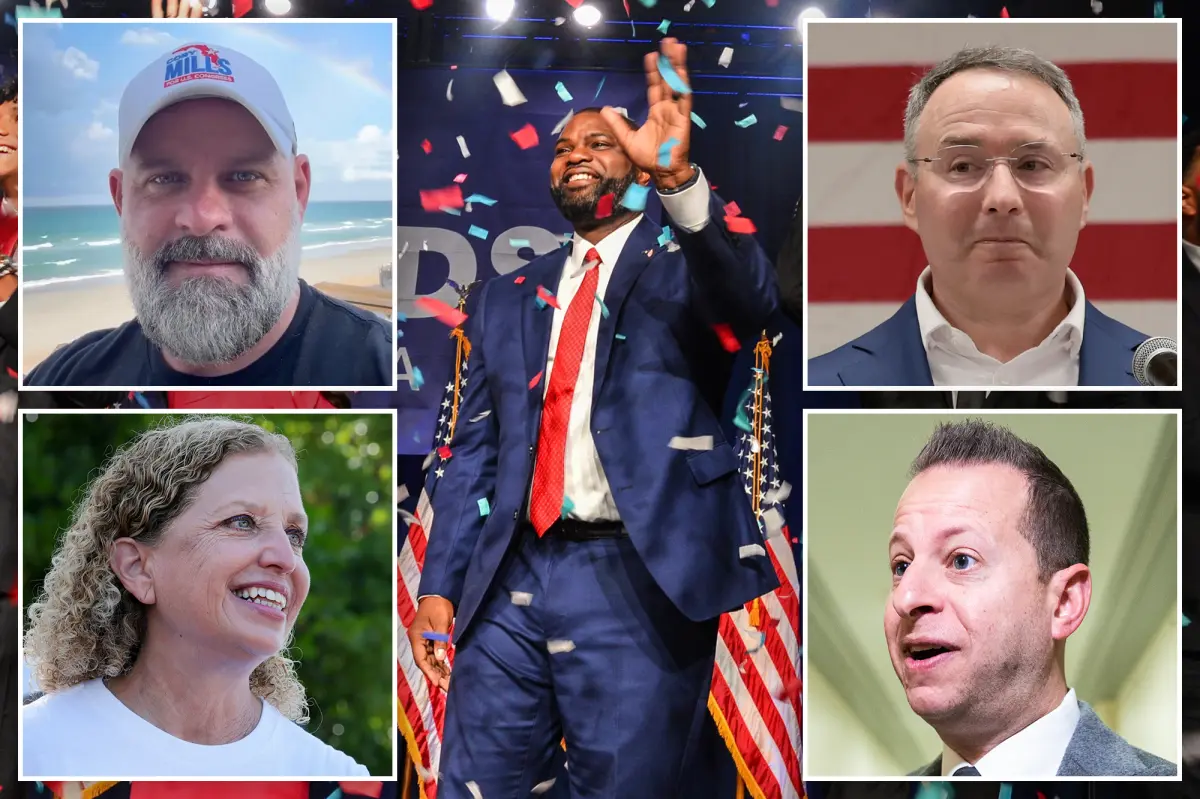
In the brutal arena of primary politics, incumbents often find themselves looking over their shoulders, wary of the knife-wielding challengers from the extreme fringes of their own parties. Yet, on this particular Tuesday, three representatives managed to survive the onslaught, proving that sometimes, the establishment can withstand a siege when the opposition is too erratic to land a decisive blow. The first survivor was Democrat Debbie Wasserman Schultz, a name synonymous with Democratic machinery. Facing a crowded field in Florida’s 20th Congressional District, she found herself targeted by progressive activist Elijah Manley, who criticized her for representing a majority-minority district that he felt deserved a more radical voice. But Wasserman Schultz, a former chair of the Democratic National Committee, flexed her political muscle and soundly defeated her four opponents, demonstrating that institutional memory and foundational support still hold power against ideological purity tests. Her victory was a sigh of relief for the mainstream Democratic establishment, which feared a repeat of the “squad” style upsets that have plagued the party in recent years. Meanwhile, another Democrat, Jared Moskowitz, faced a challenge that was arguably more ideological. He squared off against socialist Oliver Larkin, a candidate endorsed by the far-left streamer Hasan Piker and former Representative Jamaal Bowman. In a race that illustrated the widening chasm within the Democratic Party regarding support for Israel and the direction of progressive politics, Moskowitz, backed by the Democratic Congressional Campaign Committee and AIPAC, managed to not only hold his ground but decisively beat back the insurgency. It was a clear sign that while the left wing is loud, it is not always victorious. However, the most bizarre and visceral display of extremism came from the Republican side in Florida’s 6th District, where incumbent Randy Fine faced off against the far-right influencer Dan Bilzerian. Bilzerian’s campaign was less of a political bid and more of a sociopathic meltdown. In one shocking campaign ad, he suggested that Nazi dictator Adolf Hitler needed to be reassessed, and proceeded to unleash a torrent of anti-Semitic slurs against Fine, referring to him as a “fat Jew,” “Shylock,” and a “Satanic whore.” It was a stomach-churning spectacle of hate speech that Republican voters overwhelmingly rejected. Fine triumphed by nearly 40 points, a resounding rebuke not just of Bilzerian, but of the toxic, hateful rhetoric he represented. These three victories served as a reminder that while primaries can be chaotic, voters often retain a baseline of sanity that rejects the most radical elements seeking to hijack the political process.
Paragraph 3: The Price of Hubris—When Alleged Crime Doesn’t Pay
There is a specific, almost poetic justice in watching political figures who have been mired in scandal attempt a comeback, only to have their dreams shattered by the very constituents they once betrayed. Florida’s primary night was a veritable graveyard for these fallen stars, a stark reminder that while time heals all wounds, it does not necessarily erase the memory of corruption. The most significant casualty was incumbent Representative Cory Mills, a Republican who was under active investigation by the House Ethics Committee for a litany of disturbing allegations. Mills, who had cruised into office with the backing of Donald Trump, seemed to believe that his proximity to power would shield him from accountability. He was sorely mistaken. He faced Ryan Elijah, a former Orlando TV news reporter who ran a grassroots campaign focusing on integrity and transparency. Despite Trump’s endorsement, the voters in the 7th District decided that the stench of ethics violations was too potent to ignore. Mills’ defeat marked him as the tenth incumbent in the House to lose a primary this cycle, a staggering statistic that underscores the volatile mood of the electorate. His loss was a testament to the power of local journalism and the voters’ intolerance for alleged misconduct, proving that even the strongest political shields can be pierced by the sword of truth. But Mills wasn’t the only one to suffer. Former Representative Sheila Cherfilus-McCormick, who had resigned from Congress after being indicted by federal authorities for allegedly stealing millions in COVID-19 relief funds, made a desperate bid to reclaim her seat in the 20th District. Her audacity was met with swift punishment; she finished a distant fourth, a humiliating end to a political career that had collapsed under the weight of legal scrutiny. The voters simply refused to welcome back someone who had allegedly preyed on the public trust during a national crisis. And then there was the curious case of Chris Collins, the former New York Congressman who had pleaded guilty to insider trading and lying to the FBI back in 2019. Now residing in Florida, Collins decided to run for the seat being vacated by Donalds in the 19th District. It was a long-shot from the start, but his showing was pathetic. He mustered only about seven percent support, easily losing to local broadcasting magnate Jim Schwartzel. The message from the electorate was brutally clear: the past matters. You cannot simply relocate to a new state and expect to wash away a felony conviction. These three defeats sent a powerful message that in the current political climate, ethical standards are no longer optional.
Paragraph 4: The Resistance Loses Its Icon—and the DSA Celebrates
If the night belonged to the establishment in the down-ballot races, it belonged to the far-left in one of the most shocking upsets of the evening. The special Democratic Senate primary delivered a seismic shockwave that rattled the foundations of the anti-Trump resistance. Retired Army Lieutenant Colonel Alexander Vindman, who became a household name during Donald Trump’s first impeachment trial, was widely expected to secure the nomination. Vindman, a decorated war veteran, had positioned himself as the ultimate patriot, the man who risked his career to testify against a president he believed was breaking the law. He entered the race with a glare in his eye and a narrative of heroism that seemed unassailable. However, Florida Democrats, or rather the specific voters who turned out for the primary, had other ideas. They delivered a stunning defeat to Vindman at the hands of Angie Nixon, a state lawmaker and member of the Democratic Socialists of America. Nixon’s victory was not just a loss for Vindman; it was a searing indictment of the so-called “Resistance” movement, which has often been criticized for being elitist, out of touch, and obsessed with cable news appearances rather than grassroots economic issues. Nixon ran on a platform of unapologetic progressive populism, tapping into a vein of anger that the educated elite often miss. The irony was thick enough to cut with a knife. The man who embodied the frantic, anti-Trump activism of 2019 and 2020 was dispatched by a socialist who represented the exact type of radical that Trump loves to vilify. Donald Trump, ever the provocateur, was gleeful in his response, posting on Truth Social that “SleazeBag Vindman” had lost to a “Radical Left Lunatic,” adding a mocking “How cool is that???” The defeat showed that the Democratic primary electorate in Florida is not the same as the coastal suburbs of New York or California. They are a diverse, often working-class demographic that responds to economic anxiety more than impeachment dramas. Nixon will now face incumbent Senator Ashley Moody in November in a race that is assuredly a long-shot for the left, but on this night, the left celebrated a symbolic victory that proved their electoral muscle is still capable of surprising the world. It was a moment where the ghosts of the Trump era collided with the new socialist wave, and the old hero was left in the dust.
Paragraph 5: The Redistricting Chessboard—Republicans Ready to Strike
While the candidates were fighting for their political lives on the surface, an even more insidious battle was being waged on the map itself. Mid-decade redistricting, a controversial and often nefarious political tool, has given Republicans a distinct advantage in Florida, and this primary night showcased exactly who they plan to send into battle this November. In four Democratic-held congressional districts that have been redrawn to favor the GOP, the Republican primary winners emerged, ready to attempt a takeover of the House of Representatives. In the 14th District, former State Rep. Mike Beltran won the GOP nod and will now face the long-serving Democrat Kathy Castor. Castor, a progressive stalwart, is facing a tough fight in a district that has been jerrymandered to dilute the Democratic vote in the Tampa Bay area. Similarly, in the 9th District, the race was too close to call, with Dan Green holding a razor-thin lead over Ben Butler. The winner will have the unenviable task of taking on Darren Soto, another Democratic incumbent, but with the new boundaries, Soto’s path to reelection just became significantly more treacherous. Further south, in the 22nd District, businessman Casey Askar emerged from the GOP field and will face Democrat Pia Dandiya. But perhaps the most intense general election matchup will be in the 25th District, where former Boca Raton Mayor Scott Singer won the primary and will face Jared Moskowitz. Moskowitz, having just survived his socialist challenger, now has to immediately pivot to a general election fight in a district that was explicitly redrawn to be more Republican-friendly. This is the strategic genius of the GOP’s redistricting effort. They are not just trying to win open seats; they are trying to flip seats that have been Democratic strongholds for years. The candidates they selected are not the fringe radicals we saw in other races; they are polished, establishment figures like business executives and former mayors, designed to appeal to the suburban swing voters who will decide these contests. The primary results in these four districts serve as a stark warning to the national Democratic Party. While they were busy fighting internal battles over socialism and endorsements, the Republican Party was quietly methodically stacking the deck. November in Florida is shaping up to be a brutal environment for Democrats, and the GOP has now finalized its team of gladiators ready to storm the gates.
Paragraph 6: A Historic Governor’s Race—and a Legacy in the Making
As the dust settled on the chaotic primary night, all eyes turned to the final showdown for the Florida governorship, a race that promises to be one of the most consequential and historic in the state’s modern history. Byron Donalds, flush with victory and the momentum of a dominant performance, now faces former Representative David Jolly, who won the Democratic nod. On paper, this appears to be a mismatch. Florida has not elected a Democratic governor since Lawton Chiles in 1994, and the state has drifted increasingly rightward over the past two decades. Buddy MacKay, the last Democrat to hold the office, was essentially an accidental governor who served for less than a month after Chiles died in office back in January 1999. The demographics and the political winds are overwhelmingly in Donalds’ favor, but the true weight of this race lies not in partisan mathematics, but in the breaking of a formidable barrier. If Donalds wins in November, he will not just become the 45th governor of Florida; he will become the first Black governor in the history of the state. This is a monumental milestone that transcends party lines, placing Donalds in the rare position of being a conservative pioneer. He represents a Florida that has changed dramatically since the 1990s, a Florida where a Black Republican can not only compete but be the overwhelming favorite. Donalds’ journey from a struggling youth in Brooklyn to the cusp of the Governor’s Mansion is an American story in the truest sense, one that he leveraged heavily on the campaign trail. His victory speech on Tuesday was not just a celebration of winning a primary; it was a framing of the future, a promise to continue the legacy of Ron DeSantis but with his own unique style and grit. Jolly, meanwhile, faces an uphill battle that seems almost insurmountable. He enters the race as a moderate in a party that has swung hard to the left, and he is running in a state that has become the epicenter of conservative populism. The primary night revealed a Florida that is alive, unpredictable, and fiercely partisan. From the toppling of anti-Trump icons to the survival of embattled incumbents, and from the rejection of extremist vitriol to the strategic placement of new challengers, the political landscape has been irrevocably altered. In just a few short months, the voters will return to the polls, not to decide who gets the nomination, but to decide whether Byron Donalds will etch his name into the history books, marking a new era in the Sunshine State where the impossible has become entirely possible.