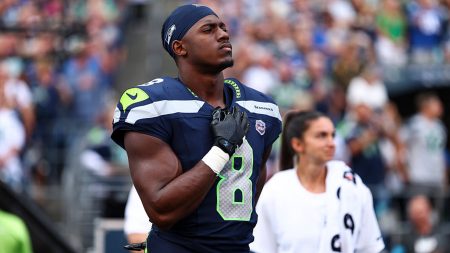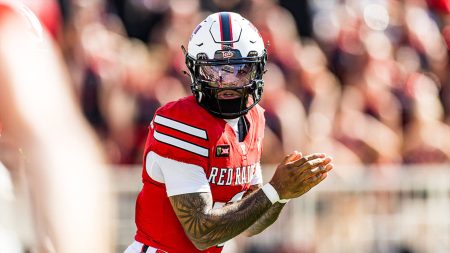


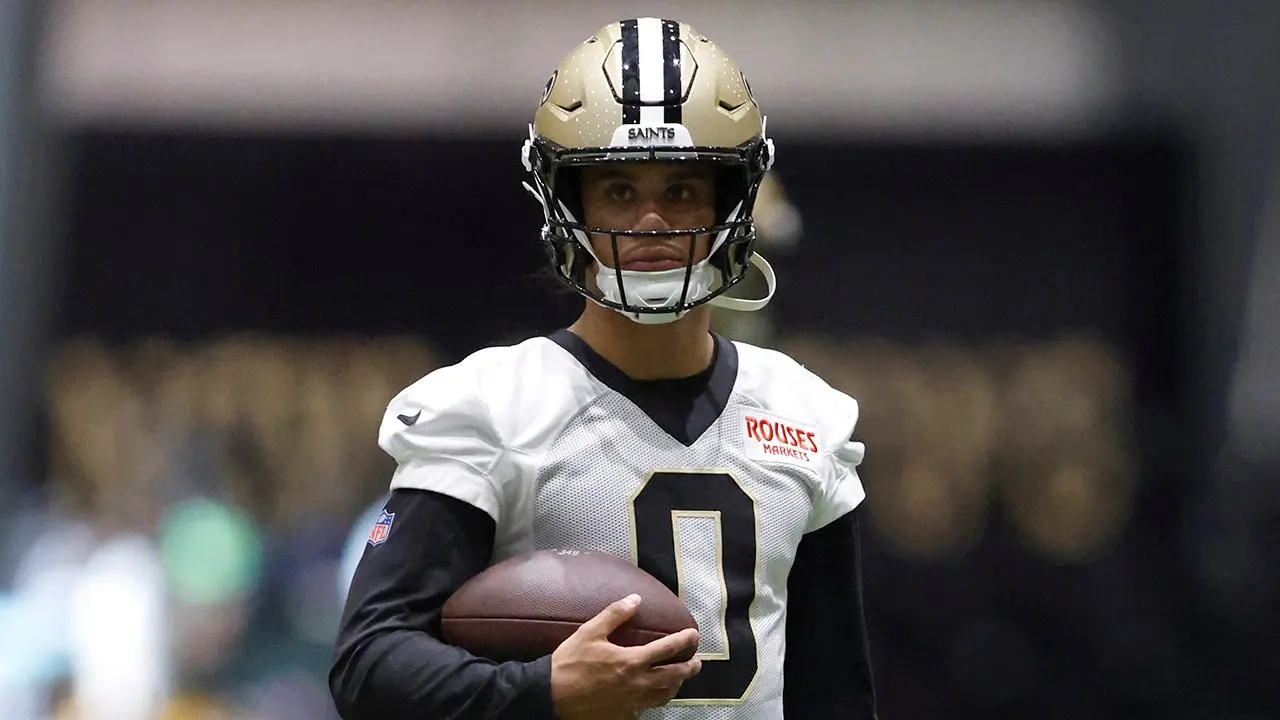
It was supposed to be a beginning, not a setback. Jordyn Tyson had done everything right: he arrived at rookie minicamp eager, soaked up the playbook, built chemistry with quarterbacks, and flashed the kind of explosive speed and precise route-running that convinced the New Orleans Saints to make him the eighth overall pick in the 2026 NFL Draft. He was living the dream, maybe even better than he had imagined. Then, in the span of a single rep during a joint practice with the Jacksonville Jaguars, that dream hit a sudden and painful pause. A foot slipping on the grass, a shove from behind, and a hamstring that grabbed and screamed in protest. The football world now knows the sobering truth: Tyson could miss up to two months, a timeline that would sideline him for at least five regular-season games and push his rookie debut into October. For a 22-year-old who had left Arizona State early to conquer the NFL, to be stopped by something as ordinary and stubborn as a hamstring is almost cruelly ironic. The physical pain is one thing, but the mental weight is another—watching teammates practice while you ride a stationary bike, answering reassuring text messages with “I’m fine” when your heart is heavy. In the NFL, two months can feel like an eternity. The season moves fast, and rookies are supposed to be sprinting, not sitting. Yet sometimes the hardest part of professional football is not the speed of the game; it is the silence of the trainer’s table while the season turns without you. The dreams do not disappear with a pulled muscle. They simply learn how to wait. And for Jordyn Tyson, the waiting has now begun.
According to NFL Network, the injury occurred last Thursday during a joint practice with the Jacksonville Jaguars. It was not a dramatic collision or a twisting fall destined for highlight reels. It was the kind of subtle, almost banal incident that football fans usually shrug off—a wrong step, a slip, a sudden tightness in the back of the leg. But for Tyson, the aftermath has been anything but simple. Reports soon emerged that he had sought multiple opinions on the hamstring, a precaution that is understandable for a player with his draft capital and long-term significance. Yet in the modern sports landscape, every piece of news is magnified, and social media quickly filled with worried fans and frantic speculation. People began to wonder if the Saints were bracing for something worse than a few missed weeks, and the anxiety was not without reason. The franchise had invested the eighth overall pick in Tyson, hoping he would become a centerpiece of the offense for years to come. Now that investment is wrapped in uncertainty, measured in doctor visits and MRIs instead of touchdowns and catches. If the current two-month timeline holds, Tyson would be looking at a return near Week 6, when the Saints travel to MetLife Stadium to face the New York Giants. After that, the team heads to Paris for the NFL’s International Games—a showcase that any rookie would love to be part of, a global stage where memories are made and careers are celebrated. Missing those games is not just a statistical loss. It is a loss of moments, of laughter on the bus, of nervous energy in the tunnel, of the electric feeling of running onto an NFL field with your new brothers for the first time. The season will not stop for Jordyn Tyson, because the league never does. And so he is left to rehabilitate in the shadows while the football world moves on without him.
One person not ready to panic is Kellen Moore, the Saints’ head coach who enters his second season leading the franchise. Moore has been here before, standing in front of microphones and trying to balance honesty with hope. He understands that one bad practice can change a team’s trajectory, but he also understands that panic only makes things worse. In the days after the injury, Moore addressed reporters with a steady voice and a clear message: this was not a recurrence of old problems. Tyson had dealt with hamstring issues during his time at Arizona State, and some people naturally pointed to that history as a red flag. But Moore refuted that speculation with the kind of directness that coaches are known for. “I think my understanding of this one, any player that was put in his situation where your foot slips and you get shoved from behind, this has nothing to do with Jordyn’s history,” he explained, according to ESPN. “Any player in that situation probably has the same diagnosis coming out of this.” It was an important point. Injuries are not always a reflection of a player’s durability or character. Sometimes they are just the random, unlucky consequences of a violent sport. Moore also wanted to make sure everyone knew how well Tyson had been performing before the setback. “He’s played really good football,” Moore said. “Inevitably, this is the unfortunate part of what preseason and training camp football is. We’ve already had a few of these guys, that you just have something that comes up and… we’ll just work through it. He’ll be fine. We’ll get through this, and he’ll be good to go.” Those words matter. In a league often driven by reaction and rumor, the coach’s calm voice can be an anchor for a young player who might feel like everything is falling apart. Moore has been where Tyson is now, in some form, and his faith is more than just coach-speak. It is a reminder that careers are defined by how athletes respond to adversity, not by how they avoid it.
There is a reason the Saints believed in Jordyn Tyson long before that unfortunate practice in Jacksonville. His journey to the NFL was not a straight line. He arrived at Arizona State with promise, but it was not until the 2024 season that he truly exploded onto the national scene. That year, he posted a breakout 1,101-yard season, with dazzling catches, after-the-catch acceleration, and a knack for making the spectacular look routine. Scouts began to take notice, and he became one of the most intriguing receiver prospects in the country. But then came the 2025 season, and with it, another reminder of how fragile an athletic career can be. Hamstring problems limited him to just nine games, and for a moment, the narrative around him shifted. Could he stay on the field? Was he too much of a risk for a top-ten pick? The criticism was not loud, but it was persistent. Yet even as the injuries followed him, the talent did not. In those nine games, Tyson still managed to haul in 61 catches for 711 yards and eight touchdowns, proving that even at less than 100 percent, he was capable of changing a game. The Saints saw that. They saw a young man who played through pain, who produced through uncertainty, and who never let the doubters define him. That resilience is exactly what he will need now. He has been through this specific battle before, and although that does not make the current moment easier, it does give him a blueprint. He knows how to climb back. He knows the grind of morning treatments, the monotony of stretching, the frustration of waking up sore and sore again. He also knows that on the other side of the work, there can be a payoff. The NFL is not a league of perfect stories. It is a league of second acts, of comebacks, of players who found a way to write a better ending than the one everyone anticipated. Jordyn Tyson has already proven he is capable of that. Now he has to do it again.
When he does return, he will step into an offense that has been built for success. The Saints ended last season on a promising note, and much of that momentum came from Tyler Shough, the team’s second-round draft choice a year ago, who was named the starting quarterback and now has a full offseason to prepare as the leader of this team. New Orleans did not stop there. They surrounded him with weapons. The organization locked down top receiver Chris Olave on an extension before the start of the season, ensuring that the passing game has a proven anchor on the outside. They added Travis Etienne Jr. on a four-year, $48 million contract, giving the backfield another explosive option. And, of course, Alvin Kamara is still there—an evergreen playmaker who can take over a game from the backfield or the slot. In that kind of environment, Tyson was expected to be the cherry on top, a dynamic rookie who could stretch the field, win contested catches, and give Shough yet another target to trust in critical moments. That role is still waiting for him. The offense will not be complete until he is in the huddle, and the coaching staff knows it. But for now, Tyson must find a way to contribute from the sideline, learning through film, through conversations with Olave, through listening to the cadence and the coverage calls on the headsets. It is not the same as being on the field, but it is still part of becoming a professional. In some ways, the supporting cast around him becomes a support group. Kamara has been around long enough to understand the loneliness of injury. Olave knows what it means to carry expectations. Shough knows how it feels to have doubters watching every throw. The locker room is not going to abandon Tyson. It is going to pull him along, keep him involved, and remind him that he is still a vital piece of the puzzle. The season is long. The NFL is unforgiving. But the door is still open for him to be the player the Saints believed he could be.
So what happens now? Jordyn Tyson gets better. He does the tedious, unglamorous work that no one sees. He strengthens the leg, trusts the process, and refuses to let a bad month define a bright future. The timeline is what it is, and no amount of wishing will make the hamstring heal faster. But the story is not over. The rookie year is not lost. When the Saints face the Giants in Week 6, Tyson should be nearing the finish line of his recovery, and when the team travels to Paris for the International Games, he may be ready to make his mark on the global stage. Whether that happens or not, the human side of this experience is worth remembering. Jordyn Tyson is not just a first-round pick or a football player. He is a 22-year-old with a family, friends, fears, and the same fragile heart that beats in all of us. He has worked his entire life for this opportunity, and he is not about to let it slip away because of one bad break. The NFL is full of players who have faced much worse and come back to do extraordinary things. The league rewards patience, resilience, and belief. It rewards the ones who refuse to stop fighting, even when their bodies tell them to rest. In a world obsessed with instant gratification, there is something beautiful about a young athlete choosing to trust the process. Jordyn Tyson will be back. The question is not if, but when, and when he does return, the wait will make the moment sweeter. The roar of the crowd, the first catch, the first touchdown—all of it will mean more because of the struggle that came before it. That is the beauty of sports, and the beauty of the human spirit. We fall down. We get up. We keep going. And one day, we look back at the setbacks and realize they were not the end of the story. They were just the turning of a page.