


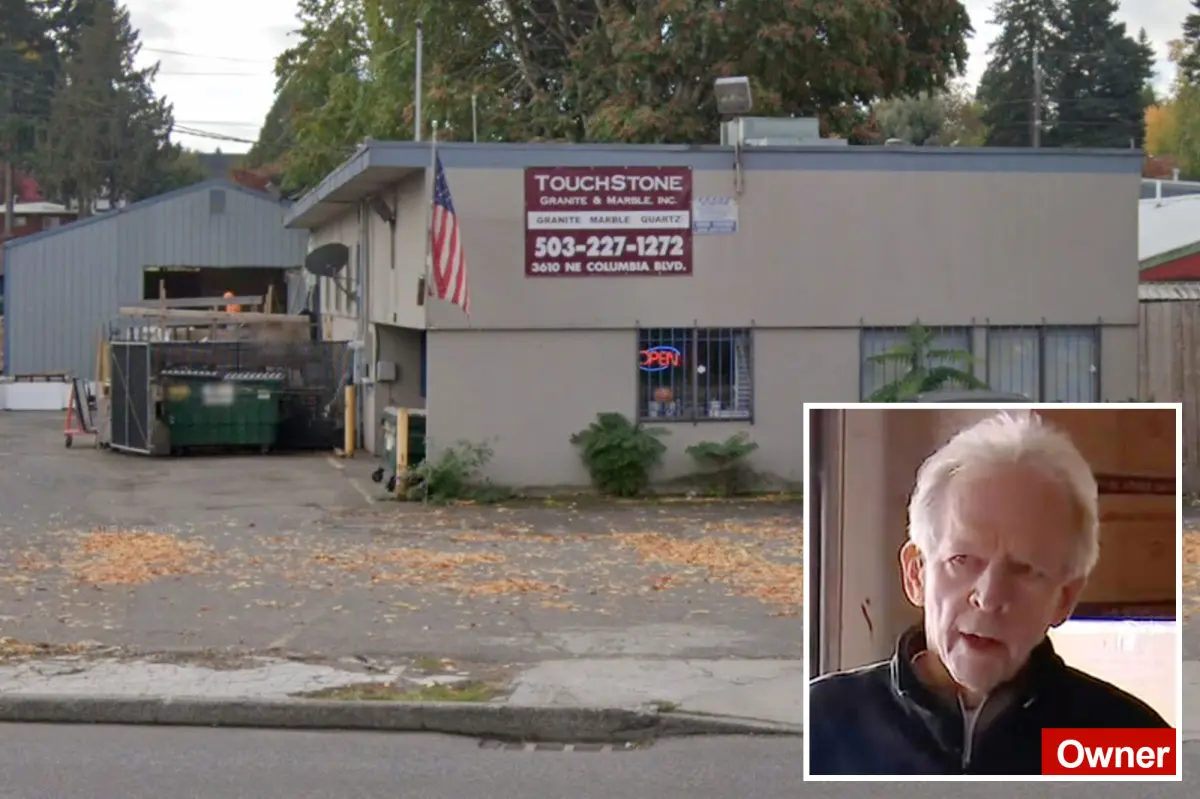
The fog clung to the streets of Portland like a stubborn ghost on the morning of March 6, 2023, a damp chill that seemed to seep into the very bones of the city. In the industrial district, the Touchstone Granite & Marble workshop stood as a monument to hard work—a place where massive slabs of stone, heavy with the weight of the earth, were crafted into countertops destined for kitchens that would host family dinners and quiet morning coffees. It was a fortress of productivity, but on that fateful morning, it became the backdrop for a violent collision between two vastly different human lives. Kenneth Voyles, a man with no address, no stable home, and a life that had clearly spiraled far from any semblance of stability, slipped into that closed business with one clear, desperate intention: to steal a bag of drill tools. He admitted this openly in his court filings, a rare moment of candor that cuts through the usual legal opacity. But what happened next—the eruption of gunfire, the screams, the shattered bones, and the collapse of a lung—would transform a simple act of theft into a deeply tragic, morally murky saga that now finds its resolution in the sterile halls of a courtroom, where Voyles is demanding a staggering $10 million for his “emotional distress.”
The chaos began when James Grant, the business owner and a man who had poured his life’s work into that granite shop, arrived unexpectedly. Voyles, caught in the act, panicked. According to his lawsuit, he apologized on the spot, a pathetic and frantic plea, and made a mad dash for the door, presumably hoping to escape into the anonymity of the morning streets. But Grant, confronted with the violation of his sanctuary, did not simply call the police. The lawsuit alleges that he unleashed a furious assault upon the fleeing man, hurling a coffee mug and heavy, jagged tiles at him—a barrage of projectiles intended, one might presume, to inflict pain or fear. However, Grant tells a starkly different story. He claims that Voyles was not fleeing at all. Instead, the homeless man allegedly snatched a pair of bolt cutters, turned back, and advanced aggressively, his body language screaming with menace, ready to attack. In the adrenaline-fueled haze of that moment, Grant fired his weapon three times. “I only shot him when he was standing looking at me ready to come at me and then I just let him go because I just wanted it to be over,” Grant later told KPTV, his voice heavy with the weariness of a man who had been forced to cross a line he never wanted to approach. It is a classic he-said-she-said, but the stakes are impossibly high: one man is fighting for his life and his future, the other for his freedom and his sanity, and both are trapped in a web of fear, regret, and stubborn survival instincts.
The physical aftermath was catastrophic for Voyles. He didn’t just walk away with a flesh wound; the bullets tore through his body, collapsing a lung, leaving severe, gaping chest wounds, and shattering the bones in his right arm beyond simple repair. The damage required extensive vascular repair and multiple emergency surgeries, a grueling ordeal that would leave him facing months, perhaps years, of painful rehabilitation. He now bears the permanent, scarred map of that single violent moment on his body. It was in this state of profound vulnerability and pain that Voyles, through his legal counsel, filed the lawsuit earlier this year in May. The suit against Touchstone Granite & Marble Inc. and James Grant accuses the owner of battery, assault, negligence, and the intentional infliction of emotional distress. On paper, the legal arguments are as cold as the granite slabs in the shop: Voyles seeks $5 million in compensation for his injuries—the medical bills, the pain, the loss of quality of life—and an additional $5 million in punitive damages, a sum designed to punish Grant for what Voyles alleges was a grossly disproportionate and malicious response to a property crime. The lawsuit even attempts to hold the corporation itself vicariously liable, bizarrely arguing that Touchstone failed to implement proper security protocols or adequately train its crew on how to de-escalate situations with after-hours intruders—a claim that almost borders on the absurd, given the inherent unpredictability of a surprise intrusion.
Yet, as we wade through the legal legalese, we must humanize the two men at the center of this storm. James Grant, the business owner, is not a soulless villain. He is a man who likely built his business from the ground up, who watches every dollar, who worries about payroll and insurance premiums. Waking up to find a stranger in your private workspace, your tools being stolen, triggers a primal, reptilian fear. The police may take twenty minutes to arrive; the intruder is there in thirty seconds. Grant’s choice to fire his weapon was not made in a vacuum of malice but in a split-second crucible of terror. His statement, “I just wanted it to be over,” reveals a man emotionally exhausted, haunted by the moment he pulled a trigger and ended another human being’s physical integrity. He is now facing a lawsuit that could bankrupt his business, all for defending what he owned. On the other side, Kenneth Voyles is not a career criminal mastermind. He is a man who was homeless, likely suffering from mental illness, addiction, or simply the devastating weight of societal failure. The decision to steal a drill bag was a desperate act of survival, born of a society that has largely abandoned its most vulnerable. He is now lying in a hospital bed, physically shattered, and his response is to sue. It’s a tragic cycle—a man so marginalized that he must resort to theft, and then so desperate for recourse that he must weaponize the legal system to get any semblance of justice or security for his ruined body.
The public reaction to this case has been explosive. Online, the sentiment is overwhelmingly one of outrage and disgust, with many labeling the lawsuit as a quintessential example of a “frivolous” claim that “should fall under the theft by deception statute.” One commenter on a Reddit thread, echoing the thoughts of many, pointed out the irony, “Dude literally admits mid complaint he planned to steal a bag of drill tools. He can’t even stop himself from lying in his legal filings.” There is a deep, visceral anger at the perceived inversion of justice: a criminal seeking to profit from his own crime, a home/business owner being punished for defending his property. This anger taps into a broader cultural anxiety about the justice system being a lottery, where the loudest victim complex wins. However, it’s worth pausing to consider the underlying human tragedy that the public so easily dismisses. Voyles is alive, but he is likely permanently disabled. Grant may be legally vindicated, but he will carry the psychological weight of shooting another human being for the rest of his life. The public wants a clear-cut villain, but reality is far messier. Voyles made a terrible choice. Grant made a consequential choice. The $10 million lawsuit is not a sign of greed; it is the scream of a man who has lost everything and has no other way to voice his pain except through a legal claim that feels morally bankrupt but is legally plausible in a system that prioritizes civil damages.
Ultimately, this story transcends the simple binary of victim and perpetrator. It is a bleak mirror held up to our society, reflecting the vast chasm between the haves and the have-nots. Grant had a business, a livelihood, a reason to stand his ground. Voyles had nothing but a bag of stolen tools and a broken body. The $10 million demand is the mathematical expression of that chasm—an attempt to place a dollar value on a life that society has already devalued to the point of invisibility. The lawsuit will likely be dismissed or settled for a fraction of the asking price, but the damage is already done. Two men are now permanently intertwined in a narrative of violence, poverty, and legal warfare. The granite slabs in Touchstone’s showroom remain polished and beautiful, indifferent to the blood that was spilled to protect them. As we read the headlines, we are forced to confront uncomfortable questions: How far would we go to protect our property? How desperate must a man be to risk his life for a drill bag? And in the cold calculus of the courtroom, when one man’s security meets another man’s desperation, is there ever a true winner, or are we all just left with the weight of a single, irreversible trigger pull? The answer lies somewhere in the fog, waiting for a resolution that neither $5 million nor a prison sentence can ever truly provide.