



The Unseen World Beneath the Surface
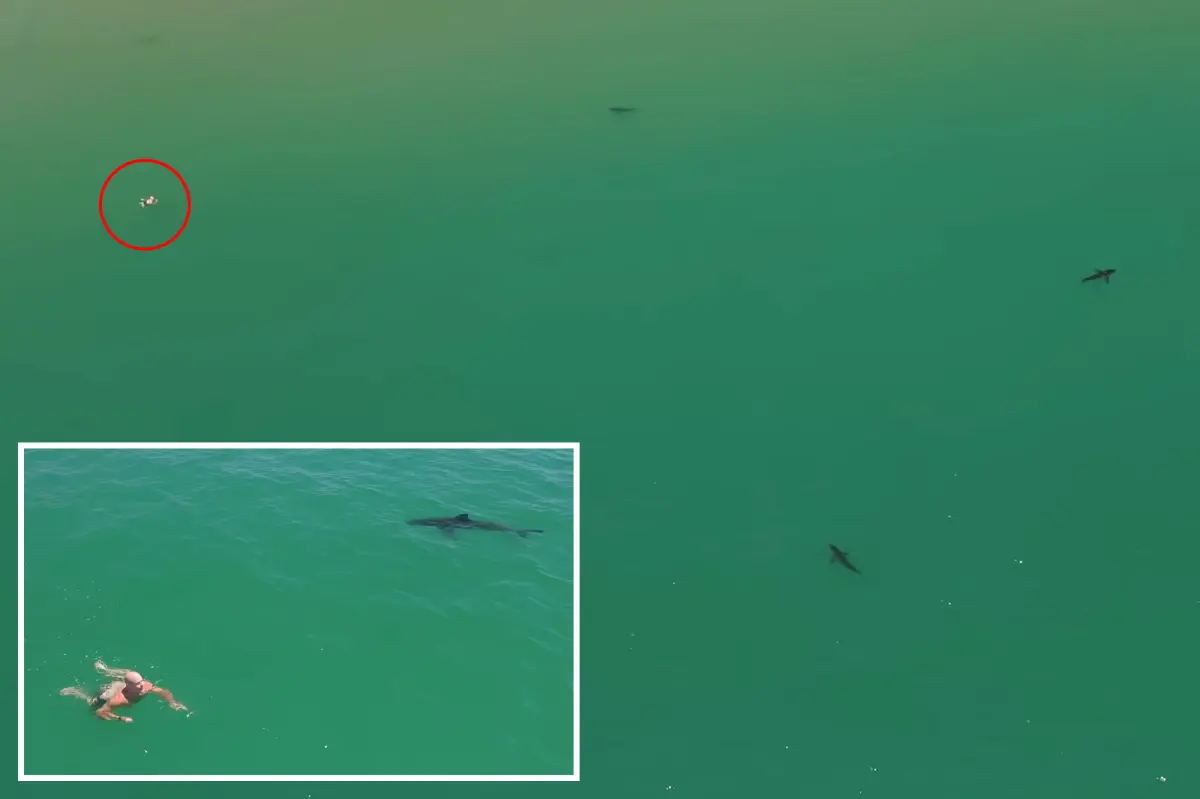
The Pacific Ocean off the Southern California coast often presents a picture of serene tranquility, its surface a shimmering expanse of blue that invites swimmers, surfers, and sunbathers to seek solace and adventure. Yet, beneath this placid facade lies a bustling, dynamic world teeming with life, some of it formidable. On a seemingly ordinary day, a lone swimmer became the focal point of an extraordinary, nerve-wracking spectacle. As he leisurely moved through the shallow, sun-dappled waters between Santa Barbara and Malibu, he was completely unaware that he was not alone. A pod of six juvenile great white sharks, sleek and powerful, was patrolling the same stretch of ocean, their movements a silent, calculated ballet of predatory grace. From above, the scene was one of stark contrast: a single, vulnerable human figure drifting through a gauntlet of nature’s most efficient hunters, a tableau that would soon be captured by a drone and shared with the world.
The swimmer, oblivious to the danger that circled him, continued his course, his strokes rhythmic and unhurried. The sharks, for their part, did not seem to be acting with aggression but rather with a curious, inherent instinct, their movements tracing intricate patterns in the water around the human interloper. It was a precarious coexistence, a moment where the thin line between humanity and the wild was visually and dramatically blurred. The water, which must have felt cool and refreshing to the swimmer, was also the hunting ground for these magnificent, often misunderstood creatures. The scene was a powerful reminder that the ocean is not a human domain, but a shared space, a world where we are, at best, temporary guests. The irony was palpable: the swimmer sought peace and relaxation in a place that was, at that very moment, the stage for a delicate, high-stakes dance of nature.
The Eye in the Sky: A Videographer’s Perspective
Observing this entire scene from a safe distance in the sky was Carlos Gauna, a marine documentarian known to his online followers as The Malibu Artist. From his vantage point, the ocean became a transparent canvas, revealing secrets that were completely hidden from the swimmer below. His drone, a silent sentinel in the sky, captured the unfolding drama with breathtaking clarity. Gauna’s perspective was not one of fear, but of fascination and documentation. He is a regular observer of the Southern California coastline, and his work has consistently revealed the close, often unnoticed proximity between humans and sharks. For him, this was not just a shocking viral moment; it was another piece of evidence in his ongoing study of the region’s marine life. He saw six juvenile great whites, powerful creatures, navigating the same waters that bathers and surfers frequent daily. The footage he captured was raw and compelling, showing the sharks moving with a purpose that was both awe-inspiring and terrifying.
The video shows the swimmer bobbing in the water while the sharks, each several feet in length, glide past him. At one point, the tension escalates as a juvenile shark passes within what appears to be a single body length of the unsuspecting man before executing a sharp turn and making another close pass. It was a heart-stopping moment, a clear reminder of how quickly a peaceful swim could turn into a dangerous encounter. Gauna, from his aerial perch, could see the entire geometry of the situation—the swimmer as the stationary point, and the sharks as the moving, circling force. He knew that the man below was likely unaware of the danger, as the sharks’ presence was invisible from the surface. The footage is a stark illustration of the unseen world that exists just a few feet below the ocean’s surface, a world that humans often share without even knowing it.
The Lifeguard’s Warning and a Swimmer’s Choice
The situation did not go unnoticed by the lifeguards monitoring the beach. They too had seen the sharks, or at least the commotion from the drone, and they acted quickly to ensure the swimmer’s safety. They tried to alert him, calling out from the shore, but their warnings seemed to fall on deaf ears. Determined to prevent a potential tragedy, one lifeguard took a more direct approach, paddling out on a rescue board to physically reach the swimmer and warn him of the imminent danger. The confrontation was a study in human nature: the lifeguard, representing caution and safety, and the swimmer, representing a stubbornness or perhaps a lack of comprehension of the peril he was in. Despite the urgent plea and the clear threat, the swimmer made a conscious choice to remain in the water. He seemed unfazed, perhaps believing that the sharks were not a threat, or perhaps simply unwilling to let fear dictate his actions.
This decision to stay, captured on film, is a compelling and controversial element of the story. It raises questions about risk perception, the human desire for personal freedom, and our relationship with the natural world. Why would someone ignore such a clear warning? Was it a show of bravado, a calculated risk, or a deep-seated trust that the sharks would not attack? The swimmer’s choice highlights a common, perhaps naive, belief that we are safe in the ocean, a belief that is challenged by the very presence of these apex predators. For the lifeguards, it was a frustrating and tense moment, as they could only do so much to protect someone who was unwilling to protect themselves. The incident underscores the complex responsibilities of those who watch over our beaches, and the unpredictable nature of the public they serve. The swimmer’s calmness in the face of such a threat is either incredibly brave or profoundly reckless, and it’s this ambiguity that makes the story so captivating.
Shared Waters: A Reality of the Southern California Coast
Gauna’s footage is not just a viral video; it’s a powerful piece of ecological evidence. He points out that the shallow coastline of Southern California is a critical habitat for juvenile great white sharks. These young sharks, often between five and seven feet long, use the warm, nutrient-rich waters near the shore as a nursery, a safe haven where they can grow and develop before venturing into the open ocean. This means that encounters between sharks and people are likely far more frequent than the public realizes. The beachgoers, swimmers, and surfers who flock to these waters are, in fact, sharing them with these juvenile predators on a regular basis. The footage serves as a stark reminder that the ocean is not a human-only playground, but a shared ecosystem where different species must coexist. The fact that these encounters almost always occur without incident is a testament to the fact that sharks do not inherently view humans as prey.
This understanding is crucial for shifting the public perception of sharks from mindless man-eaters to complex, vital components of the marine ecosystem. Gauna’s long-term observation has shown that these juvenile sharks are becoming increasingly accustomed to the presence of humans, displaying a remarkable level of tolerance. He even identified one of the sharks in the video as an individual he had previously named “Tina,” a shark he has watched grow and adapt to the crowded coastal waters. He noted that her comfort around people was visible, a concerning yet fascinating development. While this acclimation might sound alarming, it also suggests that sharks are capable of learning that humans are not a food source. The real danger, as Gauna and other experts point out, lies not in the sharks’ behavior, but in the potential for a surprise encounter that could startle both parties, leading to a defensive bite.
The Apex Predators and the Rarity of Bites
While the presence of juvenile sharks is a common, if often unseen, part of the coastal environment, Gauna is also quick to warn that larger, more formidable predators are also regular visitors to these shores. He mentions that he sees adult great white sharks, ranging from 13 to 15 feet in length, on a weekly basis. These are not just juvenile transients; they are massive, powerful apex predators that command respect. The implication is clear: don’t get too comfortable. The Southern California coast is a wild place, and the ocean is their domain. Yet, even with this constant presence of large sharks, actual bites remain remarkably rare. This statistic is a powerful counter-narrative to the sensationalized portrayals of sharks in popular media. The reality is that the risk of being bitten by a shark is incredibly low, far lower than many other everyday risks we take without a second thought.
This rarity is a testament to the fact that sharks, despite their fearsome reputation, do not actively seek out humans as prey. Our movements and silhouettes are not those of their natural food sources like seals or sea lions. Most shark bites are believed to be cases of mistaken identity or exploratory, investigative bites, where a shark is trying to figure out what an unfamiliar object is. In the vast majority of cases, these encounters end with the shark moving on and the human escaping, often with only a scare or, in rarer cases, a serious but non-fatal injury. Gauna’s message is a call for understanding and coexistence. He wants the public to be aware of the world beneath the waves, to respect it, and to understand that the ocean is a shared space. The fear of sharks is deeply ingrained in our culture, but the data and the reality of the situation tell a very different story—one of a complex, intelligent creature that is far more interested in its own survival than in hunting us.
A Call for Respect and Coexistence
The story of the swimmer and the six sharks is a powerful metaphor for the human relationship with the natural world. It is a reminder that we are not separate from nature, but a part of it, and that we must learn to share this planet with its other inhabitants. The swimmer’s decision to remain in the water, while risky, also speaks to a certain human tenacity and a desire to experience the world on our own terms. However, it also highlights a dangerous level of complacency. The ocean is a wild, unpredictable environment, and we must enter it with a sense of humility and respect. Gauna’s work provides an invaluable service by bringing this hidden world to light, allowing us to see what is often just out of sight. The footage is not meant to induce panic, but to foster a deeper understanding and appreciation for the marine environment and the creatures that call it home.
Ultimately, the goal is not to clear the ocean of sharks, but to coexist with them safely. This requires education, awareness, and a fundamental shift in how we view these magnificent animals. They are not monsters; they are essential to the health of our oceans, acting as top predators that keep the entire ecosystem in balance. The encounter off the Southern California coast is a perfectly ordinary event, happening more often than we know, and it almost always ends without incident. It is a testament to the fact that humans and sharks can share the same waters, as long as we understand the risks and act with caution and respect. The video serves as a silent, powerful lesson: look beneath the surface, appreciate the world you cannot see, and remember that in the ocean, you are never truly alone. The shark’s world is one of grace, power, and survival, and we are merely visitors in it.