


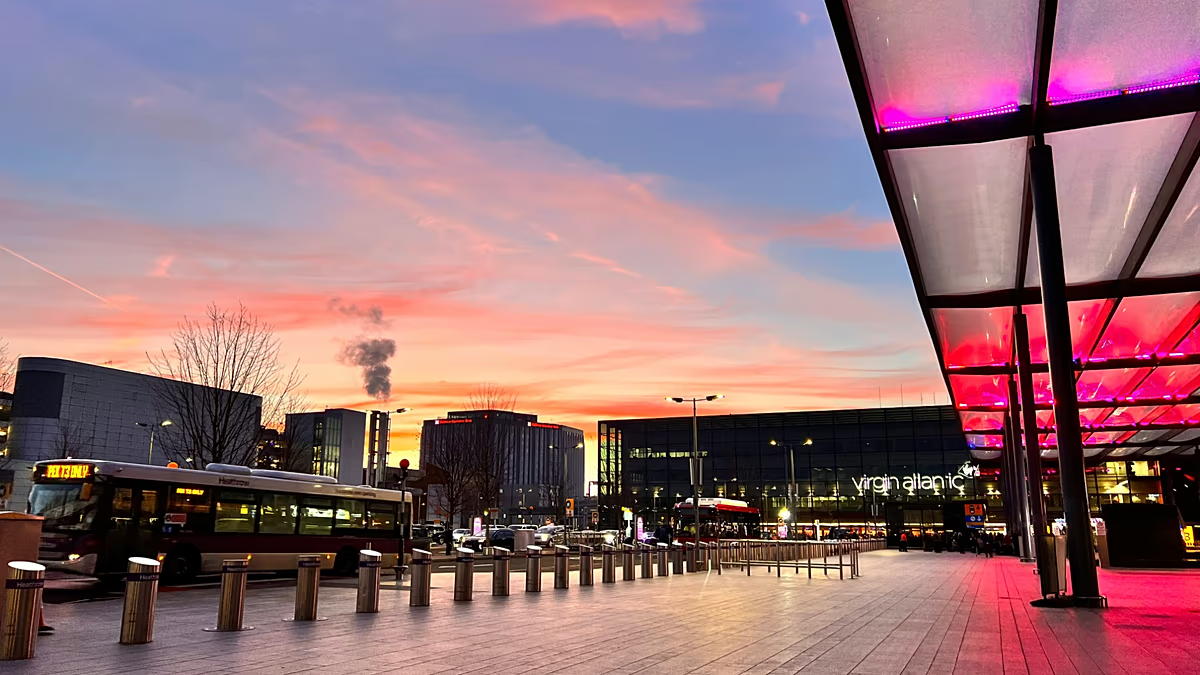
For decades, London Heathrow Airport stood as the undisputed titan of European aviation, a bustling gateway where countless human stories intersected daily. It was the place where families tearfully reunited at arrivals, business deals were forged over rushed coffees, and wide-eyed travelers embarked on life-changing adventures. However, the global travel landscape is undergoing a profound transformation, and Heathrow has once again surrendered its coveted crown as Europe’s busiest aviation hub. This summer, Istanbul Airport stepped boldly into the spotlight, welcoming nearly 300,000 more passengers than its London rival during the peak travel month of July. For Heathrow, this shift is far more than a minor statistical deviation on a spreadsheet; it represents a moment of deep reflection for an institution that has long symbolized the United Kingdom’s connection to the rest of the world, highlighting a broader story of shifting global power dynamics and changing travel preferences.
To fully understand the gravity of this transition, one must look back at Heathrow’s long-standing reign over the skies of Europe. According to data compiled by the Airports Council International, the London hub held the title of Europe’s busiest airport uninterrupted from 1996 until the world ground to a sudden halt in 2020. The arrival of the COVID-19 pandemic shattered global travel patterns, silencing terminal corridors and stripping Heathrow of its top spot as strict border controls took hold. While the airport staged a triumphant comeback to reclaim its crown in 2023, the victory proved short-lived. The rapid rise of Istanbul—a modern, sprawling mega-hub designed specifically to act as a physical and cultural bridge between East and West—presents a formidable challenge that Heathrow, constrained by its historic footprint and intense local opposition to growth, is finding increasingly difficult to match.
The hard numbers from July tell a compelling story of contrasting trajectories for these two aviation giants. Heathrow welcomed 7.86 million passengers through its four active terminals, representing a modest but telling 1.5% decline compared to the same period last year. Meanwhile, Istanbul experienced a vibrant summer boom, processing 8.15 million travelers, which marked a 2.3% increase over the previous year. This divergence is not merely a matter of airline scheduling, but a direct reflection of how geopolitical instability shapes the journeys of ordinary people. Heathrow’s passenger numbers were heavily impacted by the ongoing conflict between Iran and the United States, which caused passenger volume on Middle Eastern routes to plummet by a staggering 20.2% year-on-year. When skies become politically turbulent, the human desire for safe, predictable journeys naturally redirects the flow of global travel away from traditional hubs toward more flexible transit points.
This dip in passenger numbers has injected fresh urgency into Heathrow’s long-running and emotionally charged campaign for a third runway. For years, the airport has operated its two existing runways at virtually maximum capacity, leaving almost no room for delay recovery, scheduling flexibility, or meaningful growth. Airport representatives have used the latest passenger data to argue that the case for expansion has never been clearer if the UK wishes to remain a dominant player in global commerce. The proposed third runway is an ambitious vision of the future, aiming to scale Heathrow’s capacity to a staggering 150 million passengers annually, a massive leap from its current limit of just under 85 million. Proponents argue that without this physical expansion, the UK will continue to lose ground to international rivals who are not bound by the same spatial constraints.
However, the path to building this runway is blocked by a complex web of political drama and deep regional divides within British society. The debate over Heathrow’s expansion has become a lightning rod for questions about where wealth and infrastructure investment should be concentrated in the UK. Sacked Chancellor of the Exchequer Rachel Reeves had previously championed the project, expressing hope that a third runway could become a reality by 2035 to boost the national economy. In contrast, the newly appointed Prime Minister, Andy Burnham, has taken a much cooler stance on the expansion, reflecting a growing sentiment that London already receives a disproportionate share of national resources. Burnham has previously argued that pouring billions of pounds into Heathrow simply diverts vital investment away from the North of England, trapping wealth in the capital while leaving regional transport systems to struggle.
Despite these political battles and the loss of its top-ranking crown, Heathrow remains an incredibly vital, energetic, and resilient human space. On July 19th, the airport recorded its busiest day of the year so far, seamlessly managing the arrivals and departures of 267,000 passengers in a single 24-hour window—a testament to the dedication of the thousands of staff working behind the scenes. Furthermore, the airport’s global appeal continues to attract prestigious new partners, with Italy’s ITA Airways, Alaska Airlines, and the newly launched Riyadh Air all establishing new services from the hub this summer. While the title of Europe’s busiest airport may currently reside in Istanbul, Heathrow’s enduring legacy is not defined solely by numbers, but by its continued ability to bring diverse cultures together, proving that the true heart of aviation lies in the connections it fosters between people.