



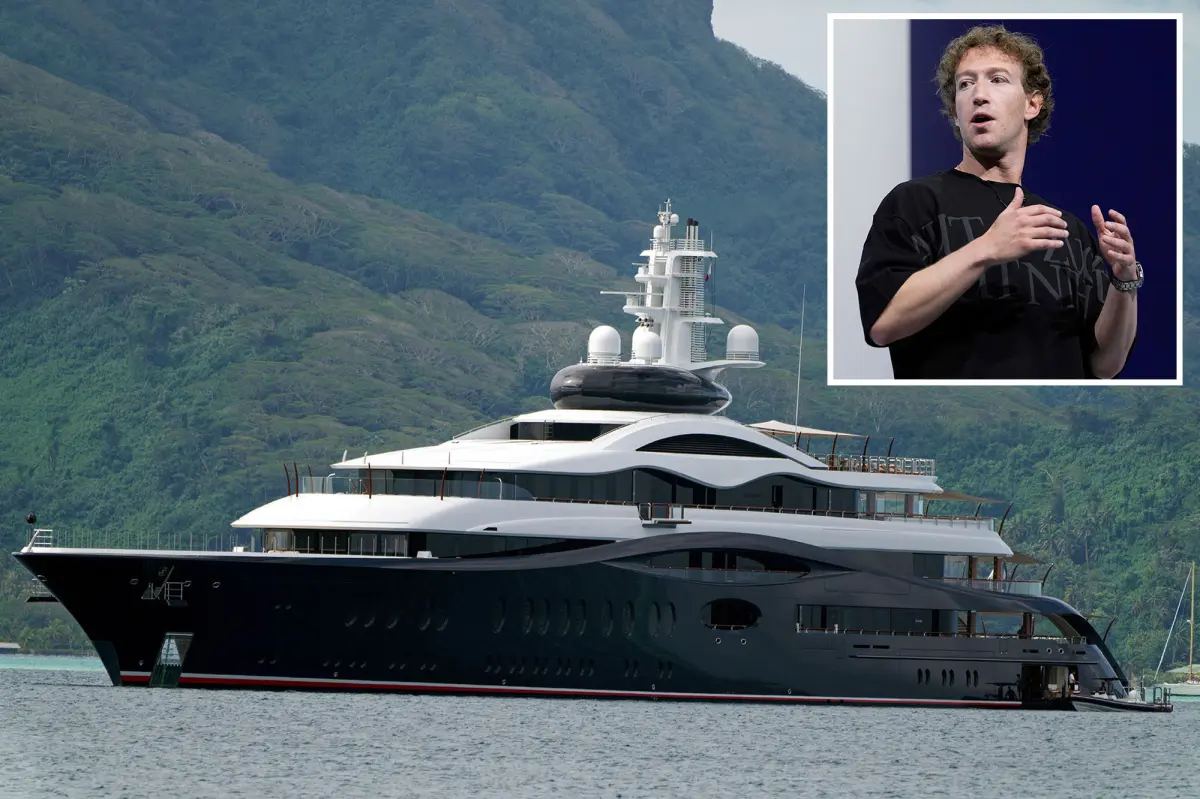
The vast, icy waters of the Alaskan coastline are renowned worldwide for their breathtaking, untouched beauty, but they also serve as a stark, daily reminder of nature’s indifferent power and the absolute necessity of human solidarity. It was against this majestic yet unforgiving backdrop on a chilly August afternoon that a troubling maritime drama unfolded, highlighting the growing chasm between ultra-wealthy isolationism and the historic, unwritten camaraderie of seafaring communities. The centerpiece of this escalating controversy was Launchpad, a breathtakingly massive 387-foot superyacht valued at a staggering $300 million, owned by the billionaire co-founder and chief executive officer of Meta, Mark Zuckerberg. Floating like a silent steel island of unprecedented luxury, the leviathan vessel found itself positioned as the closest ship to a vulnerable, 21-foot skiff that had suddenly run out of fuel and was drifting helplessly in the cold, treacherous Alaskan currents. Rather than the grand yacht springing into action to assist the stranded boaters, it remained eerily silent and stationary, seemingly oblivious to the plight of the smaller boat bobbing in its shadow. Instead, it was left to a much older, smaller, and humbler vintage tour steamboat named the Wilderness Legacy to alter its course, navigate toward the stranded mariners, and offer aid. The stark physical contrast between the colossal, inactive superyacht and the active, community-minded tour boat did not go unnoticed by those on the water. Michael Love, a New York tourist aboard the Wilderness Legacy, captured the collective frustration of the passengers in a social media post on the platform Bluesky, describing how their captain announced to the entire vessel that the Coast Guard had repeatedly radioed Zuckerberg’s state-of-the-art yacht for assistance because of its close proximity, only to receive absolute silence in return. This announcement was met with a spontaneous, near-unanimous chorus of booing from the tour boat’s passengers, who were shocked that a vessel with every modern resource at its disposal would turn a blind eye to fellow mariners in need.
In the wake of mounting public outrage and widespread criticism, representatives for the tech billionaire quickly scrambled to manage the fallout and defend the actions of the superyacht’s crew, arguing that the entire incident was the result of an unfortunate technological oversight rather than a deliberate refusal to render aid. Brian Baker, a spokesperson for Mark Zuckerberg, issued a public statement clarifying that the Meta CEO and his wife, Priscilla Chan, were not actually on board the vessel at the time of the incident, distancing them from the crew’s immediate decisions during the event. According to Baker, the crew on board the Launchpad did not intentionally ignore the emergency broadcast; rather, they simply did not hear it because they were operating on and monitoring a different radio frequency than the standard channel being utilized by the Coast Guard and the stranded skiff. The spokesperson emphasized that by the time the yacht’s crew eventually realized there was an active Coast Guard transmission and reviewed the communications on the alternative channel, the rescue operation was already well underway by the crew of the Wilderness Legacy. While Baker expressed sincere gratitude that all parties involved were ultimately safe, his explanation did little to satisfy seasoned maritime professionals, locals, and online critics alike. To many observers, the defense raised more troubling questions than it answered, particularly regarding how a highly trained, professional crew operating one of the most technologically advanced and expensive private vessels in the world could fail to monitor the default emergency radio frequency, Channel 16, which is universally recognized as mandatory listening for any ship navigating open and unpredictable waters. This communication breakdown served as a glaring, humanizing reminder that even the most sophisticated, multi-million-dollar technology is only as effective as the human attention and care dedicated to managing it, especially when life, safety, and basic decency are on the line.
To understand the legal and ethical nuances of this high-seas encounter, it is necessary to examine the strict international codes that govern marine travel, which draw a sharp line between a legal mandate and a moral obligation. Maritime law expert Ian Ralby, president of Auxilium Worldwide, provided crucial context to the public by comparing the situation to everyday roadside emergencies. Ralby explained that the legal obligation to respond to a call for help is directly tied to the severity of the situation, utilizing a brilliant and highly relatable analogy: it is the fundamental difference between calling a towing service like AAA and dialing 911 for an emergency ambulance. Under international maritime law, if a vessel issues a formal distress signal indicating that human lives are in immediate, catastrophic danger, all nearby ships are legally compelled to intervene, provided doing so does not jeopardize their own safety or the safety of their passengers. However, because the 21-foot skiff had merely run out of fuel and was not taking on water, the situation was classified as a request for assistance rather than an active, life-threatening emergency, meaning the crew of Launchpad broke no formal laws by failing to respond to the transmission. This legal distinction, while perfectly clear on paper, often runs contrary to the unwritten, deeply ingrained cultural codes of the sea, where mutual aid is considered a fundamental, non-negotiable responsibility of all mariners regardless of legal technicalities. By prioritizing legal boundaries and technicalities over the traditional spirit of maritime cooperation, the incident highlighted a frustrating, highly modernized disconnect between what is strictly required by the letter of maritime law and what is universally expected under the broader, older umbrella of basic human empathy and community-oriented maritime courtesy.
The harsh environment of the Alaskan wilderness further complicates this debate, as the region’s coastal waters are notoriously unpredictable, freezing, and unforgiving to those who find themselves unprepared or stranded. Retired Coast Guard Captain Aaron C. Davenport, a veteran with three decades of military service, noted that while running out of fuel is not technically classified as an immediate, dire emergency, the margin for error in Alaskan waters is incredibly thin. In these remote northern regions, a seemingly minor non-emergency can escalate into a life-and-death situation with terrifying speed due to extreme cold, strong tidal currents, sudden ocean storms, and the vast geographic distances between active rescue resources. Davenport pointed out that while the crew of the Launchpad was under no legal obligation whatsoever to assist the stranded skiff, common courtesy and mutual reliance are the very lifelines that keep mariners alive in these isolated areas of the globe. He emphasized that experienced sailors help one another not out of fear of legal prosecution, but because of a shared, deeply human understanding that anyone, no matter how wealthy, powerful, or well-equipped, can eventually find themselves in a vulnerable position where they must rely on the kindness of passing strangers. By failing to maintain a proper watch on the universal emergency channel and failing to respond to a nearby vessel in need, the crew of the superyacht exhibited a level of operational detachment that felt incredibly jarring to local Alaskans and experienced sailors who understand that out on the open ocean, human cooperation is the ultimate survival tool. In a place where help can be hours or even days away, ignoring a call for assistance is seen as a betrayal of the seafaring community, reminding us that nature does not respect bank accounts, and survival often hinges entirely on the active, empathetic eyes of those who happen to be nearby.
Beyond the legal definitions and technical explanations of radio frequencies, this incident serves as a powerful and visible metaphor for the widening socioeconomic divide that defines modern global society. On one hand, we have the Launchpad, a fortress designed to insulate its wealthy owners and guests from the harsh realities of the external world, complete with its own helicopter pad, swimming pool, and an array of high-tech amenities. On the other hand, we have a small, working-class skiff and an aging, wooden tour boat filled with ordinary, everyday citizens who, despite their modest resources, did not hesitate to pause their journey, consume their own fuel, and expend their own time to help a stranger in distress. The spontaneous booing from the tourists on the Wilderness Legacy was not just a reaction to a missed radio call; it was a visceral, emotional rejection of the perceived arrogance, indifference, and isolationism that so often accompanies extreme wealth. It highlighted a growing, systemic societal exhaustion with an elite billionaire class that seems increasingly disconnected from the communities they move through, traveling in bubbles of privilege that shield them from the shared responsibilities of everyday life. This event humanizes the struggle of ordinary people who still believe in the power of community, reminding us that true wealth is not measured by the sheer length of a yacht, the size of a corporate portfolio, or the sophistication of its closed communication systems, but rather by our willingness to listen to the voices of those around us and offer a helping hand when they call out into the void. When those in possession of massive fortunes choose to sail through our shared spaces while remaining tone-deaf to our struggles, it damages the social contract that binds us all together, reinforcing the desperate need for a return to mutual aid and neighborly care.
Ultimately, the story of the Launchpad and the stranded Alaskan skiff stands as a poignant, cautionary tale about the stark limits of technology and the irreplaceable, eternal value of genuine human connection. No matter how many millions of dollars are poured into constructing a state-of-the-art superyacht, and no matter how advanced its internal navigation and satellite communication systems may be, they are entirely useless if they serve to isolate us from the very people we share the physical world with. The ocean has always been the ultimate equalizer, a vast and indifferent expanse that cares nothing for social status, bank accounts, or corporate titles, demanding absolute respect from all who dare to traverse its depths. As we navigate an increasingly digitized, automated, and divided world where it is easy to become lost in our own private sanctuaries, we must strive to keep our own metaphorical radios tuned to the frequencies of those around us, ensuring that we do not allow our private comforts to deafen us to the very real needs of our neighbors. The lessons of this Alaskan encounter remind us that the ancient, unwritten laws of human empathy, mutual support, and seafaring brotherhood must always take precedence over cold technical excuses, corporate public relations statements, and legal loopholes. In the end, true security and fulfillment do not come from isolating ourselves within the walls of a $300 million fortress, but from actively listening to the distress frequencies of our shared human experience and extending a compassionate hand to those drifting in the cold. By reaffirming these values, we keep the spirit of community alive, ensuring that no one is left to face the storms of life alone while others watch in silent, comfortable indifference.