


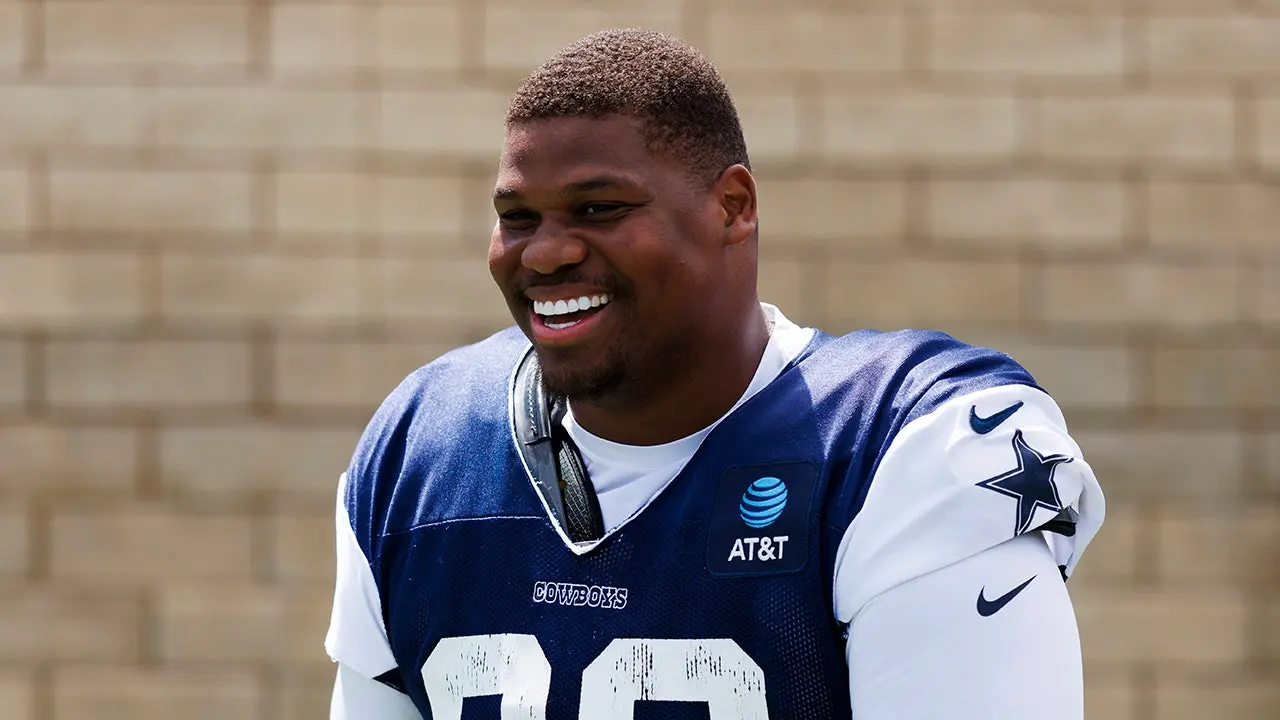
The ink dried on a piece of paper in Frisco, Texas, and with it, the trajectory of a young man’s life and the fortunes of America’s Team were fundamentally altered. When Quinnen Williams put his signature on a breathtaking three-year, $105.9 million contract extension with the Dallas Cowboys, it was far more than a mere transaction in an offseason ledger; it was the ultimate validation of a grueling, bone-crushing journey through the ranks of professional football. For an NFL player, particularly one who battles in the anonymous, violent trenches of the interior defensive line where every play feels like a minor car crash, securing $101 million in total guarantees—with a staggering $63.35 million fully guaranteed at the moment of signing alongside a $31.85 million signing bonus—is the realization of a lifelong dream. It is generational wealth earned through blood, sweat, and the constant, looming threat of career-ending injury, providing a profound sense of peace and security for a player who has spent his entire life putting his body on the line. Williams, a dominant force who has earned invitations to the last four consecutive Pro Bowls, now finds himself elevated to the absolute stratosphere of his profession, recognized not just as a defensive anchor, but as one of the most handsomely compensated athletes on the planet. This monumental agreement, finalized just as the sweltering heat of the 2026 training camp began to test the resolve of players and coaches alike, represents a mutual declaration of trust between a historic franchise hungry for championship glory and a defensive titan at the absolute peak of his athletic powers. It signals to the locker room and the broader sports world that the Cowboys are fully committed to rewarding elite talent, establishing a cornerstone around which a championship-caliber culture can be securely built. From his humble beginnings to his stellar college career at Alabama, Williams has always carried himself with a quiet dignity, and this contract stands as a monument to his relentless work ethic, his family’s sacrifices, and his unwavering dedication to the game.
To truly appreciate how Williams arrived at this luxurious and secure juncture in Texas, one must look back at the chaotic, often cold-hearted nature of the NFL trade market that abruptly uprooted him just a season prior. In a stunning mid-season blockbuster that sent shockwaves through the league, the New York Jets—mired in yet another disappointing campaign and desperate to kickstart another total rebuild—made the painful decision to part ways with two of their most cherished and highly drafted defensive assets. Alongside lockdown cornerback Sauce Gardner, who was shipped off to the Indianapolis Colts, Williams was traded to the Cowboys in a move that signaled a massive philosophical shift for both franchises. For Williams, the transition was a whirlwind of complex emotions; only a year earlier, in 2023, the Jets had seemingly locked him in as the permanent face of their defense with a four-year, $96 million extension. Yet, the realities of professional sports spare no one, and Williams soon found himself packing his bags for Dallas in exchange for a massive package that sent young defensive tackle Mazi Smith, a 2026 second-round pick, and a coveted 2027 first-round draft pick back to East Rutherford. The trade exposed the raw human vulnerability behind the plastic helmets, reminding fans and players alike that in this league, loyalty is often secondary to asset management. Williams had to quickly process the shock of being traded by the team that drafted him, relocate his family across the country in the middle of a season, adapt to an entirely new locker room culture, and learn a complex defensive playbook on the fly, all while trying to maintain his status as an elite defender under the intense glare of the Dallas spotlight. It was a test of character as much as talent, and his ability to handle the sudden upheaval with grace and professionalism earned him immediate respect in the Cowboys’ facility.
This massive financial commitment by the Dallas front office reflects a broader, highly competitive evolution in how NFL franchises value the interior of their defensive lines in the modern passing era. For decades, flashy edge rushers commanding astronomical salaries dominated the defensive market, but a recent paradigm shift has forced front offices to realize that disrupting a quarterback’s rhythm from the inside out is the quickest way to dismantle high-powered offenses. Williams’ new deal, which averages more than $35 million annually, officially places him in an exclusive, elite fraternity of defensive tackles who have shattered the once-unimaginable $30 million per season threshold. He joins the Philadelphia Eagles’ formidable young star Jalen Carter, who recently secured a four-year, $152 million contract, the Tennessee Titans’ relentless playmaker Jeffery Simmons with his three-year, $105.8 million deal, and the legendary Kansas City Chiefs champion Chris Jones, who commands a monstrous five-year, $158.75 million contract. By securing Williams through the 2030 campaign, Cowboys Executive Vice President Stephen Jones executed a masterful stroke of financial foresight, tackling a crucial roster priority that he had passionately championed at the onset of training camp, before the market could escalate any further out of reach. In doing so, the Cowboys have insulated themselves against future inflation of the salary cap, ensuring they have an elite defender locked in his prime years while other teams scramble to pay premium prices for lesser talent. This strategic moves proves that the Dallas front office is willing to make aggressive, forward-thinking moves to keep their competitive window wide open, understanding that games are won and lost in the trenches where players like Williams reign supreme.
The acquisition and subsequent extension of Williams is just one piece of a broader, incredibly ambitious defensive metamorphosis taking place in Dallas, as the front office has shown an unprecedented willingness to flex its financial muscles. Recognizing that a lone superstar cannot carry a defense to the Promised Land, the Cowboys’ brass paired Williams with fellow defensive tackle Osa Odighizuwa, cementing his presence with a handsome four-year, $80 million extension of his own to create an incredibly formidable interior duo that promises to terrorize opposing guards and centers for years to come. This high-priced interior pairing is complemented by an overhauled outer shell that features veteran tackle Kenny Clark—acquired in the seismic, bittersweet trade that sent superstar linebacker Micah Parsons to the Green Bay Packers—and elite edge rusher Rashan Gary, who chose to sign with Dallas in free agency after leaving Lambeau Field. The departure of a fan favorite like Parsons was undoubtedly a tough pill for the fan base to swallow, but the resulting influx of proven, battle-tested talent has allowed Dallas to reshape its identity from a top-heavy unit into a deep, physical, and relentless defensive front. Together, this revamped, highly expensive defensive unit has been meticulously constructed to provide the perfect counterweight to a Dallas offense that flourished under the creative direction of head coach Brian Schottenheimer during his triumphant inaugural season in 2025. By assembling this defensive juggernaut, the Cowboys’ front office has sent an unmistakable message to the rest of the league: they are building a physical, balanced roster capable of dictating the terms of any game, in any weather, against any opponent.
On the field, the impact of Quinnen Williams is immediate, visceral, and deeply felt by any offensive coordinator unfortunate enough to game-plan against him. During his brief, seven-game introduction to the Dallas faithful last season following the trade, Williams immediately proved his worth, racking up 21 combined tackles, 1.5 crucial sacks, three tackles for loss, and a relentless barrage of nine quarterback hits that constantly disrupted opposing passing games. These numbers, while impressive on their own, only scratch the surface of a career defined by sheer dominance and remarkable consistency across his seasons in the league. Over his professional tenure, Williams has amassed an eye-popping 343 combined tackles—including 62 tackles for loss—along with 41.5 sacks and eight forced fumbles, highlighted by a spectacular 12-sack performance in 2022 that earned him First-Team All-Pro honors with the Jets. Beyond the statistics, his true value lies in the invisible gravity he commands on the field; his explosive first step, immense upper-body strength, and high football IQ force opposing offenses to routinely commit two, sometimes three blockers to keep him from blowing up plays in the backfield. This constant attention frees up his fellow defenders to make plays in space, transforming the entire defensive ecosystem through his mere presence and elevating Dallas from a good defensive unit to an elite, championship-caliber force. His teammates frequently talk about the energy he brings to the huddle, a infectious mix of childlike joy for the game and a terrifying, competitive fire that elevates the play of everyone around him.
Now firmly entrenched in the heart of Texas through the end of the decade, Williams must bear both the extraordinary rewards and the intense, suffocating pressure that comes with being the highly paid savior of a legendary franchise. In Dallas, every transaction is magnified under a microscopic lens, and the team’s penchant for self-promotion—highlighted by recent viral social media moments like their heavily mocked walkthrough showcasing the Caleb Downs trophy—means that failure is never quiet and success is demanded instantly. For Williams, the challenge is no longer about proving his individual talent or securing his financial future; it is about carrying the heavy weight of expectations for a passionate, often impatient fan base that has starved for a championship for over three decades. He follows in the footsteps of legendary Cowboys defensive tackles who came before him, knowing that in Dallas, regular-season accolades mean very little if they are not accompanied by a Lombardi Trophy. As the Cowboys embark on this new era under Schottenheimer, the success of their expensive, star-studded defense will ultimately dictate whether this massive investment in Quinnen Williams is remembered as a stroke of championship genius or another cautionary tale of high-priced ambition. For Williams, the journey from a struggling squad in New Jersey to the bright lights of AT&T Stadium is complete, and the stage is now set for him to lead, dominate, and potentially cement his legacy as one of the all-time greats in the storied history of the Dallas Cowboys.