


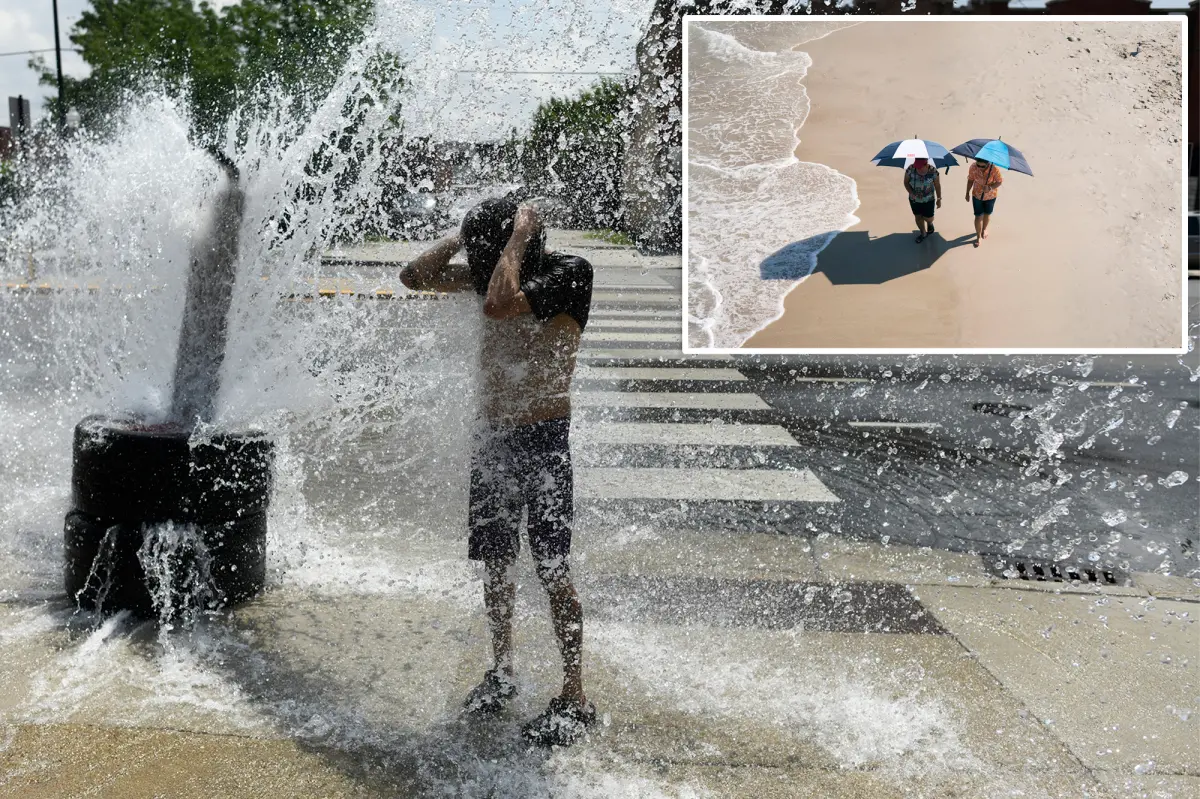
The oppressive heat of July was not merely a collection of cold, analytical data points on a meteorologist’s digital screen; it was a physical, suffocating weight that millions of Americans carried on their shoulders every single day. From the concrete canyons of bustling northeastern cities to the dusty, sun-baked agricultural valleys of the West, this summer transformed daily life into a relentless test of human endurance, mental fortitude, and structural resilience. The constant, low-frequency hum of air conditioning units became the defining, ubiquitous soundtrack of American neighborhoods, while those without access to cooling relief faced a quiet, desperate struggle for basic physical survival. Outside, the air felt thick, heavy, and hard to breathe, turning simple tasks like walking to the mailbox, waiting for a municipal bus, or walking the dog into exhausting, sweaty chores. It was a month where asphalt softened underfoot, playground slides became dangerous to touch, and the natural world seemed to hold its collective breath under a punishing, cloudless blue sky. According to the National Oceanic and Atmospheric Administration (NOAA), this shared human experience of relentless warmth has now been officially codified into the history books: July registered as the hottest month ever recorded in the contiguous United States since official record-keeping began 132 years ago. Averaging a scorching 76.9 degrees Fahrenheit across the lower 48 states—a staggering 3.3 degrees above the 20th-century average—this historic month did not just nudge past previous records; it shattered them, leaving communities across the nation to grapple with the immediate and profound realities of a warming planet. The statistics tell a story of a changing climate, but the true narrative lies in the lived experience of the people who had to navigate this unprecedented thermal wave, adjusting their daily routines, their outdoor work, and their expectations of safety to a world where extreme heat is no longer an occasional seasonal anomaly but a dangerous, regular guest in our lives.
While the record-breaking heat was felt nationally, its geographical distribution drew a stark, erratic map of climate extremes across the North American continent, illustrating how global warming does not affect everyone equally or in the exact same manner. In Alaska, residents actually experienced an unusually cool summer, offering a brief, isolated northern reprieve from the broader thermal trend; however, for the vast majority of the contiguous United States, the weather was nothing short of suffocating. The Mountain West, the Southwest, the Northern Plains, and the Southeast bore the brunt of this thermal onslaught, enduring days on end of blistering sunshine, stagnant air, and dry winds. In the Mid-Atlantic region, families attempting to celebrate the nation’s birthday were met with historic, oppressive conditions, as cities like Raleigh, North Carolina, Richmond, Virginia, and Washington, D.C., recorded their hottest Fourth of July on record, forcing many traditional outdoor parades, community barbecues, and fireworks viewings to be cut short or canceled altogether out of concern for public safety and heat exhaustion. Compounding this thermal stress was a bizarre and dangerous meteorological whiplash: despite the contiguous United States experiencing below-average overall precipitation for the month, local weather patterns exploded into localized chaos and violence. Parched landscapes were suddenly subjected to torrential, atmospheric river-style downpours and devastating flash flooding events, most notably in eastern New York, where skies opened up to dump a staggering 12 inches of rain in a single month. This violent juxtaposition of extreme drought and sudden, destructive deluges left communities reeling, highlighting the growing volatility of our atmosphere and proving that a warming world does not just mean higher temperatures, but a chaotic, unpredictable disruption of the delicate water cycles that sustain our infrastructure, our agriculture, and our daily lives.
To truly comprehend the terrifying magnitude of this July’s heat, one must look backward to the most infamous period of environmental disaster in American history: the Dust Bowl of the 1930s. For nearly nine decades, July 1936 stood as the undisputed benchmark of American heat and human misery, a legendary summer of dried-up wells, ruined crops, and mass migrations that came to define a generation’s struggle against a hostile climate. Yet, this July quietly eclipsed that historic Dust Bowl record by a significant 0.8 degrees Fahrenheit, signaling a profound shift in the scale and nature of modern heatwaves. When we look back at the years that tied with 2021 for the hottest summer on record from June through August, those historical periods of intense heat were fundamentally different in their origin, behavior, and scope. As Russ Vose, the chief of monitoring at NOAA’s National Center for Environmental Information, points out, the extreme temperatures of the Dust Bowl era were largely concentrated in the Midwest and heavily aggravated by localized, short-sighted agricultural practices that stripped the native topsoil and destroyed the regional microclimate. Today’s warmth, by contrast, is not a localized tragedy born of poor farming techniques or regional bad luck; it is a ubiquitous, blanket-like heat that smothers entire regions simultaneously, from coast to coast. We are no longer dealing with a temporary, geographically isolated ecological disaster that can be corrected by better soil management, but a systemic, planetary shift that dwarfs the extremes of the past, forcing us to recognize that the historical baselines we once used to measure safety and normalcy have been permanently redrawn. This realization brings a chilling sense of perspective: the legendary disasters of our grandparents’ stories are no longer the worst-case scenarios, but rather the starting points for the new climate reality we must now learn to navigate.
The driving force behind this modern thermal emergency is neither a mystery nor a natural cycle, but rather the direct, indisputable result of human activity and our long-standing reliance on fossil fuels. For decades, climate scientists have warned that the burning of coal, oil, and gas acts as a thickening greenhouse blanket around our planet, trapping solar radiation and steadily elevating global temperatures to levels unseen in human history. The record-breaking heat of this summer is the undeniable manifestation of these scientific predictions, representing a clear, urgent, and undeniable signal from a deeply destabilized biosphere. Climate scientists, including Katharine Jacobs from the University of Arizona, emphasize that the concurrent emergencies we are witnessing—from the extreme temperatures stretching across the continental United States to the intense droughts and raging wildfires devouring millions of acres of forest—are absolutely consistent with the established scientific models of climate change. This is not a natural fluctuation or a streak of bad luck, but a direct consequence of a global economy built on carbon emissions. Humanizing this science means understanding that every fraction of a degree of warming translates directly into human suffering: a father working in dangerous outdoor conditions to feed his family, a farmer watching his generational livelihood wither in a cracked, dry field, or a firefighter risking their life on the front lines of an increasingly volatile wildfire season. The data points collected by organizations like NOAA are, in reality, a mirror reflecting our collective societal choices, urging us to confront the systemic roots of this crisis before these record-shattering summers become the mildest seasons of our future. We are no longer talking about future generations; we are talking about our children, our elderly parents, and ourselves, living in a world that is growing less hospitable with each passing year of inaction.
One of the most insidious and overlooked aspects of this modern heat crisis is not how hot it gets during the peak of the afternoon, but how little relief the night now provides. Historically, the setting of the sun offered a vital sanctuary, a cool embrace that allowed the human body, urban infrastructure, and the natural world to shed the heat accumulated during the day and prepare for the next morning. However, as global temperatures rise, nighttime lows are climbing at an even faster rate than daytime highs, stripping away this essential period of recovery. Renowned meteorologist Jeff Masters highlights this critical vulnerability, explaining that when we discuss the dangers of heatwaves, the nighttime low temperature is actually the most crucial factor in determining total heat stress on the human body. If the temperature does not drop sufficiently at night, the human body remains in a state of high physiological stress, keeping the heart rate elevated, preventing deep, restorative sleep, and making it impossible to shed the heat load of the previous day. This lack of nocturnal cooling creates a compounding health crisis, particularly for vulnerable populations such as the elderly, young children, outdoor laborers, and marginalized communities living in urban heat islands without access to reliable air conditioning. When the night remains hot, the home ceases to be a refuge and instead becomes a thermal trap, leading to a silent accumulation of physical exhaustion, heat stroke, and cardiovascular strain that strains emergency rooms and claims lives long before the sun rises again. It is a quiet, exhausting torment that drains the vitality of entire communities, turning sleep from a basic human necessity into an unaffordable luxury for those who cannot pay the rising costs of climate-controlled shelter.
As we stand on the threshold of this hot new reality, the record-breaking temperatures of July must serve as more than just a fleeting headline or an alarming statistic; they must be a catalyst for profound collective action, empathy, and systemic change. The challenges ahead are undeniably immense, requiring us to radically rethink how we design our cities, protect our workers, manage our natural resources, and transition our energy systems away from the fossil fuels driving this crisis. Yet, in the face of this daunting warming trend, the path forward lies in strengthening the bonds of our communities and cultivating a deep sense of mutual care. Humanizing the climate crisis means recognizing that survival in a warmer world depends heavily on our willingness to look out for one another—checking on elderly neighbors during prolonged heat spells, demanding fair labor protections for those who work under the sun, and investing in public cooling centers and green spaces that protect the most vulnerable among us. We have the scientific knowledge, the technological tools, and the collective resourcefulness to adapt and mitigate the worst outcomes of this changing climate, but we must find the political and social will to deploy them at scale. The searing heat of this historic July is a powerful reminder that our planet is speaking to us in a voice that can no longer be ignored, calling us to rise to the occasion, rewrite our relationship with the Earth, and build a more resilient, compassionate, and sustainable future for the generations to come. Ultimately, our response to this crisis will define not just our climate, but our character as a society, proving that even in the face of unprecedented heat, our capacity for human warmth and collective action remains our greatest resource.