



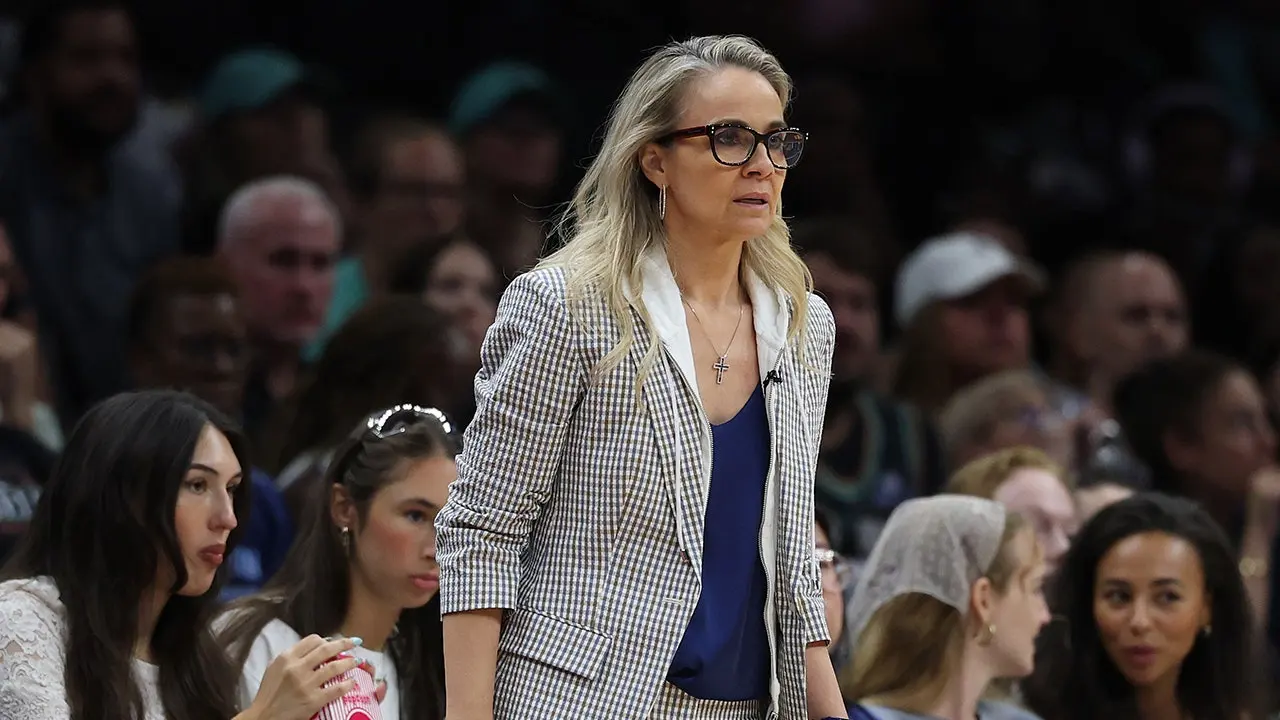
The Barclays Center in Brooklyn was supposed to be the stage for a spectacular showdown, a highly anticipated clash between two of the WNBA’s most formidable powerhouses, the Las Vegas Aces and the New York Liberty. Broadcast to a national audience on ABC, the Sunday afternoon game was marketed as a premier showcase of elite women’s basketball, drawing thousands of eager fans to the arena and locking in viewers across the country. Yet, as the starting lineups were announced, a wave of confusion swept through the crowd and social media alike. Las Vegas Aces head coach Becky Hammon unveiled a starting five that nobody saw coming, leaving her primary superstars on the bench. Instead of watching four-time MVP A’ja Wilson, elite playmaker Chelsea Gray, and dynamic guard Jackie Young take the court, fans watched Jewell Loyd, Dana Evans, and Brianna Turner step into the spotlight. Throughout the entire game, the Aces’ star trio never once checked in, remaining on the sidelines in their warmups, acting not as competitors on the hardwood but as the ultimate cheerleaders for their teammates. To the casual observer, it seemed like a baffling concession in a marquee matchup against a fierce rival, but to those familiar with the grueling realities of professional sports, it was a quiet, deliberate act of resistance against a system that often prioritizes entertainment value over the physical limits of human beings.
To truly understand Hammon’s controversial decision, one must look at the exhausting twenty-four hours that preceded Sunday’s tip-off. Just the day before, on Saturday afternoon, the Aces had battled through a physically punishing game against the Minnesota Lynx in Minneapolis, ultimately falling 98-87. During that intense contest, Hammon had leaned heavily on her core group, with Wilson playing 33 demanding minutes, Young logging another 33, and Gray pushing through 36 minutes of high-intensity basketball. After the final buzzer sounded in Minnesota, the clock immediately began ticking against the Aces. The team had to pack up, navigate airport security, fly halfway across the country, check into a hotel, and try to get a semblance of restorative sleep before waking up for a midday game in Brooklyn the very next morning. The turnaround time was brutally short, demanding that elite athletes perform at the highest level of human capability with less than twenty-four hours of recovery time, compounded by the physical toll of air travel. It was a scheduling nightmare that left little room for physical recovery, let alone the mental preparation required to face a championship-caliber team like the New York Liberty on their home court.
Faced with this logistical gauntlet, Becky Hammon chose to draw a line in the sand, placing the long-term well-being of her players above a single regular-season win or the demands of television networks. In her post-game press conference, following a predictable 111-71 blowout loss to the Liberty, Hammon was unapologetic, fiercely defending her decision to implement load management. She emphasized that the health and safety of her players must always come first, arguing that risking a catastrophic injury to her stars during a period of high fatigue and relentless travel was simply unacceptable. Hammon, a former WNBA legendary point guard herself, understands the physical wear and tear of a professional season on a deeply personal level. She framed the decision as a strategic sacrifice, recognizing that taking a temporary loss in the standings is a minor price to pay if it ensures her roster remains healthy and intact for the postseason push. For Hammon, this was about the “bigger picture,” a calculated move to protect her players’ bodies from being run into the ground, even if it meant absorbing criticism from fans and league executives who wanted to see a star-studded showdown on national television.
This scheduling conflict highlights a growing tension within the WNBA regarding player welfare and the league’s rapid commercial expansion. Under the current collective bargaining agreement, which was negotiated to improve playing conditions, there is explicit language stating the league must make “reasonable and good faith efforts” to provide at least twenty hours of buffer time between the start of back-to-back games. Furthermore, the league operates under a guideline that seeks to guarantee a minimum of twenty-two hours between consecutive games, provided travel does not cross more than one time zone—a policy modeled closely after the NBA’s scheduling practices. In this specific instance, the Aces tipped off in Minnesota at 1:00 p.m. Eastern Time on Saturday and were scheduled to play in Brooklyn at 12:30 p.m. Eastern Time on Sunday, technically squeezing by the league’s minimum guidelines. However, the human body does not calculate recovery in minimum league guidelines. The reality of traveling across time zones, dealing with flight delays, and operating on disrupted sleep cycles means that a twenty-three-hour window is rarely enough time for an elite athlete to fully recover from playing over thirty minutes of intense, high-impact basketball.
The reaction from the opposing bench on Sunday illustrated a shared understanding of this physical reality, even among competitors who had hoped for a true test of strength. While the New York Liberty cruised to an easy, uncontested victory against a depleted Aces roster, their star forward Jonquel Jones expressed genuine empathy for Hammon’s predicament after the game. Jones acknowledged that while as fierce competitors they wanted to test themselves against the best players in the world, she fully understood and respected the Aces’ need to prioritize their health and listen to their bodies. This sentiment speaks to a broader sisterhood within the WNBA, where players recognize the immense physical demands placed upon them and support collective efforts to protect one another’s longevity. The fans in attendance may have felt shortchanged by the lack of star power on the court, but the players themselves understand that careers are built on sustained health, not on sacrificing one’s knees and ankles for a single mid-season broadcast.
Ultimately, Becky Hammon’s decision to bench her stars in Brooklyn serves as a powerful, symbolic statement at a pivotal moment in the history of women’s professional basketball. The WNBA is experiencing an unprecedented surge in popularity, media attention, and financial investment, which has led to plans for an expanded fifty-game regular season schedule next year. As the league grows and the business demands increase, the pressure to deliver high-quality entertainment for television audiences will only intensify. However, Hammon’s actions send a clear message to the league’s front office: the rapid commercialization of the sport must not come at the expense of the human beings who make the game possible. By refusing to compromise on player safety, Hammon has sparked an essential conversation about the sustainability of the league’s scheduling practices, proving that she will not hesitate to protect her athletes, no matter how bright the television lights or how loud the public outcry.