



Every parent who has ever packed up a minivan with plastic storage bins, extra-long twin sheets, and enough laundry detergent to survive a minor apocalypse knows the unique, bittersweet blend of pride, anxiety, and deep nostalgia that accompanies college move-in day. For Lori DiBisceglie Massaro, a devoted mother of four from the quiet, tree-lined Long Island suburb of Albertson, New York, this particular milestone felt both intimately familiar and entirely unprecedented as she prepared to send her sophomore son, Will, back to the University of Delaware for his second year. As an accomplished professor at the Fashion Institute of Technology and an alumna of New York University, Lori was certainly no stranger to the landscape of higher education, but her own experience as a commuting student had largely shielded her from the raw, unvarnished realities of off-campus residential living. Sending Will off to live in his first fraternity house—specifically the local Phi Kappa Sigma chapter—felt like a major, symbolic step toward his independence, a chapter of his young adult life that should have been filled with academic ambition, social camaraderie, and newfound personal responsibility. Armed with maternal optimism, a heart full of hope, and a family vehicle packed to the absolute brim with home goods, Lori and her husband made the long journey south to Delaware, anticipating the bittersweet transition of watching their son carve out a home of his own among his peers. What they did not anticipate, however, was that this supposedly exciting milestone would rapidly devolve into a dizzying, head-scratching confrontation with the shocking, unfiltered, and deeply unhygienic underbelly of collegiate brotherhood, challenging every notion of domestic comfort they had spent a lifetime teaching him.
The vast disparity between what we expect of the world and what the world actually delivers is often where life’s most comedic and horrifying moments reside, and Lori’s expectations had been heavily shaped by the polished lens of modern television. In the weeks leading up to the big move, her imagination had been thoroughly captured by the popular Prime Video series Off Campus, a show that paints a decidedly glamorous picture of student life. In her mind’s eye, the fraternity house would closely mirror the idyllic, effortlessly cool, and surprisingly clean hockey house depicted on the screen, where charismatic student-athletes like Garrett Graham shared a spacious, well-appointed home with roommates like Tucker, a character who possessed a charming penchant for whipping up gourmet meals for his friends around a beautiful, gleaming center kitchen island. It was an image of youthful vitality wrapped in suburban luxury—a cozy, clean sanctuary where young men balanced their active social lives with an impressive degree of domestic order. Armed with this cinematic fantasy, Lori was completely unprepared for the sudden, visceral jolt of reality that awaited her the moment they pulled up to the actual Phi Kappa Sigma property. While the front exterior of the building appeared reasonably tidy and unassuming under the late-summer sun, the illusion shattered instantly when they drove around to the back of the property, where a depressing graveyard of sunken, weather-beaten outdoor couches sat rotting on the grass. Stepping through the back door, Lori was immediately hit by a wave of shock as she realized that the home’s interior was less “cool college house” and more “abandoned municipal building.” The kitchen, which she had hoped would be the heart of her son’s daily routine, was a stark, depressing void; it possessed no shelves, no cabinets, and no usable countertop space, featuring instead only a solitary, grime-stained sink and an ancient stove that looked as though it had witnessed decades of culinary neglect. To make matters even more bizarre, the refrigerator was not even located within the kitchen itself, requiring the boys to walk out into the drafty public hallway just to retrieve their food, a chaotic layout choice that Lori could only describe as absolute “bananas.”
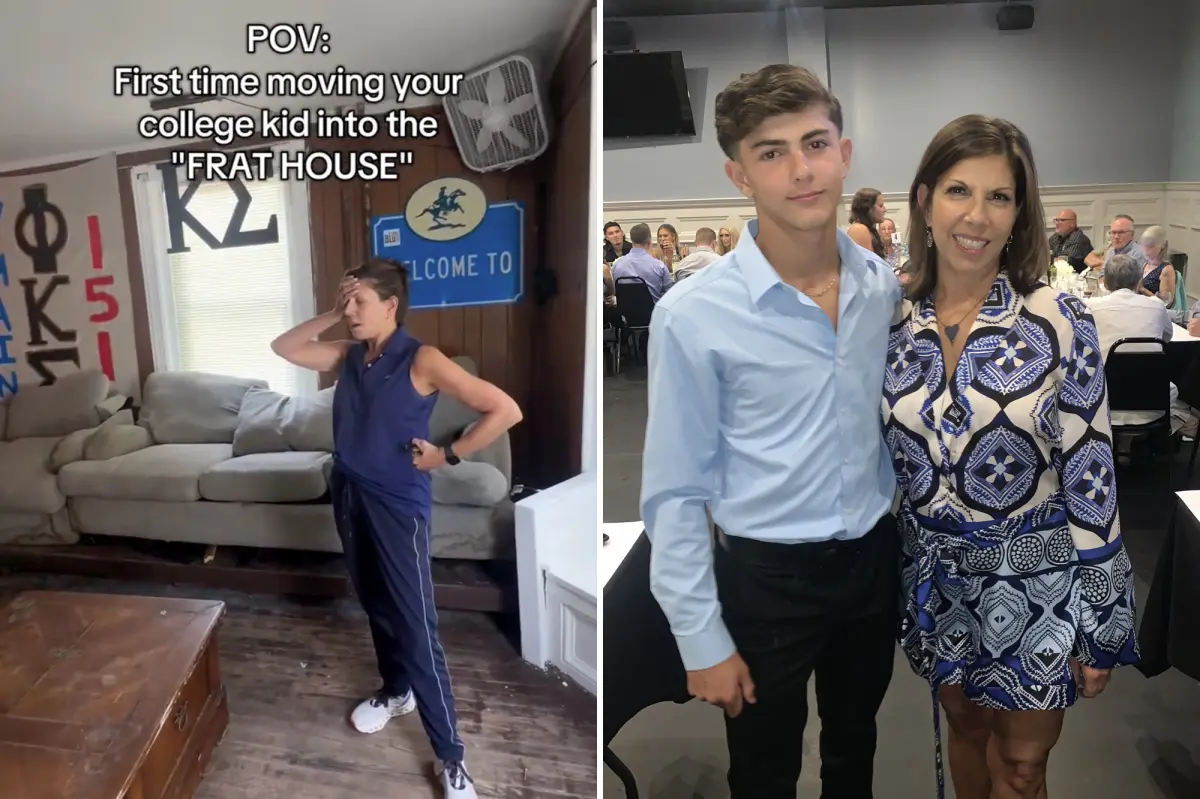
As Lori ventured deeper into the three-story residence, the true scale of the domestic disaster began to unfold before her eyes, leaving her to wonder how eight college sophomores—each paying a substantial and hard-earned $1,000 a month in rent—could possibly tolerate such squalor. Every single surface she encountered seemed coated in a thick, mysterious layer of stuck-on, ancient dirt that felt as though it had integrated itself into the very structural integrity of the walls and floors, defying any hope of ever being lifted by normal cleaning supplies. The communal bathroom was a particular point of absolute horror, radiating an aura of neglect so profound and unhygienic that Lori found herself actively pleading with her son to avoid using it altogether, suggesting instead that he make the daily trek to the campus fitness center just to utilize their clean showers and facilities. There was a profound, almost tragicomic irony in the financial reality of the situation; these young men, including her accounting-major son, were paying premium rent for living conditions that fell far below the basic standards of human decency, yet they seemed entirely oblivious to, or perhaps even perversely proud of, the chaotic state of their surroundings. Even the sudden appearance of a lone maintenance man on the property did little to ease Lori’s bewilderment, as she jokingly wondered what exactly he was supposed to be maintaining in a house that seemed to have abandoned all pretenses of physical upkeep years ago. The building’s layout had clearly been optimized not for academic study, quiet reflection, or nutritional health, but for the singular, chaotic pursuit of large-scale social gatherings, exemplified by the total absence of a traditional dining room in favor of a massive first-floor “party room.” This room featured a bizarre, DIY arrangement of “stadium seating” created by placing heavy wooden platforms under various sagging couches, a design choice Lori dryly assumed was intended to provide optimal visibility for the television, or perhaps to make it easier to slide the furniture out of the way when the time came to host the fraternity’s next crowded social event.
The true test of parental fortitude came when they finally reached Will’s individual bedroom on the upper floors, a space that was supposed to serve as his personal sanctuary and study haven for the upcoming academic year. Will, approaching the situation with the practical, numbers-oriented mindset of an accounting major, was immensely proud of the fact that he had negotiated a deal with the previous tenant to purchase all of the existing furniture, viewing it as a savvy financial triumph that saved him both money and effort. To his mother’s horrified eyes, however, the inherited decor was nothing short of a nightmare—a collection of stained, weary, and deeply questionable items that looked as though they had survived a minor natural disaster and several decades of neglect. Recognizing that her son could not possibly sleep on a mattress of such mysterious origins, Lori and her husband immediately went into emergency mode, abandoning their carefully planned unpacking schedule to launch a frantic rescue expedition to the local Costco. They purchased a brand-new, sterile mattress to replace the biohazard left behind by the previous occupant and spent the remainder of the afternoon scrubbing, disinfecting, and sanitizing every square inch of that single bedroom, determined to carve out at least one clean, safe haven for Will amidst the surrounding domestic chaos. It was a grueling, sweat-inducing labor of love, a physical manifestation of a mother’s instinct to protect her child from the harsh, grimy realities of the world, even when that reality is just a very dirty bedroom in a college town. As they wiped down sticky baseboards and assembled the fresh bedding, the stark contrast between Will’s genuine pride in his new home and Lori’s quiet, scrubbing-induced desperation highlighted the enduring, hilarious gap between the priorities of a twenty-year-old college boy and those of his protective mother.
Recognizing the sheer, undeniable absurdity of the situation she had found herself in, Lori decided to document her coping mechanism on social media, filming a short, highly relatable video of herself holding her head in sheer disbelief as she navigated the chaotic, untidy hallways of the fraternity house. Captioned with a witty, self-deprecating nod to her shattered television expectations—”Why was I expecting this to look like Garrett Graham’s cool house in @offcampusonprime”—the clip tapped into a deep, universal vein of parental anxiety and quickly went viral, racking up over 1.4 million views on Instagram within just twenty-four hours of being posted. The comments section of her video quickly became a bustling digital town square, exploding with a mixture of hilarious commiseration, nostalgic reflection, and comforting solidarity from thousands of parents who had walked the exact same path with their own children. While some seasoned moms and dads offered horrifying anecdotes of their own experiences with fraternity houses that made Will’s residence look like a five-star luxury resort by comparison, others offered the pragmatic, albeit difficult, advice that every experienced college parent eventually learns to live by: “Why did you even go inside? You’re just supposed to drop them off, hand them their bags, and look the other way.” For Lori, who had missed out on the traditional residential dorm experience during her own commuting years at NYU, this digital outpouring of support was both deeply comforting and incredibly eye-opening, transforming her personal shock into a shared moment of collective laughter among a global community of parents who knew the struggle of letting go all too well.
Ultimately, the messy, grimy reality of the Phi Kappa Sigma house became far more than just a viral internet sensation; it served as a beautiful, deeply humanizing reminder of the chaotic, emotional transitions that define the long journey of parenthood. Despite her initial horror and the urge to pack her son up and bring him back to the pristine comforts of Long Island, Lori’s resilient sense of humor and deep, unconditional love for her son shone through the layers of dust and grime, proving that a mother’s devotion can withstand even the most formidable fraternity house bathroom. As she reflected on the whirlwind day, she came to realize that letting go of her pristine, television-inspired expectations was a necessary and healthy step in allowing Will to grow, adapt, and learn to navigate the world on his own terms—even if those terms involve stadium-style couch seating, a hallway refrigerator, and a kitchen with no cabinets. When asked if she would ever consider returning to the house or perhaps even attending one of the fraternity’s legendary weekend parties in the future, Lori laughed warmly, refusing to rule out the possibility of dipping her toes back into her son’s wild, chaotic new world. This messy chapter in Delaware became a lasting testament to the enduring, unbreakable bond between a mother and her child, illustrating with humor and grace that while we cannot always protect our children from the messy realities of life, we can always stand by them with a brand-new mattress, a container of disinfectant wipes, and a willing heart to laugh through the chaos of growing up.