




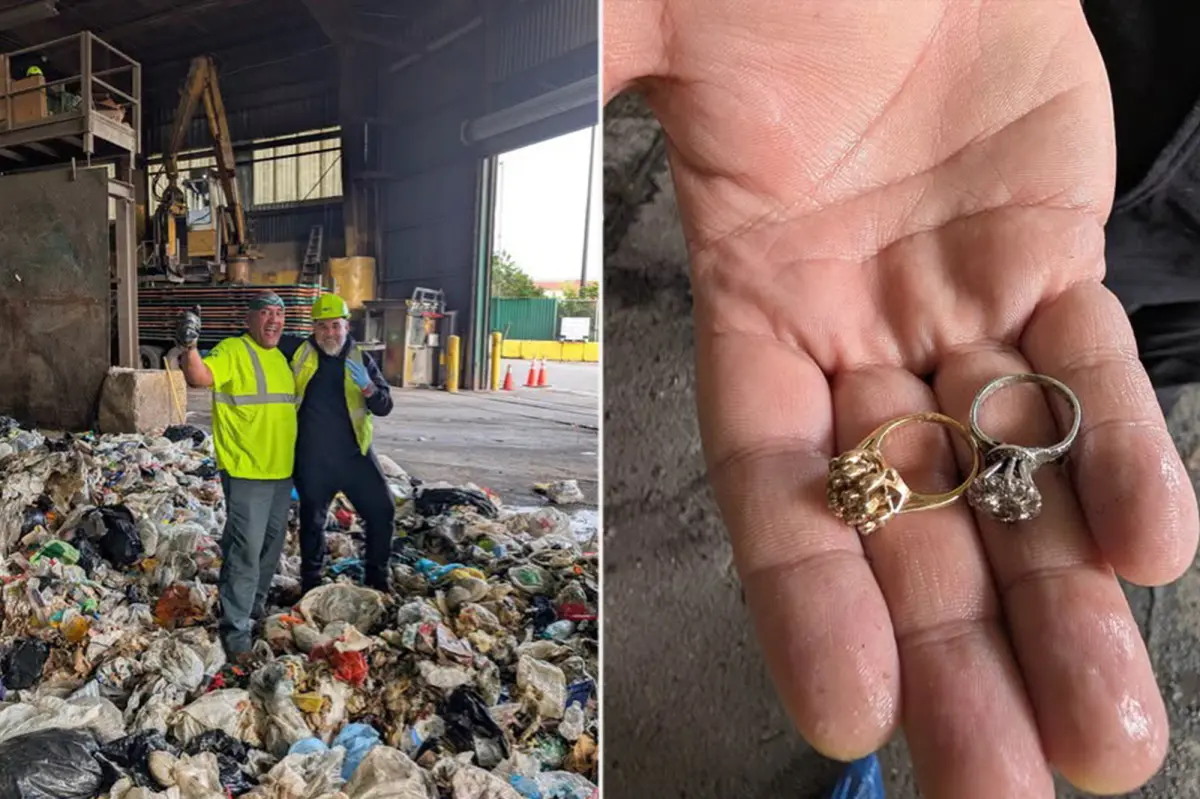
Imagine the sickening, cold dread that pools in the stomach at the exact moment of realization: a priceless piece of your family’s history, a physical token of love passed down through generations, has vanished into the mundane abyss of the household trash. This nightmare became a terrifying reality for one anonymous Brooklyn resident last week when they accidentally discarded not one, but two deeply sentimental heirloom rings. Among the lost items was a magnificent four-generation platinum and diamond engagement ring, a sparkling testament to decades of enduring family love, alongside a delicate gold and diamond promise ring representing future dreams. In the quiet rhythm of daily life, it takes only a split second of distraction—a misplaced tissue, a hasty cleanup, or a momentary lapse in focus—to sweep away history. For this New Yorker, the ordinary act of tidying up instantly morphed into a frantic, heart-stopping crisis, reminding us all of how fragile our most cherished physical connections to the past can truly be. The sheer weight of losing something so irreplaceable is enough to paralyze anyone, but in the fast-paced, unsentimental environment of New York City, there was absolutely no time for tears or hesitation; the clock was already ticking, and the city’s relentless machinery of waste disposal was moving forward. Heirloom jewelry carries a weight far beyond its market value; it is a repository of whispered promises, ancestral blessings, and milestone celebrations, making its sudden loss feel like a sudden fracture in the family tree. Faced with the devastating prospect of having permanently severed this generational link, the resident had to battle through the paralyzing fog of panic, knowing that every passing second carried their precious diamonds further away into a vast, unforgiving urban labyrinth of refuse. It was a race against a system designed to make things disappear forever, a battle of hope against overwhelming mathematical odds.
Fueled by pure adrenaline and desperate hope, the resident bolted out of their home and onto the bustling Brooklyn pavement, scanning the streets for any sign of salvation. By some stroke of sheer, miraculous timing, they managed to flag down two hardworking members of the New York City Department of Sanitation (DSNY) who were going about their daily route. Explaining the situation with breathless urgency, the resident found not bureaucratic indifference, but immediate, deep human empathy in the eyes of the two sanitation workers. Recognizing the profound emotional emergency of the situation, the workers did not hesitate to spring into action, immediately contacting their supervisor to halt the gears of the disposal process. This quick thinking set off a rapid-fire chain of events behind the scenes of the city’s massive waste management network. The supervisor quickly coordinated with the DSNY waste management facility located on Varick Street, initiating a high-stakes rescue protocol to isolate the specific collection truck before its contents could be lost forever. It is easy to view a giant city department like the DSNY as merely a collection of trucks and schedules, but this moment highlighted the warm, compassionate human hearts beating beneath the neon safety vests. These workers understood that they weren’t just dealing with garbage; they were holding the lifeline to a family’s precious memories, proving that even in a metropolis of millions, individual kindness can still pivot the course of a day. Without their rapid communication and willingness to step outside their routine duties, the rings would have been ground down into the anonymous belly of the city’s sanitation system, gone before the search could even begin. Their swift intervention served as a crucial shield against the relentless timeline of urban waste disposal, demonstrating that the first and most important tool in any rescue mission is the simple willingness of strangers to listen and care.
To understand the daunting nature of what lay ahead, one must picture the colossal scale of the Varick Street waste management facility, a place where the city’s discarded lives converge in an overwhelming sensory assault. The DSNY isolated the specific truck, but the challenge remained monumental: the precious rings were buried somewhere within up to 20,000 pounds of compacted, putrid rubbish. In this massive concrete arena, a single truckload represents an intimidating mountain of black plastic bags, rotting organic waste, shattered household items, and the wet, heavy debris of everyday life. The process of searching for something so small in a pile so large is the literal definition of looking for a needle in a haystack—or, more accurately, a pair of diamonds in a mountain of rot. The DSNY personnel orchestrated the scene with mechanical precision, slowly dumping the massive, ten-ton load across a concrete tipping floor, spreading the foul-smelling contents out like a map of misfortune. This concrete floor is a stark, industrial stage where hope and despair collide under harsh fluorescent lights. Time is of the absolute essence in these operations because the facility operates on a strict, continuous loop; once a truck dumps its load into the main transfer station, it is almost instantly merged with waste from dozens of other vehicles. From there, it is mechanically loaded onto massive barges or rail cars, destined for landfills far beyond the city limits. Once that threshold is crossed, the door to recovery slams shut forever, making the tipping floor at Varick Street the final, desperate battleground for the resident’s lost family treasures. The air in the facility, thick with the stench of decay and the rumbling roar of heavy machinery, served as a grim reminder of the hostile environment in which these delicate symbols of love were now trapped, requiring a level of resolve that few ordinary people ever have to summon.
While the Department of Sanitation is incredibly supportive in facilitating these high-stakes searches, providing crucial access to their secure facilities and specialized equipment, their standard operating procedures dictate that DSNY personnel do not physically dig through the trash themselves. This means the heavy lifting, the literal dirty work, falls squarely on the shoulders of the grieving owner and whoever they can recruit to join them in the trenches. To aid in this daunting endeavor, the department equips the brave searchers with essential gear, including heavy-duty protective gloves, shovels, pickers, and other specialized tools designed to handle hazardous waste. However, the DSNY doesn’t just hand over a shovel and wish them luck; they also provide invaluable intellectual guidance based on years of managing the city’s waste patterns. Experienced sanitation experts can analyze the collection route to offer strategic clues that dramatically narrow down the search area. For instance, if the resident’s home was near the very beginning of the sanitation truck’s morning route, the supervisor knows that their trash will likely be positioned deep toward the back of the compacted load. This kind of systematic, analytical thinking transforms a blind, chaotic scramble into a calculated, targeted operation. It is a fascinating intersection of cold logistics and warm human assistance, where city workers use their intimate knowledge of garbage flow to give devastated residents a fighting chance. Armed with heavy gloves, a borrowed shovel, and these vital structural clues, the resident and their support system had to brace themselves to confront the formidable, smelling mountain of debris, driven by the singular, burning hope of reclaiming what was lost. This collaborative dynamic showcases a unique side of civic service, where the strict boundaries of municipal policy bend just enough to offer a hand of guidance and a beacon of hope to a citizen in distress.
What happened next on that dirty concrete tipping floor defies all realistic expectations and borders on the miraculous. With 20,000 pounds of putrid, compacted garbage spread before them, the searchers braced themselves for an exhausting, hours-long ordeal of tearing through torn plastic and rotting waste, fully aware that the odds of success were astronomically low. Yet, in an astonishing twist of fate, the search lasted a mere ten minutes before a sudden, brilliant glint of metal caught someone’s eye amidst the gray sludge of refuse. There, shining defiantly against the backdrop of discarded plastic and decaying food, were the two heirloom rings, completely intact and unharmed by the truck’s brutal compacting system. The sheer velocity of this discovery was mind-boggling, a lightning-fast triumph that turned an afternoon of absolute despair into a moment of euphoric celebration. To find two tiny, delicate bands of platinum and gold within a ten-ton mountain of urban waste in less time than it takes to order a cup of coffee is nothing short of a modern-day fairy tale. The explosive relief that washed over the resident in that moment is almost impossible to put into words; it was a physical lifting of grief, a sudden restoration of history, and an overwhelming rush of gratitude. The glittering diamonds, which had survived decades of family history only to face their greatest threat in a Brooklyn trash can, were finally back where they belonged, safe from the crushing jaws of the landfill. This incredibly rapid resolution was a testament to the perfect alignment of timing, precise DSNY logistics, and a healthy dose of pure, unadulterated luck. It stood as a radiant victory over the chaotic forces of the city, proving that sometimes, against all conceivable logic, the universe conspires to return what we cherish most. The dirty, industrial tipping floor of the Varick Street facility, normally a place of endings and discarded things, was temporarily transformed into a theater of joy, echoing with sighs of disbelief and tears of profound happiness as the small, sparkling treasures were lifted from the muck and held high in the light once more.
This extraordinary Brooklyn saga serves as a powerful reminder of both the fragility of our material lives and the incredible efficiency of the systems that keep our cities running. While this particular story ended in a joyous miracle, the Department of Sanitation emphasizes that timing is the absolute key to recovery, urging anyone who finds themselves in a similar crisis to act immediately by calling 311. The window of opportunity to save lost items is incredibly narrow, and once the trash is mixed and loaded onto transport barges, it enters a point of no return where recovery becomes physically impossible. Beyond the practical advice and the logistical warnings, however, this heartwarming incident shines a bright light on the unsung heroes of the DSNY, whose empathy and rapid coordination made this happy ending possible. It humanizes the massive, often-invisible workforce that cleans our streets, showing that they are not just collectors of waste, but guardians of our community who are willing to stop and help a neighbor in need. The four-generation engagement ring and the promise ring now carry a brand-new, unforgettable chapter in their long history—a story of loss, community kindness, a dirty mountain of trash, and a ten-minute miracle on a concrete floor in Brooklyn. As these family heirlooms are passed down to future generations, they will carry not just the memory of ancestral love, but a shining story of New York City grit, municipal compassion, and the beautiful reminder that some things are simply too precious to be lost forever. This tale will undoubtedly be retold at family gatherings for decades to come, a legendary narrative of how a community came together to rescue a piece of their heritage from the brink of oblivion, forever cementing the bond between a grateful family and the dedicated public servants of their city.