

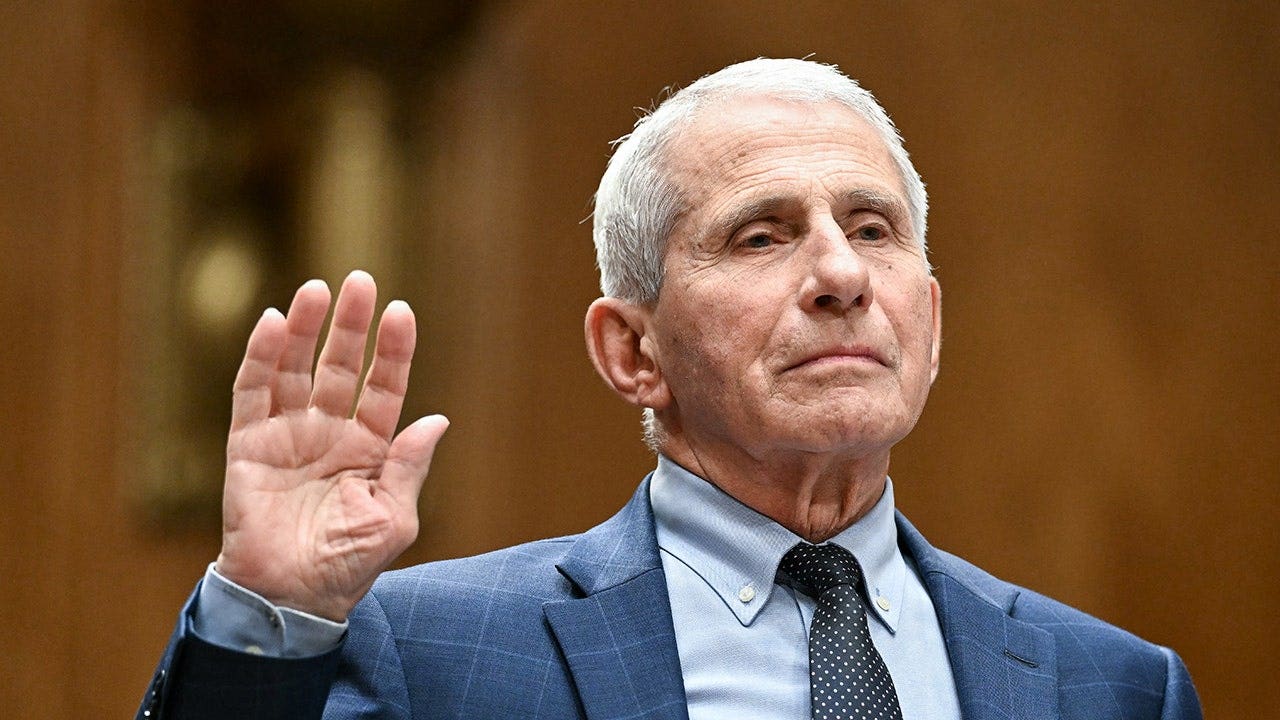
The enduring fallout of the COVID-19 pandemic has once again taken center stage in the halls of American power, reigniting a fierce ideological battle over accountability, public trust, and the limits of governmental authority. At the absolute epicenter of this storm is Dr. Anthony Fauci, the former director of the National Institute of Allergy and Infectious Diseases, whose decades-long career as the nation’s preeminent public health official has made him both a revered shield against disease and a lightning rod for intense political scrutiny. The latest chapter in this high-stakes drama unfolded during a highly charged hearing before the Senate Committee on Homeland Security and Governmental Affairs, chaired by one of Fauci’s most relentless and vocal adversaries, Senator Rand Paul of Kentucky. In a scene that captivated observers nationwide, Dr. Fauci invoked his Fifth Amendment right against self-incrimination more than one hundred times, a defensive legal strategy that shielded him from direct questioning but simultaneously handed his conservative critics a potent political weapon. For millions of Americans watching at home, the spectacle of a retired, high-profile public servant repeatedly refusing to answer questions about some of the most critical decisions in modern history felt like a profound betrayal of the transparency they believe they are owed. The intense political backlash was swift and decisive, prompting House Republicans to pivot from mere rhetorical condemnation to concrete legislative action designed to ensure that such administrative evasions carry severe personal and professional consequences.
This mounting frustration found a powerful legislative voice in Representative Rich McCormick, a Georgia Republican and physician himself, who quickly introduced a provocative new bill designed to ban Dr. Fauci from ever working for the federal government again. In explaining his motivation for the legislation, McCormick sought to bypass complex constitutional arguments and instead connect with the average American through a deeply human, common-sense analogy that speaks directly to the realities of everyday working life. He argued that while every citizen possesses a sacred, constitutionally protected right to remain silent under the Fifth Amendment, that right does not insulate an individual from the professional consequences of their silence in the workplace. Using the relatable example of a fast-food worker, McCormick suggested that if a Burger King employee’s cash register comes up short by twenty dollars at the end of a shift, and that employee chooses to plead the Fifth when questioned by their manager, they certainly have the legal right to do so—but the manager also possesses the undeniable right to immediately fire them. In McCormick’s view, the exact same standard of basic accountability must apply to the highest echelons of the federal bureaucracy, where unelected officials wield immense power over the lives, livelihoods, and basic liberties of hundreds of millions of citizens. For many everyday Americans who live under the constant threat of immediate termination for any perceived lapse in job performance or honesty, the idea that a highly compensated public official could retreat behind constitutional protections while avoiding accountability feels like a glaring double standard that the new bill seeks to permanently dismantle.
Dubbed the “STOP the SWAMP Act,” McCormick’s proposed legislation represents a sweeping attempt to fundamentally rewrite the rules of federal employment and significantly curtail the perceived immunity of the Washington establishment. According to details released directly from McCormick’s congressional office, the bill would enact a strict federal mandate barring any individual from holding a position within the federal government if they refuse to answer legitimate oversight questions from lawmakers, or if they are formally convicted of perjury. Far from being a mere symbolic gesture or a localized retaliatory strike against a single retired doctor, the act is structured as a systemic overhaul aimed at correcting what critics describe as an arrogant, self-serving administrative state that views itself as unaccountable to the elected representatives of the people. Furthermore, the legislation would explicitly authorize members of Congress to refer uncooperative hearing witnesses directly to the Department of Justice for criminal prosecution if they are determined to have unlawfully withheld crucial information from legislative investigators. By establishing clear, legally binding consequences for administrative non-cooperation, the bill seeks to restore a sense of democratic balance, ensuring that federal employees, regardless of their stature or the prestige of their positions, remain subservient to the public interest and the constitutional oversight of Congress.
The political drama is further intensified by the deeply personal, long-standing rivalry between Dr. Fauci and Senator Rand Paul, two highly educated medical professionals who hold diametrically opposed philosophies on governance, individual liberty, and the ethical boundaries of state-mandated public health interventions. Following the contentious hearing, Senator Paul announced that his committee would officially initiate the formal process to hold Dr. Fauci in contempt of Congress, a serious legal escalation that carries the potential for criminal prosecution and jail time. This bitter clash is not merely a dry dispute over administrative procedures, but a deeply human struggle between two powerful men who have spent years publicly trading barbs, reflecting a much larger, agonizing national division over how the pandemic was managed. To Paul and his supporters, Fauci represents the embodiment of an overreaching, unelected technocracy that locked down society, disrupted the economy, and trampled on constitutional rights without sufficient scientific consensus or democratic consent. Conversely, to Fauci’s defenders, the relentless congressional investigations are viewed as a politically motivated, bad-faith witch hunt designed to scapegoat a dedicated public servant who worked tirelessly under unimaginable pressure to save human lives during the worst global health crisis in a century.
The emotional temperature of this confrontation rose dramatically following the public release of highly personal diary entries that Dr. Fauci kept during the peak of the global health crisis, which Senator Paul obtained and made public just prior to the high-profile hearing. These intimate, written reflections have offered a rare and highly controversial glimpse into the private thoughts of a man who was thrust into the blinding spotlight of global fame, revealing a complex psychological landscape filled with self-reflection, awareness of his historic role, and candid thoughts on the origins of the virus. Most controversially, some of these private diary entries appeared to show Dr. Fauci quietly taking credit for orchestrating and influencing the sweeping governmental policies that shuttered schools across the nation—a revelation that stands in stark, uncomfortable contrast to his public testimony before the House Oversight Committee in January 2024, where he explicitly stated, “I did not close the schools.” This apparent discrepancy between his private writings and his public assertions has ignited a firestorm of public outrage, particularly among parents and educators who are still grappling with the devastating academic, social, and emotional fallout of prolonged school closures on America’s children. For critics, the diary entries serve as a smoking gun of institutional dishonesty, suggesting that Fauci was far more politically calculating and influential in enforcing lockdowns than he was willing to admit under oath, thereby fueling the drive for criminal referrals and permanent bans from public service.
As the legislative battle over the STOP the SWAMP Act begins to unfold, it forces a profound, highly uncomfortable national conversation about the legacy of a man who served as the public face of the American pandemic response, having led the NIAID through some of the nation’s most challenging medical crises from 1984 all the way through his retirement in late 2022. Dr. Fauci, who has consistently and vigorously denied any legal or ethical wrongdoing and currently faces no formal criminal charges, remains a deeply polarizing symbol of an era that forever changed the relationship between the American public and their government. This latest Republican-led push to bar him from future office and hold him in contempt is far more than a localized dispute over a retired doctor’s pension or employment status; it is a vital, highly emotional proxy war over how future national emergencies will be governed and who will ultimately be held responsible when policies fail. By attempting to humanize the complex, often opaque mechanisms of congressional oversight through relatable analogies and tangible legislative reforms, lawmakers are tapping into a deep-seated public desire for healing, justice, and a restoration of fundamental trust. Whether the STOP the SWAMP Act ultimately becomes law or remains a symbolic gesture, the fierce debate surrounding it guarantees that the painful, unresolved questions of the pandemic era will continue to shape the landscape of American politics, law, and society for many years to come.