


The devastating contrast between the roaring, euphoric heights of a packed, spotlight-drenched college football stadium and the cold, indifferent confinement of a Miami-Dade County jail cell is almost impossible to fully comprehend for those who have never experienced either extreme. Yet, this is the tragic and deeply sobering reality currently facing Demetrius Byrd, a former Louisiana State University wide receiver who once stood as an absolute deity of the gridiron to millions of passionate collegiate sports fans, but who now finds himself behind bars following a highly publicized and deeply troubling incident on a public transit bus in Florida. For sports enthusiasts across the nation, names like Demetrius Byrd are etched into the permanent architecture of nostalgia—forever frozen in moments of youthful perfection, high-octane physical grace, and game-ending triumphs that felt larger than life itself. When news breaks of a former hero’s sudden and violent fall from grace, the public reaction often balances precariously between immediate shock, deep disappointment, and an undercurrent of morbid curiosity. However, behind the sensationalized headlines and the stark facts of the police arrest report lies a fragile, complex, and profoundly human narrative of physical vulnerability, severe identity loss, and a life that was violently knocked off its axis just as it was poised to reach its ultimate professional zenith. The transition from being a celebrated national champion, whose athletic determination brought unbridled joy to thousands of screaming spectators in the Deep South, to an individual struggling on the severe margins of society represents a modern American tragedy that speaks volumes about the temporary nature of athletic fame, the extreme fragility of the human psyche, and the silent, agonizing struggles that often persist long after the stadium lights have gone dark, the cheering crowds have dispersed into the night, and the support systems of elite athletics have withered away.
The harrowing details surrounding Byrd’s recent arrest in Miami paint a chaotic, unpredictable, and deeply alarming picture of a man in the throes of an apparent emotional, psychological, or neurological crisis. According to official arrest records obtained from the Miami-Dade police department and first reported by the New York Post, the volatile incident occurred on a standard municipal bus, where the tension rapidly escalated from an unsettling verbal disturbance into a terrifying, direct threat to the safety of everyone on board. Public transit buses often serve as a unique microcosm of daily life, drawing together people from all walks of life who expect a safe commute, making the sudden eruption of violence all the more terrifying for the passengers trapped in the moving vehicle. Passengers reportedly watched in mounting horror as Byrd, apparently in a highly agitated and combative state, began yelling indiscriminately at those around him, creating an immediate, suffocating atmosphere of panic and vulnerability in the closed, inescapable environment. When a brave bystander stepped forward in a courageous, empathetic attempt to de-escalate the hostile situation and calm the former athlete down, the interaction immediately turned dangerous; Byrd allegedly brandished a sharp blade or knife, turning his aggressive focus directly onto the well-meaning individual. The police report details a chilling, existential question allegedly uttered by the former athletic star during the height of the confrontation: “Who wants to die?” This terrifying display of aggression ultimately culminated in his arrest on charges of aggravated assault with a deadly weapon, with online booking records indicating he is being held on a $5,000 bond alongside an outstanding warrant related to domestic violence, a disturbing detail that hints at a broader pattern of instability and personal pain. This sequence of events forces a difficult public confrontation with a harsh reality: the line between public admiration and a desperate, isolated cry for intervention is perilously thin.
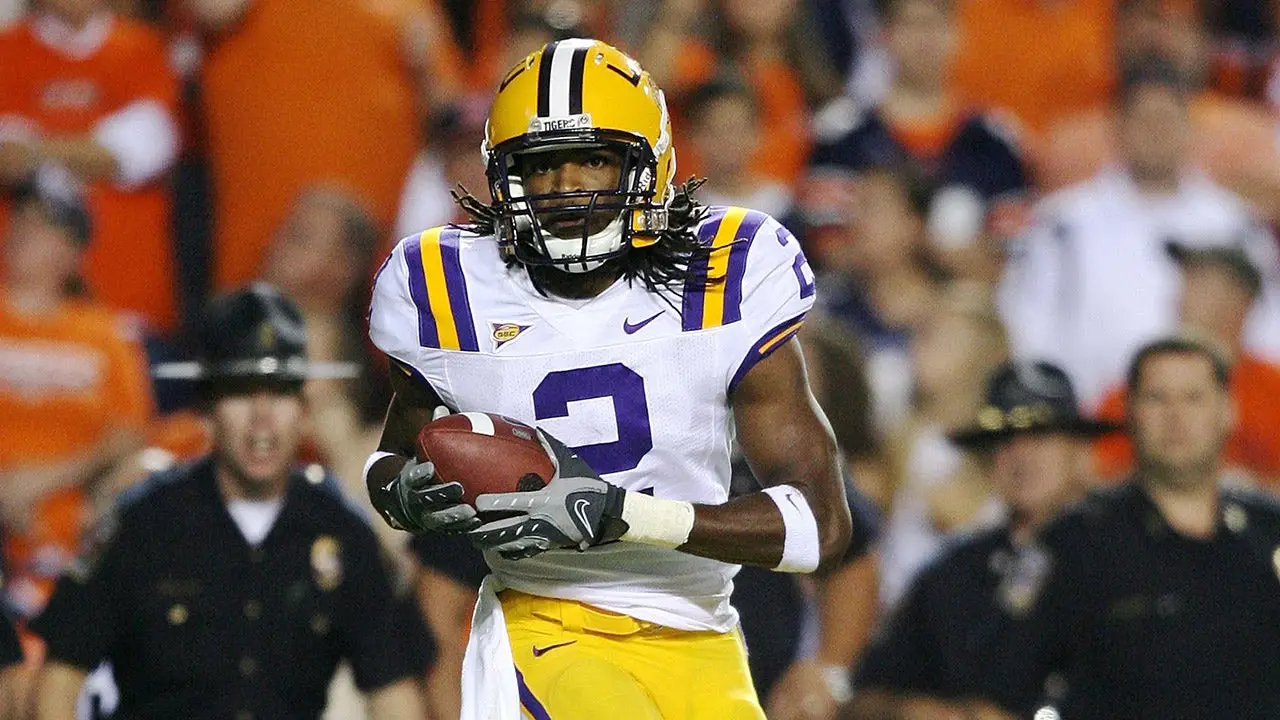
To fully understand the gravity of this tragedy and the profound sense of loss felt by those who followed his career, one must travel back to the golden autumn of the 2007 season, a period when Demetrius Byrd could do absolutely no wrong in the eyes of the purple-and-gold faithful in Baton Rouge. He was the quintessential clutch player, a target of immense reliability and explosive athleticism whose signature moment remains permanently enshrined in the history books of the Southeastern Conference. On a warm, humid October night against the rival Auburn Tigers, with the LSU squad trailing 24-23 and the clock mercilessly bleeding down to its final, desperate tick, quarterback Matt Flynn threw a high, arching 22-yard pass into the corner of the end zone, throwing caution to the wind; Byrd rose gracefully above the defenders, snatched the football out of the air with just one second remaining on the game clock, and sent Tiger Stadium into an absolute frenzy of pure, unadulterated ecstasy. That single, miraculous catch not only secured a crucial, historic victory but also propelled the LSU Tigers directly toward their ultimate destination: winning that year’s national championship, cementing Byrd’s status as an immortal figure in college football lore, beloved by a passionate fan base that fully expected to watch him dominate the professional ranks for years to come. Over his illustrious 27-game career with the Tigers, Byrd accumulated 72 receptions for 1,134 yards and 11 touchdowns, establishing a legacy of success that seemed to guarantee a long, lucrative, and celebrated career in the National Football League, where scouts eagerly anticipated his transition to the professional stage.
However, the trajectory of Byrd’s promising life was forever, catastrophically altered just one week before his dreams of playing in the National Football League were to be realized in the 2009 NFL Draft. While driving in Florida, Byrd was involved in a horrific car crash that left him in critical condition, fighting tirelessly for his basic survival in an intensive care unit rather than preparing for the celebratory phone call of a lifetime from an NFL front office. The physical toll of the accident was devastating and immediate, shattering his draft stock and causing him to plummet all the way to the seventh round, where he was eventually selected by the San Diego Chargers in a bittersweet moment of what could have been. Though he beat the immediate medical odds simply by surviving the impact and somehow finding the physical strength to sign an NFL contract, the extensive, deep-seated trauma of his physical injuries ensured that he would never actually play a single down of professional football, bringing an abrupt, heartbreaking end to an athletic journey that had seemed destined for multi-million dollar contracts and legendary status. This sudden, violent dislocation from his lifelong calling left a profound, echoing void, as the transition from an elite, high-performing athlete to a young man dealing with severe, chronic physical and psychological rehabilitation is a path fraught with immense, often invisible hurdles that society rarely prepares these young men to face. The sudden loss of identity, coupled with the lingering physical pain of a near-fatal accident, can distort a person’s sense of purpose, turning what should have been a lifetime of financial security and athletic celebration into a daily battle for emotional and physical survival.
The psychological impact of losing one’s identity so abruptly is a quiet, devastating crisis that plagues many former athletes, but it is magnified tenfold when accompanied by traumatic physical injury and public abandonment. When an individual spends their entire developmental life defined solely by their physical capacity, their speed, and their utility to a multibillion-dollar sports enterprise, the sudden, violent removal of that outlet can leave a deep, toxic emptiness that is incredibly difficult to heal or navigate. For Byrd, the trauma was double-edged: he not only had to mourn the loss of his childhood dream and the financial security that would have protected his family for generations, but he also had to navigate the physical and cognitive aftermath of a near-fatal, high-speed car crash. The medical community increasingly recognizes the long-term mental health challenges, behavioral changes, emotional instability, and potential cognitive impairments that can plague survivors of severe physical trauma and traumatic brain injuries, issues that are tragically exacerbated when a former star is left to navigate the complex, uncaring world without the rigorous schedule, elite medical care, and constant social support of a high-level athletic program. Viewed through this more compassionate and humanized lens, the disturbing events on that Miami bus cease to be merely a story of a fallen criminal, exposing instead the agonizing, slow-motion struggle of a broken man who may have spent the last fifteen years drowning in the invisible quiet of a life derailed by forces completely beyond his control.
As Demetrius Byrd sits in his jail cell, awaiting the slow, methodical wheels of the justice system to turn, his story serves as a poignant, cautionary tale about the fragile nature of human existence, the transient nature of youth, and the acute vulnerability of our cultural heroes. While the law must certainly hold individuals accountable for actions that threaten the lives and peace of innocent citizens—and the terrifying experience of the passengers on that Miami bus cannot and should not be minimized—there must also be a call for systemic empathy, comprehensive mental health support, and intensive rehabilitation rather than simple, punishment-focused disposal. True justice in Byrd’s case would not merely involve lock-and-key confinement, but rather a concerted, compassionate effort to address the deep-seated trauma, psychological scars, and neuro-cognitive issues that have undoubtedly accumulated since that fateful, catastrophic car wreck in 2009. The LSU community, along with football fans nationwide, must look past the sensationalized headlines of a mugshot and remember the young man who once flew high in the back of the end zone, realizing that the same society that cheers for these young men during their moments of athletic triumph possesses an ongoing moral obligation to care for them when they fall. Ultimately, Byrd’s current struggle is a powerful, humbling reminder that behind every fallen legend is a real, breathing human being who deserves a pathway to healing, redemption, and human dignity, long after the stadiums have emptied, the lights have dimmed, and the cheering has faded away into history.