


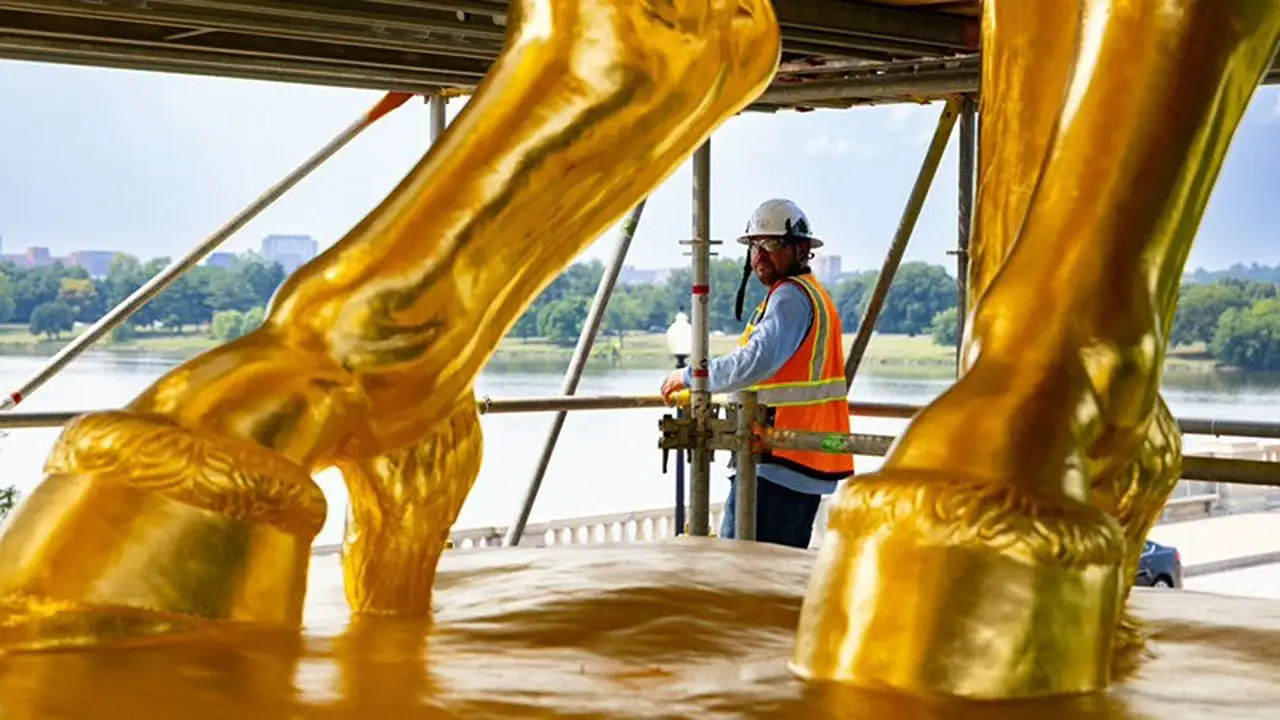
The capital city of Washington, D.C., has long served as an expansive, living canvas of collective American identity, a geographic space where stone, bronze, and gold converge to narrate the intricate stories of a nation’s historical triumphs, deep-seated struggles, and eternal aspirations. Recently, this legendary historical landscape received a breath of brilliant, dazzling new life, captured in a singular moment of striking visual transformation that was proudly shared with the global public by President Donald Trump. Taking to his social media platform, Truth Social, Trump offered the American people a first look at the spectacular, long-awaited resurgence of the iconic Arts of War sculptures, which had been hidden away for several months beneath a dense matrix of towering metal scaffolding, heavy protective tarps, and chain-link fencing. Sharing a series of photographs that showed skilled construction workers meticulously dismantling the massive, cage-like structure near the Lincoln Memorial, Trump enthusiastically celebrated the triumphant return of these newly regilded monuments, writing, “Taking down the scaffolding around the regilded Arts of War sculptures!” This dramatic revelation was soon corroborated and vividly captured by exclusive Fox News video footage, which recorded the precise moments when specialized crews carefully peeled back the final obstructing sections of steel pipes and canvas to unveil the brilliant, sun-catching gold surfaces of the colossal figures below. Situated authoritatively at the eastern entrance to the Arlington Memorial Bridge, just west of the towering Lincoln Memorial, these majestic figures of charging horses and heroic human companions seemed to emerge gracefully from their long chrysalis of public restoration, instantly revitalizing the entire scenic landscape. To the casual observer strolling past, the scene was not merely one of standard municipal maintenance, but rather a dramatic, awe-inspiring unveiling that restored a profound sense of class, history, and majesty to one of the most heavily trafficked and symbolically charged entryways into the heart of the national government, reminding everyone of the enduring beauty that waits patiently beneath the wear and tear of time.
To fully understand the deep emotional, historical, and aesthetic impact of this dramatic unveiling, one must step back in time to appreciate the origin and legacy of these monumental public works of art, which have stood as silent, heroic sentinels over the Potomac River for generations of citizens. The legendary Arts of War sculptures—consisting of two massive, beautifully detailed bronze groups individually titled Valor and Sacrifice—were originally designed by the celebrated American sculptor Leo Friedlander, whose creative vision sought to capture the complex duality of military duty and national preservation. Meanwhile, their equally striking companion pieces, known collectively as the Arts of Peace—comprising the serene paired works of Music and Harvest alongside Aspiration and Literature—were crafted by the skilled hands of sculptor James Earle Fraser and sit elegantly nearby along Parkway Drive. Erected in the mid-20th century after decades of conceptual planning, these grand monuments were deliberately designed to frame the monumental plaza linking the neoclassical Lincoln Memorial directly to the lush hills of Arlington National Cemetery, physically and symbolically representing the sacred bridge between the profound sacrifices of the nation’s fallen defenders and the ultimate triumph of democratic peace and cultural progress. Each of these extraordinary monuments features dynamic, larger-than-life gilded bronze figures mounted proudly atop massive, hand-carved Swedish granite pedestals, capturing the kinetic energy of galloping, powerful stallions and the resolute, muscular human forms that evoke classical Roman and Greek virtues of strength, honor, and civic duty. Over the past seven decades, these statues have integrated themselves into the daily visual fabric of the Washington experience, acting as a familiar, comfortingly permanent backdrop for millions of busy commuters, early-morning joggers, international tourists, and military veterans alike, though their magnificent presence is easily taken for granted in the rush of modern life until they are temporarily lost from view behind the dark, utilitarian barriers of a necessary restoration project.
Indeed, the journey to restore these masterpieces to their original mid-century luster was born out of an urgent, pressing physical emergency, as the relentless elements of nature had taken a severe toll on the precious materials over more than half a century of constant exposure to Washington’s brutal, humid summers and harsh, freezing winters. According to a detailed 2018 preservation study conducted by the renowned architects at MTFA Design for the National Park Service, the colossal monument bases had developed extensive, highly unsightly purple staining caused by decades of chemical runoff, as copper slowly self-corroded and dripped down from the aging bronze surfaces onto the porous granite pedestals. This natural chemical degradation not only severely marred the clean, dignified gray aesthetic of the granite bases but also signaled to preservationists that the protective skin of the sculptures themselves was failing, threatening the long-term structural integrity and structural preservation of the irreplaceable monuments. In direct response to this conservation crisis, the National Park Service initiated a specialized preservation endeavor that demanded a delicate, artful balance between heavy engineering and historic artistic craftsmanship. Conservators had to carefully scrub the deep-set purple stains from the granite using specialized chemical poultices, stabilize the ancient internal anchors of the heavy bronze structures, and ultimately undertake the incredibly painstaking and ancient process of regilding the entire exterior. This meticulous gilding process involves applying microscopically thin sheets of pure 24-karat gold leaf directly onto a specially prepared adhesive surface on the bronze, an intensive task requiring immense levels of patience, a steady hand, and absolute shelter from the wind, as even the slightest breeze can tear the delicate gold leaf before the artists can burnish it to the brilliant, reflective finish that now catches the morning sun.
In order to facilitate this technical and sensitive restoration process, the National Park Service had to implement strict safety, traffic, and preservation guidelines on the ground, creating a temporary environmental disruption that nonetheless served to heighten the natural curiosity of the passing public. Beginning on July 2, the conservation agency temporarily closed off the surrounding manicured green lawns and historic turf spaces immediately adjacent to the monuments to establish a safe, secure workspace for the massive truck cranes, specialized scaffolding crews, and sensitive gilding materials. While these specific ground restrictions are officially scheduled to remain in place through September 30 to allow the newly restored turf to heal and to ensure all industrial equipment is safely removed, park officials have consistently reassured the public that they intend to reopen sections of the historic parkland just as soon as the physical work no longer poses any safety risks to visitors. Remarkably, despite the sweeping scope of this delicate restoration, the agency made sure that the adjacent pedestrian sidewalks leading directly onto the bustling Memorial Bridge remained fully open, allowing thousands of curious tourists, historic preservation enthusiasts, and daily workers to observe the fascinating restoration process in real-time. Walking past the site, pedestrians were treated to a unique, close-up look at history in the making, as the metallic clatter of scaffolding poles, the gentle sweeping of workers’ brushes, and the bright, shimmering glints of newly exposed gold created a vibrant industrial symphony that contrasted beautifully with the historic, quiet dignity of the neighboring memorials. The careful logistical planning executed by the management teams ensured that vehicular traffic on the active Arlington Memorial Bridge was never disrupted, keeping the physical lifeblood of the city moving seamlessly while a vital piece of the nation’s shared cultural memory was carefully and lovingly revitalized just a few feet away from the daily commuter lanes.
Beyond the technical triumphs of historic preservation and daily urban logistics, the dramatic unveiling of the newly regilded Arts of War sculptures has carried a powerful contemporary political and cultural resonance, serving as a shining physical metaphor for civic pride, national strength, and cultural renewal during a time of self-reflection across the United States. A top official within the Trump administration enthusiastically pointed to the ongoing, sweeping cleanup and aesthetic makeover of Washington, D.C., as concrete, undeniable proof that the American republic is actively rejecting what many critics have labeled a narrative of “decline by choice,” choosing instead to invest in the dignity and preservation of its most iconic public spaces. This impassioned sentiment of cultural and aesthetic restoration is particularly meaningful and well-timed as the nation rapidly approaches its 250th anniversary, the landmark Semiquincentennial celebration set to occur in 2026, an upcoming historical milestone that has elevated the preservation of national monuments to a matter of great cultural urgency and patriotic pride. Within this grand, historic context, the gleaming golden horses of the Arts of War find an even deeper modern purpose; they stand not merely as beautiful museum pieces of a bygone artistic era, but as active, glittering symbols of a self-confident society that is actively preparing to honor its rich historical past with a renewed sense of public pride, structural beauty, and global leadership. By sharing the stunning progress of this physical transformation directly with the public on social media, Donald Trump and his administrative team have successfully framed the physical shining of the capital’s monuments as an act of profound cultural rejuvenation, passionately suggesting that by polishing the iconic symbols of our historical foundation, we simultaneously polish the national spirit, reject societal cynicism, and boldly reaffirm our collective commitment to the enduring ideals of valor, sacrifice, and peace that these grand statues represent.
As the last of the towering metal scaffolding is dismantled piece by piece and the protective tarps are finally folded away into storage, the magnificent Arts of War sculptures stand fully and proudly revealed to the world once more, their radiant, pristine gold surfaces serving as a brilliant, glowing beacon across the neoclassical landscape of the nation’s capital. This long-awaited visual transformation is nothing short of breathtaking, as the meticulously restored statues now catch the shifting, glorious light of the mid-Atlantic sky, casting a warm, heroic, and inspiring glow across the busy entrance to the Arlington Memorial Bridge and offering a message of hope and grandeur to all who travel into Washington. By choosing to dedicate the precise artistry, financial resources, and physical labor required to rescue these towering creations from the slow, destructive erosion of pollution and time, the restoration project has successfully secured the future of a vital piece of the American story, ensuring that future generations of visitors will stand in absolute awe beneath their golden wings. The dramatic, stark contrast between the dull, purple-stained bronze of the past few decades and the brilliant, blindingly bright gold of today serves as an enduring reminder that history is never a dormant, static thing; it is a living legacy that requires active, passionate caretakers, dedicated defenders, and a robust collective will to prevent its brilliance from fading into the shadows of neglect. As the last of the heavy machinery and orange safety barrels are cleared from the Parkway Drive lawns, the Arts of War and Arts of Peace stand ready to continue their silent, majestic vigil over the Potomac, forever bridging the geographical space between the final resting places of our national heroes and the eternal chamber of the Great Emancipator, shimmering proudly under the vast American sky as an enduring, beautiful testament to what can be accomplished when a great country chooses to polish, protect, and cherish its most sacred public monuments.