


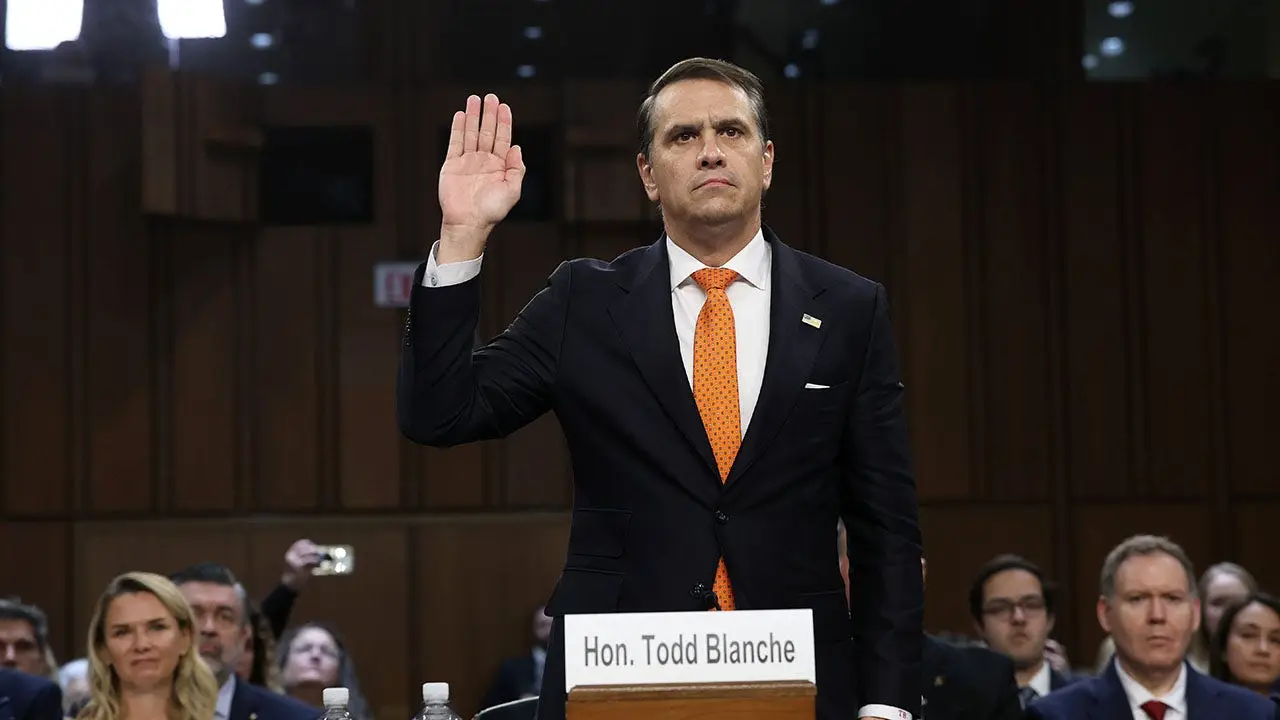
Acting Attorney General Todd Blanche recently faced an intense, grueling second day of Senate confirmation hearings. His journey to securing the nation’s top law enforcement job has become increasingly complicated, transforming what could have been a straightforward political appointment into a high-stakes legislative drama. Despite his extensive legal background, Blanche’s close association with Donald Trump and past decisions have placed his nomination under a microscope, turning the Senate Judiciary Committee room into a stage of sharp questioning and political maneuvering. For Blanche, this is no longer just a routine vetting process; it is a profound test of his professional integrity and his ability to convince a deeply divided Senate that he can lead the Department of Justice with absolute independence.
The most critical hurdle standing between Blanche and his confirmation is not the predictable opposition from Democrats, but rather the cautious reluctance of two influential Republican senators: Thom Tillis of North Carolina and John Cornyn of Texas. Because of the Senate’s tight party margins, these two lawmakers hold the keys to his political future, and neither has been willing to offer a premature stamp of approval. Their primary concern revolves around a controversial, now-defunct $1.8 billion “anti-weaponization fund” established under a previous IRS settlement. This massive fund, designed during the Trump administration to compensate individuals claiming to be victims of government overreach, is viewed by critics as a politically motivated slush fund. While Blanche testified that the settlement remains technically enforceable but is not currently moving forward, both Tillis and Cornyn are demanding absolute certainty that this fund is permanently dead before they cast their deciding votes.
During the hearings, Senator Cornyn remained notably noncommittal, emphasizing that he is in no rush to make a final decision while information is still being gathered and evaluated. The Texas senator also carefully observed a particularly tense moment during the testimony when Blanche accidentally referred to himself as the president’s current lawyer before quickly correcting himself to state that he is now the deputy attorney general. Cornyn remarked that Blanche is attempting to “walk a very difficult line” between demonstrating loyalty to the president who nominated him and proving to the public that he can run an impartial Justice Department. Meanwhile, Senator Tillis has focused his attention on securing a legislative solution to dismantle the controversial fund permanently. He found a glimmer of hope when Blanche agreed to work on legislation to end the fund for good, suggesting that the administration might finally be willing to leave this contentious issue behind.
Unsurprisingly, Senate Democrats have united in fierce opposition against Blanche, mounting a passionate and relentless campaign to sink his nomination. Leading the charge, Senator Dick Durbin of Illinois delivered a blistering critique, arguing that anyone who could legally represent Donald Trump is fundamentally unfit for public service. Durbin launched a barrage of questions regarding the Justice Department’s handling of millions of documents related to the late, convicted sex offender Jeffrey Epstein, demanding to know if Blanche would commit to meeting personally with Epstein’s survivors. The emotional weight of the Epstein investigation, combined with the partisan anger surrounding Trump’s broader legal battles, has energized the opposition, centering the debate on whether Blanche possesses the moral independence required to serve as the nation’s chief law enforcement officer.
Adding to the opposition, Senator Chris Coons of Delaware acknowledged Blanche’s basic technical qualifications as a former prosecutor but argued that his legal expertise makes his actions even more concerning. Coons expressed deep worry that Blanche would allow the Department of Justice to be transformed into a personal tool of political retribution for Donald Trump, rather than an objective institution dedicated to the rule of law. This fear of a weaponized Justice Department remains a central theme for Democrats, who argue that Blanche’s history as Trump’s personal defense attorney makes it impossible for him to separate his past loyalty to his client from his constitutional duty to the American people.
As the confirmation hearings draw to a close, Todd Blanche finds himself in a delicate political limbo, waiting for a definitive sign of support from the Republican holdouts who hold his fate in their hands. The intense scrutiny has highlighted the deep-seated anxieties in Washington regarding the independence of the federal judiciary and the executive branch. Whether Blanche can successfully navigate this political minefield and secure his confirmation remains to be seen. However, one thing is abundantly clear: his path to becoming the next Attorney General will require him to continuously prove that his ultimate allegiance belongs to the United States Constitution, rather than to any single political figure.