



For the first time in nearly a thousand years, a true masterpiece of medieval craftsmanship has crossed the English Channel to return to its birthplace. The legendary Bayeux Tapestry—a colossal, 230-foot embroidered marvel originally stitched in 11th-century England before spending centuries in Normandy, France—was quietly transported to the British Museum during a highly classified overnight operation. The British Museum’s director, Nick Cullinan, alongside the French ambassador, watched in awe as the massive crate arrived safely, marking a historic homecoming for an artifact that serves as a vital bridge between two nations. This monumental loan, which preserves a shared heritage, has reignited global fascination with a work of art that is as culturally significant as it is surprisingly cheeky.
Beyond its artistic grandeur, the tapestry is a vivid, 58-scene graphic novel of the Middle Ages, chronicling the dramatic events leading up to the historic Battle of Hastings and the Norman Conquest of 1066. This pivotal moment in history didn’t just crown William the Conqueror; it completely dismantled the Anglo-Saxon ruling class, radically reshaped the English language with heavy French influences, and permanently bound the destinies of England and France. Yet, while historians have spent centuries analyzing the geopolitical fallout of this invasion, a much cheekier and entirely different kind of debate has occupied the minds of scholars for decades: a meticulous, lighthearted count of the tapestry’s surprisingly numerous depicted phalluses.
This X-rated game of “I Spy” has sparked a hilarious and surprisingly academic rivalry among medievalists. The debate kicked off in earnest in 2018 when Oxford University’s Professor George Garnett proudly claimed to be the very first scholar to officially tally the tapestry’s hidden anatomical details. His initial count stood at 93, a total that included five human members and an astonishing 88 equine ones, with William the Conqueror’s own warhorse boasting the most impressively sized appendage of the herd. Garnett’s playful bragging about being the unrivaled pioneer of medieval phallus-counting stood unchallenged for five years, treating the public to a delightfully humanizing look at how modern academics engage with ancient art.
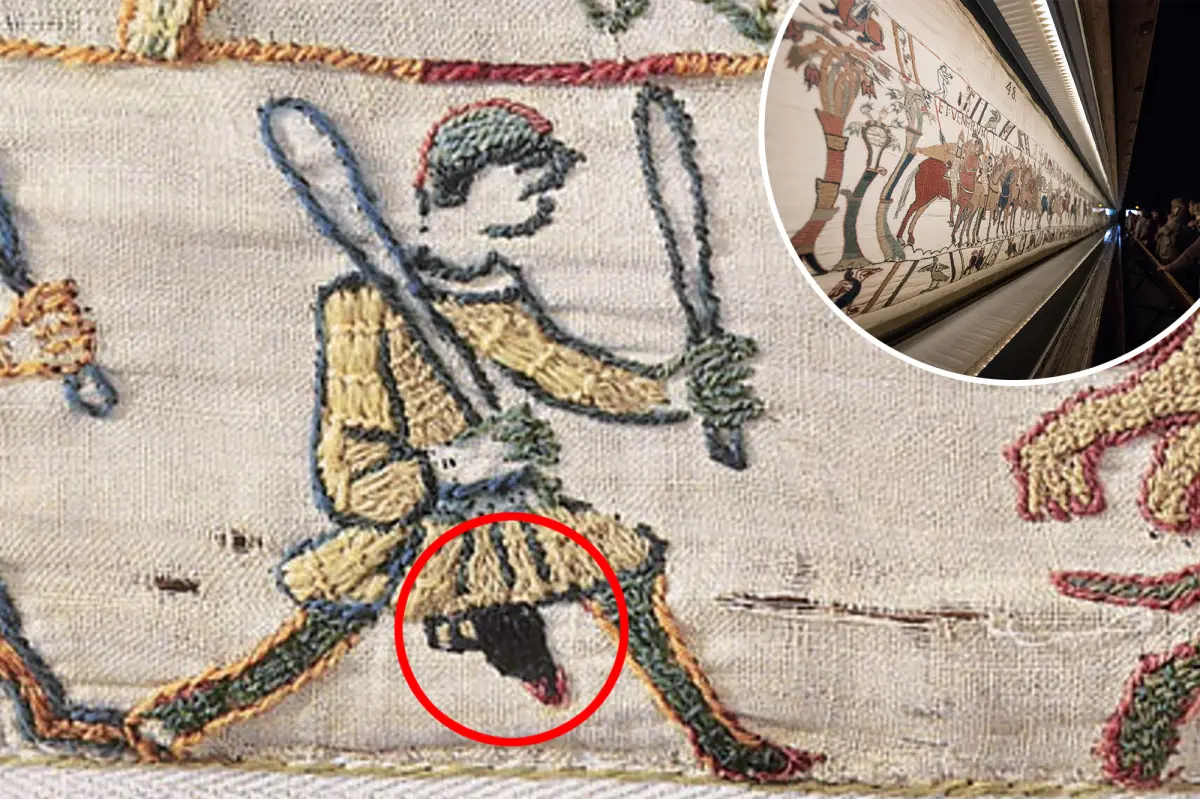
However, intellectual rivalries are fierce, even when they concern millennium-old embroidery. Last year, Anglo-Saxon nudity expert Dr. Christopher Monk challenged Garnett’s findings, claiming to have discovered a missed ninety-fourth penis belonging to a running man in a tunic, describing the newly spotted detail as surprisingly lifelike and anatomically complete. Garnett quickly fired back, defending his original count of 93 by arguing that Monk’s “discovery” was actually just a dagger’s scabbard, pointing to a yellow, brass-like blob at the tip that is entirely absent from the tapestry’s undeniable anatomical depictions. This spirited back-and-forth captured the attention of history enthusiasts worldwide, highlighting the wonderfully bizarre arguments that can arise from studying history so closely.
Naturally, this abundance of explicit details begs the question of why 11th-century embroiderers felt compelled to include them in a solemn tale of war and political conquest. Historians have floated several theories, ranging from simple medieval humor reminiscent of bathroom stall graffiti to more sophisticated artistic choices. Some believe these graphic details acted as a form of subversive, silent commentary meant to critique the morals, greed, or ethics of the historical figures depicted. Others suggest they might be clever, hidden nods to the moral lessons found in Aesop’s fables, proving that this ancient, embroidered masterpiece is a deeply layered riddle designed to entertain and challenge viewers for generations.
Ultimately, the return of the Bayeux Tapestry is a massive win for public history, allowing millions to appreciate both its profound cultural weight and its quirky, human details. On display at the British Museum from September until July 2027, the exhibition has already experienced an unprecedented wave of excitement, shattering records by selling over 100,000 tickets for its first four months alone. Nearly a thousand years after its threads were meticulously hand-spun, this legendary artwork continues to captivate, educate, and amuse us, reminding the world that even the grandest historical narratives are woven with a very healthy dose of human spirit, humor, and charm.