


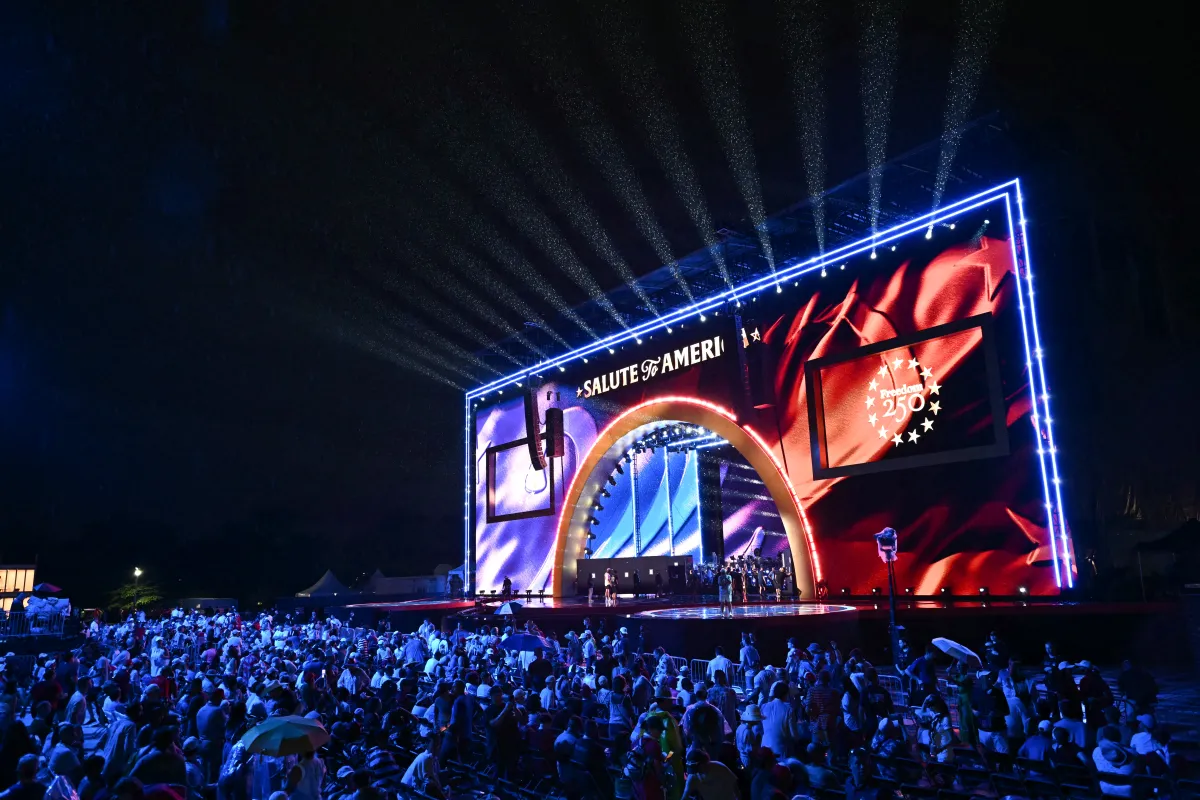
On a stormy Saturday night in Washington, D.C., the National Mall transformed into a stage of political imagery and high drama. As severe weather threatened to wash out the annual Fourth of July celebrations, many attendees packed up and headed home. Yet, in true showman fashion, President Donald Trump took to the podium late in the evening around 11:00 p.m. to address a resilient crowd that had hastily gathered after the evacuation orders were lifted. Clad in patriotic colors of red, white, and blue, the remaining spectators filled nearly every seat at ground level and occupied a significant portion of the bleachers. Amidst the sea of waving flags and banners, Trump claimed that prior to the storm-induced evacuation, the Mall had harbored upwards of 375,000 people. While news outlets could not immediately verify this staggering figure, the visual of a dedicated, cheering crowd standing in the damp night air served as a reminder of Trump’s ongoing fixation with crowd sizes—a topic that has frequently been a flashpoint of political debate and comparison with his rivals.
This latest gathering instantly reignited the long-running national debate over how presidential events are attended and measured. Comparing Independence Day crowds across different administrations is a complex task because presidents approach the holiday through vastly different lenses. While Trump has historically favored massive, open-access public spectacles, his predecessors, Barack Obama and Joe Biden, preferred more intimate, highly structured gatherings. For instance, former President Barack Obama’s Fourth of July celebrations were typically hosted on the South Lawn of the White House, serving primarily as a tribute to military families and invited guests. In 2016, Obama noted that organizers had planned for a cozy crowd of approximately 5,000 people for the annual concert. President Joe Biden largely maintained this tradition of exclusive, military-centric events, remarking during his 2024 White House celebration that several thousand guests were in attendance, keeping the scale focused on personal gratitude rather than public scale.
The stark contrast in event styles explains why standardizing these numbers is virtually impossible. While Biden and Obama kept their circles small, Trump’s Independence Day events have routinely pushed the boundaries of venue capacity. Even in 2020, during the height of the COVID-19 pandemic, Trump’s speech at Mount Rushmore drew an estimated 7,500 people, marking one of the few clearly documented figures from recent years. The benchmark for his public celebrations remains the 2019 “Salute to America” on the National Mall, where he became the first president in decades to deliver a major holiday address from the Lincoln Memorial, complete with military flyovers. However, finding hard facts to support any side is difficult because the National Park Service no longer issues official crowd estimates for Mall events. Without official data, researchers are left to piece together clues, such as Washington’s Metro system recording over 400,000 rider trips that day, or the Pentagon distributing 5,000 tickets to military personnel, leaving final tallies forever open to partisan interpretation.
As the nation looks forward, these patriotic celebrations are taking on a grander scale in anticipation of “America250,” the official national commemoration of the 250th anniversary of the signing of the Declaration of Independence. Established by a bipartisan congressional act in 2016, the America250 Commission was designed to coordinate nationwide events, educational programs, and public exhibits to honor the country’s semiquincentennial. Over the years, the planning has evolved into a multi-organizational effort, reflecting different political visions for how the milestone should be celebrated. Alongside the official congressional commission, the Trump administration established a parallel initiative called “Freedom 250” to plan and execute large-scale, federally funded public events. Today, this dual-track planning has resulted in a tapestry of federal, state, local, and nonprofit groups organizing overlapping activities to mark the country’s historic birthday.
One of the most highly anticipated, yet controversial, centerpieces of this anniversary is the Great American State Fair on the National Mall. Originally envisioned as a massive, unified showcase featuring representation from all fifty states and U.S. territories, the fair recently had to adjust its ambitious format. Several state governments quietly declined to send official delegations, with some state officials citing high travel costs, while others expressed concerns that the state fair had become too politically polarized. To adapt to these absences, organizers shifted their strategy, relying heavily on private corporate partners, independent exhibits, and a smaller coalition of participating states. Despite these logistical hurdles, the fair remains a premier attraction of the anniversary year, running as a 16-day interactive expo.
Despite the political friction and planning adjustments, organizers are determined to make the Great American State Fair an unforgettable tribute to the American spirit. The sprawling 16-day event features state-themed pavilions, rich cultural exhibits, live musical performances, and historic military displays spread across the National Mall between the U.S. Capitol and the Washington Monument. It serves as an educational and entertaining hub designed to remind visitors of the diverse fabric of the nation. As America moves closer to its 250th milestone, these events highlight a enduring truth: while the country may often find itself divided over politics, crowd sizes, and logistical debates, the collective desire to gather, celebrate, and reflect on the American journey remains as powerful as ever.