

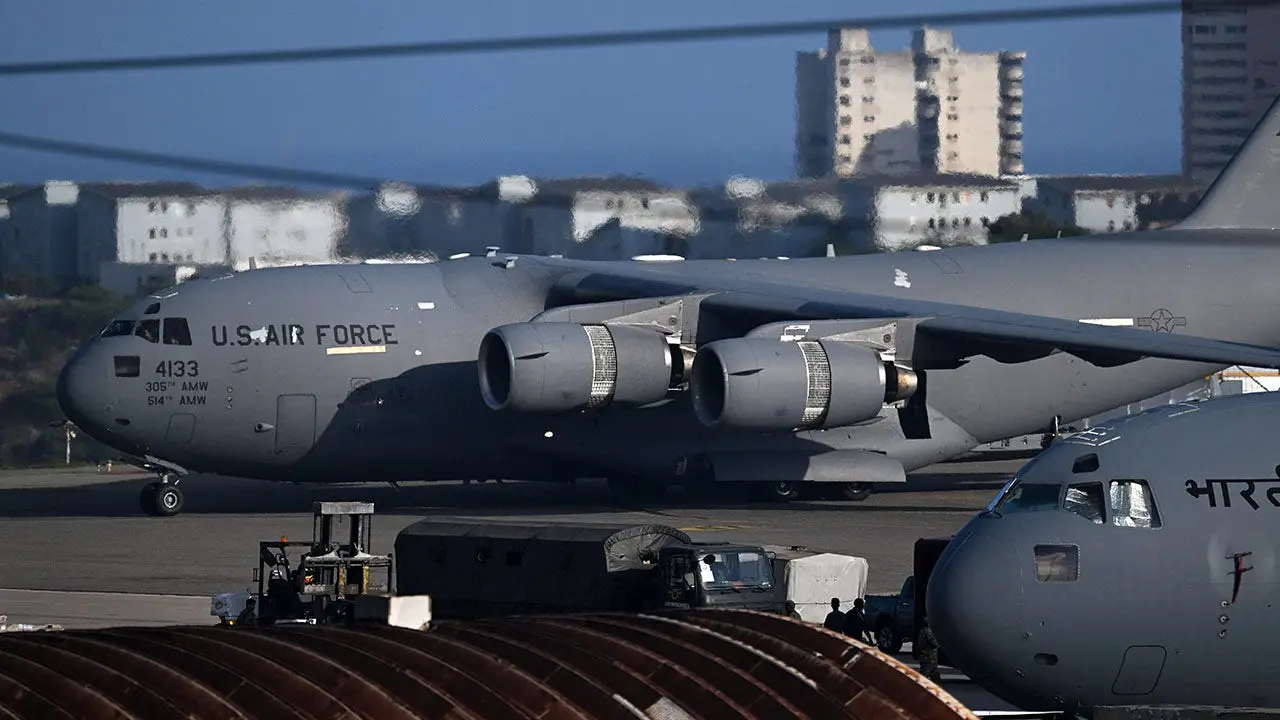
In the wake of the devastating 7.2 and 7.5 magnitude earthquakes that recently struck Venezuela, the U.S. military has rapidly intensified its compassionate relief efforts to support a grieving nation. On Friday, a U.S. Air Force C-17 Globemaster cargo aircraft touched down to deliver the last of ten U.S. Marine Corps Medium Tactical Vehicle Replacements (MTVRs). These rugged, highly capable transport vehicles—which have historically proven their mettle in challenging environments like Iraq and Afghanistan—are now being redeployed for a far more peaceful and urgent mission. Operating under the direction of U.S. Southern Command (SOUTHCOM), the MTVR crews are tasked with navigating damaged infrastructure to transport urgently needed supplies directly into the heart of devastated local communities.
This vital logistics network is being orchestrated on the ground at Caracas’s Simón Bolívar International Airport, where the U.S. military’s Humanitarian Assistance Coordination Center (HACC) has established a bustling hub of operations. Here, service members are working hand-in-hand with local Venezuelan authorities, the U.S. State Department, and various international aid agencies to ensure that help reaches those who need it most without delay. The atmosphere is one of intense collaboration and shared humanity, with personnel working around the clock to organize incoming cargo, coordinate medical dispatches, and manage the complex logistics of a large-scale disaster response.
To bypass collapsed roads and reach isolated mountainous regions, a diverse fleet of Marine, Navy, and Army vertical-lift and rotary-wing aircraft has been mobilized. These helicopters are performing continuous airlift and transport flights, carrying critical payloads of pre-packaged, self-contained meals to sustain survivors who have lost everything. Meanwhile, just off the coast, the USS Fort Lauderdale remains anchored at the Port of La Guaira. The massive naval vessel is serving as a critical lifeline, anchoring local communication networks and functioning as a floating command and distribution center to coordinate the flow of life-saving resources from sea to land.
This mobilization of military assets is part of a broader, compassionate $150 million humanitarian aid package deployed to support the South American nation during its darkest hour. Alongside financial and material aid, a specialized Disaster Assistance Response Team of more than 250 highly trained personnel has been deployed to the ground. This team includes three elite Urban Search-and-Rescue units, whose members are trained to find signs of life amidst the wreckage. Their presence offers a glimmer of hope to families waiting desperately for news of their missing loved ones.
The sheer scale of the tragedy continues to weigh heavily on both the survivors and the responders, as the official death toll has tragically climbed to nearly 2,000 people and is expected to rise further. Amidst the grim statistics are deeply personal stories of profound loss and miraculous survival that have touched hearts worldwide. Newspapers have reported on the devastating loss of Argentine soccer player Lucas Trejo, who tragically lost his wife and two children in a building collapse. Yet, amidst such overwhelming sorrow, moments of pure hope sustain the rescuers—such as the miraculous rescue of a two-year-old boy who was pulled alive from the rubble six days after the twin quakes.
As the search-and-rescue phase transitionally shifts towards long-term recovery and sustenance, the joint efforts of the U.S. military, local volunteers, and international agencies stand as a testament to global solidarity. The road to recovery for Venezuela will undoubtedly be long and fraught with emotional and physical challenges. However, the presence of these dedicated relief teams, coupled with the steady delivery of food, shelter, and medical supplies, ensures that the survivors of this historic natural disaster will not have to rebuild their lives alone.