


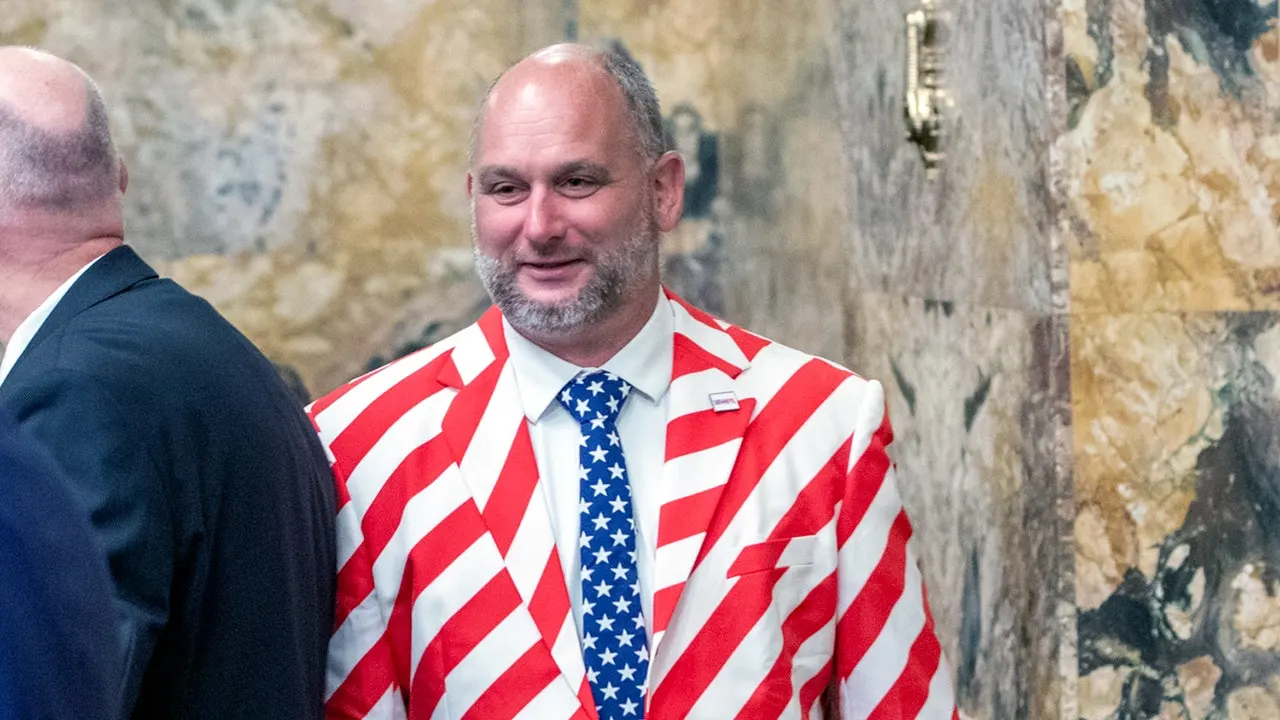
The morning light filtering through the towering, stained-glass windows of the historic Pennsylvania State Capitol in Harrisburg usually illuminates a room filled with quiet legislative preparation, but on a recent Tuesday, it shone on a political firestorm sparked by a simple suit of clothes. Representative Eric Davanzo, a Republican representing a hardworking, postindustrial region of Westmoreland County that stretches between Pittsburgh and Greensburg, walked onto the House floor wearing his patriotism on his sleeve—literally. In anticipation of the nation’s upcoming semiquincentennial, Davanzo had donned a vibrant, eye-catching suit emblazoned with a bold red, white, and blue motif, anchored by a matching star-spangled tie. For Davanzo, the outfit was personal; born in the historic American Bicentennial year of 1976, he is a self-described “Bicentennial Baby” who takes immense pride in his roots and his country’s history as it approaches its 250th birthday. Pennsylvania, the very cradle of American liberty where the Declaration of Independence was drafted and signed, is currently a highly polarized swing state, boasting a divided government where Democratic Governor Josh Shapiro shares power with a Republican-controlled Senate and a Democratic-led House holding a razor-thin, one-seat majority. This fragile political ecosystem, overseen by Democratic House Speaker Joanna McClinton of Southwest Philadelphia, is always one spark away from a partisan flare-up. Davanzo’s arrival in his patriotic regalia was intended to be a cheerful nod to the state’s central role in the nation’s founding, but as he chatted warmly with colleagues and posed for a house photographer, he was entirely unaware that his choice of attire had painted a target on his back, setting the stage for an unprecedented confrontation that would highlight the deep cultural and political fractures currently dividing the Keystone State.
The breezy pleasantries of the legislative morning were abruptly cut short while Davanzo was standing near the back of the chamber, casually conversing with House Minority Whip Timothy O’Neal. After a legislative photographer captured a snapshot of the striking ensemble, O’Neal was suddenly called away by a member of the leadership staff, leaving Davanzo alone for a few moments. When O’Neal returned, the jovial expression on his face had completely vanished, replaced by an uneasy look of dread as he signaled that trouble was brewing. O’Neal pulled Davanzo aside and delivered a message that left the Westmoreland County representative in absolute disbelief: Speaker McClinton had formally flagged his outfit as a violation of House decorum and wanted him to change. Davanzo’s initial reaction was one of sheer shock, asking if it was a joke, but the severity of the situation became undeniably clear when a House security guard approached his desk. The guard, acting on direct orders from the Speaker’s dais, presented Davanzo with a stark ultimatum—either strip off the red, white, and blue jacket immediately or exit the chamber entirely. Refusing to strip away his display of national pride under pressure, Davanzo decided that walking off the House floor in protest was the only honorable course of action, a dramatic exit that left many in the room stunned. Interestingly, the heavy-handed decision by Democratic leadership did not reflect the attitudes of all the party’s members; after the incident, several Democratic lawmakers privately approached Davanzo to voice their disapproval of his ejection, recalling how Representative Jordan Davis of Philadelphia had earlier praised the outfit as a beautiful, patriotic tribute, revealing a widening gap between rigid party leadership and the everyday camaraderie shared by rank-and-file legislators.
For Davanzo, the sudden enforcement of a strict dress code felt like a glaring manifestation of political hypocrisy, particularly given the chamber’s recent history of embracing highly expressive, untraditional clothing when it aligned with specific social causes. Just weeks prior, during Pride Month in June, House leadership had actively encouraged members to dress in vibrant, pride-themed colors for an official group photograph taken directly on the House floor. Davanzo pointed out this stark contrast with burning frustration, quoting from Speaker McClinton’s own public statements regarding Pride Month, which championed the progressive ideals of allowing individuals to “authentically exist” and “love freely.” In Davanzo’s view, it was a profound irony that the leadership would zealously protect the right to express personal identity while simultaneously banning the red, white, and blue colors of the American flag—the very symbol of the nation whose brave service members died to secure those freedoms of self-expression in the first place. He argued that the chamber’s modern dress code has become highly arbitrary, noting that lawmakers are routinely permitted to walk the floor wearing casual tennis shoes, eccentric top hats, and rugged camouflage jackets without facing any disciplinary action or threat of removal. By singling out a suit designed to honor the nation’s founding, Davanzo believed the Democratic leadership had exposed a troubling double standard that prioritizes progressive social symbols over foundational national ones, suggesting that patriotism is now treated by some as a provocative political statement rather than a unifying American value. This arbitrary gatekeeping of expression, he asserted, alienates everyday Pennsylvanians who view the flag not as a partisan badge, but as a shared heritage. During his media appearances following the incident, Davanzo held up his colorful jacket as a symbol of defiance against a political class that he believes has lost touch with the humble, patriotic sentiments of the middle-class communities he represents in the western half of the commonwealth.
The bitter dispute over Davanzo’s attire unfolds against a much larger, highly anticipated backdrop as Pennsylvania and the wider nation prepare to celebrate the fast-approaching semiquincentennial of the United States. With the 250th anniversary of the signing of the Declaration of Independence just around the corner, both state and national leaders are scrambling to showcase their patriotic fervor through various public initiatives. At the federal level, the Trump administration has already begun laying the groundwork to showcase the “Great American State Fair,” a massive, nationwide celebration of American exceptionalism and agricultural heritage. Closer to home, Governor Josh Shapiro’s administration is heavily promoting “America250PA,” a sweeping, statewide initiative designed to bring concerts, historical exhibitions, and community fairs to every corner of the commonwealth, stretching all the way from the industrial hubs of Pittsburgh to the valleys of Wilkes-Barre. As a native Pennsylvanian born in 1976—the nation’s Bicentennial year—Davanzo feels a deep, visceral connection to these milestone celebrations, viewing his very existence as intertwined with the modern history of the republic. Pennsylvania occupies a sacred place in the American story, as it was in Philadelphia, just 250 miles east of Davanzo’s home district, where the founding fathers gathered two and a half centuries ago to forge a new nation. For Davanzo, wearing the patriotic suit was a natural extension of this collective celebration, an attempt to bring a piece of that historic pride from the eastern halls of Philadelphia and the western valleys of Westmoreland directly into the legislative heart of the state, making his sudden ejection feel like an insult not just to him, but to the rich historical legacy that Pennsylvanians of all political persuasions are preparing to commemorate. He expressed a desire to see the state unified under one banner as the countdown to July 4th, 2026, begins, lamenting that a milestone meant to bridge divides is instead being bogged down by petty Capitol gatekeeping. As he plans his own milestone fiftieth birthday in tandem with the nation’s 250th, the representative remains determined to keep the focus on America’s achievements rather than the political discord.
Beyond his love for patriotic fashion, Davanzo’s political identity is defined by a fierce commitment to the principles of his constituents back home in Westmoreland County, a region that has suffered the painful economic sting of deindustrialization but retains a resilient, patriotic spirit. As the leader of the State House “America First Caucus,” Davanzo has dedicated his legislative career to policies aimed at bringing back manufacturing jobs to the postindustrial towns of the Keystone State, rebuilding local economies, and strengthening community safety. His legislative agenda features bold, populist measures, including controversial proposals such as implementing an automatic death penalty for undocumented immigrants convicted of murdering Pennsylvania citizens. To mark the nation’s upcoming milestone, Davanzo even introduced a bill that would distribute $250 celebratory checks to every single household in Pennsylvania, a practical, financial gesture designed to help struggling families participate in the spirit of the semiquincentennial. He believes that true patriotism is not just about wearing the flag, but about actively passing legislation that improves the daily lives of the hardworking families who keep the state running. His legislative efforts, which he champions with the same unapologetic energy as his patriotic suit, are geared toward restoring a sense of pride and prosperity to communities that feel forgotten by the metropolitan political machines of Philadelphia and Pittsburgh, representing a grassroots ideology that refuses to apologize for putting American workers and American heritage at the very center of the political conversation. This legislative philosophy is deeply reflective of Westmoreland County’s blue-collar roots, where families place a high premium on faith, flag, and hard work. For Davanzo, the $250 check proposal was a way to ground a historical milestone in tangible economic relief, ensuring that the semiquincentennial is not just an elite celebration for politicians in suits, but a meaningful moment of appreciation for everyday citizens. His actions in the legislature, whether fighting for local manufacturers or wearing his heart on his sleeve, stem from a singular desire to champion the identity of the people who elected him, standing firm against what he calls a detached political establishment.
Ultimately, the dramatic confrontation on the Pennsylvania House floor serves as a poignant microcosm of the broader cultural and political tensions currently pulling at the fabric of American society. What should have been a simple, lighthearted moment of patriotic expression instead morphed into an ideological battleground, revealing how even the nation’s most foundational symbols can become weaponized in a hyper-partisan era. Sitting down for a follow-up interview with the media while proudly wearing the exact same red, white, and blue suit that caused his ejection, Davanzo remained entirely unrepentant, asking a fundamental question that resonates far beyond the walls of the Harrisburg Capitol: “What is so wrong with what I have on?” His steadfast refusal to apologize or back down highlights a growing national weariness with political correctness and perceived double standards, as millions of Americans watch traditional values clash with modern progressive sensibilities. As Pennsylvania gears up to play host to the world during the 2026 semiquincentennial, this incident serves as a stark reminder of the challenges that lie ahead in uniting a deeply divided populace. Yet, despite the bitterness of the dispute, Davanzo’s unwavering pride in his country and his refusal to silence his patriotism offers a compelling testament to the enduring power of the American spirit, proving that while leaders may squabble over the rules of decorum, the passion for the red, white, and blue remains an unbreakable force in the hearts of those who call the Keystone State home. This saga underscores the idea that patriotism is not a relic of the past to be hidden away in a closet, but a living, breathing sentiment that deserves a seat at the table. As the nation marches toward its historic milestone, the hope remains that the shared heritage of freedom can eventually transcend the partisan bickering of the present day, allowing all Americans to celebrate their history together, with or without a colorful suit. For Davanzo, the path forward is clear: he will continue to wear his colors proudly, reminding his colleagues and his constituents that the struggle for the American dream is always worth standing up for, even if it means getting kicked out of the room.