


The journey of the United States Men’s National Soccer Team has always been characterized by a quiet, persistent yearning for respect on the global stage. On a cool, electric Wednesday night in Santa Clara, California, that yearning transformed into a statement of historic proportions. With a hard-fought 2-0 victory over a resilient Bosnia and Herzegovina side, the USMNT secured their coveted ticket to the Round of 16, marking only the second time in the modern era of American soccer that the team has navigated the treacherous waters of the World Cup knockout rounds. To trace the lineage of this achievement, one must travel back more than two decades to the legendary 2002 tournament, where a historic victory over arch-rivals Mexico stood as the sole monument of American knockout success. Now, a new chapter is being written. The road ahead leads the Americans back to the Pacific Northwest, where an eager, raucous crowd in Seattle awaits a heavyweight clash against a formidable Belgium squad—a team that proved their own mettle by clawing their way back from a dramatic two-goal deficit against Senegal. For decades, the narrative surrounding the American squad in tournament play was one of the plucky, hyper-athletic underdog, a group of scrappy players hoping to grind out a surprising upset through sheer willpower. Yet, under the bright lights of this expanded tournament format, on their own home soil, the emotional landscape had fundamentally shifted; the Americans were no longer the hunters, but the hunted, carrying the heavy, unfamiliar mantle of overwhelming pre-match favorites.
The match began not with the elegant, dominant display the sold-out San Francisco Bay Area Stadium crowd had anticipated, but with a sudden, throat-clearing gasp of vulnerability. Bosnia and Herzegovina, playing with the dangerous freedom of a team with nothing to lose, immediately forced the issue, earning a sequence of dangerous corner kicks that tested the nerves of a tense American backline. Step forward Matt Freese, the American goalkeeper whose tournament thus far had been largely defined by quiet observation and comfortable distribution. Suddenly thrust into the crucible of high-stakes action, Freese was forced to make a desperate, acrobatic scramble, punching away a goal-bound effort that would have completely altered the psychological trajectory of the match. Having survived this early scare, the USMNT gradually asserted their authority, orchestrating waves of attack that felt less like a question of if they would score, and more a question of when. The breakthrough seemed to arrive in the 29th minute when Folarin Balogun, the clinical talisman of this American campaign, expertly latched onto a defensive turnover and calmly slotted the ball home. The stadium erupted, only for the ecstatic roar to be abruptly silenced by the assistant referee’s upright flag. Replays confirmed a clear offside position, a decision met not with furious protest from head coach Mauricio Pochettino, but with a collective, disciplined reset from a team that knew their moment would come again.
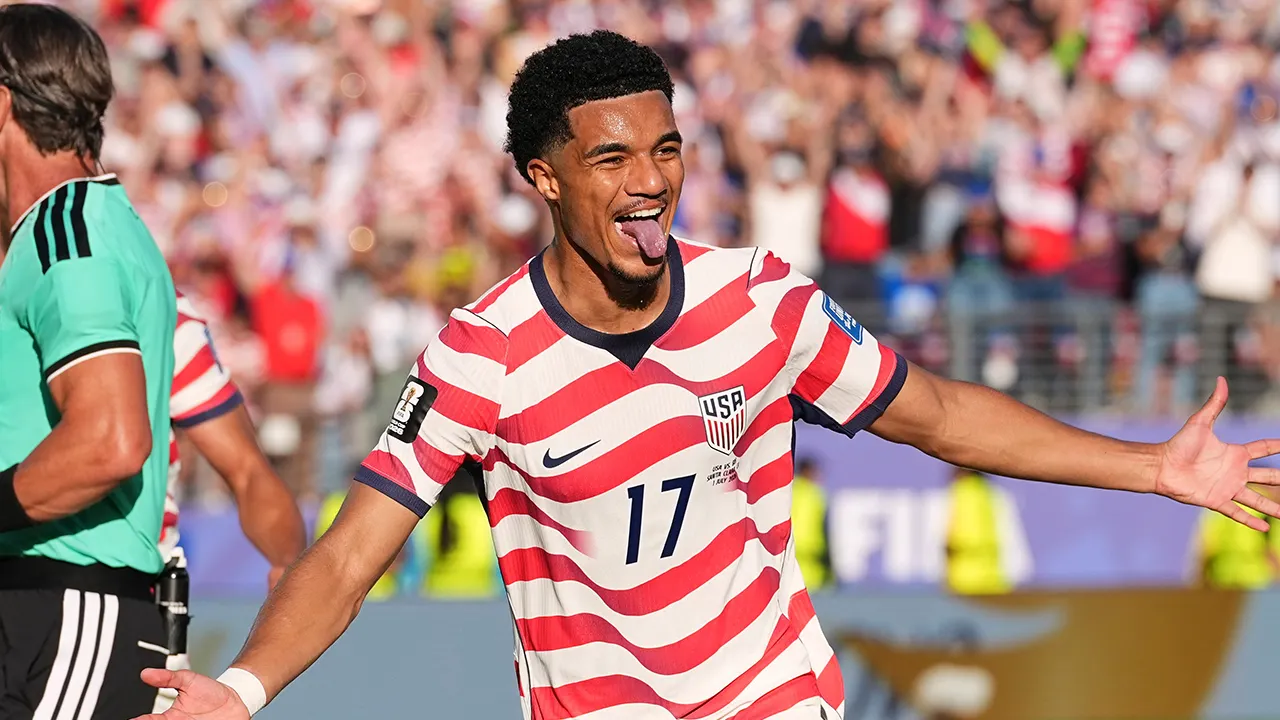
That moment of redemption materialized in the dying embers of first-half stoppage time, courtesy of Balogun’s sheer, unyielding predatory instinct inside the penalty box. Surrounded by a dense thicket of Bosnian defenders who tried desperately to suffocate his space, the young striker showcased the elite physical presence and technical poise that has made him one of the most exciting young talents in global football. With back to goal, Balogun pivoted elegantly, shielding the ball with his body before unleashing a low, lethal left-footed strike that slipped directly through the goalkeeper’s legs and into the back of the net. The stadium dissolved into absolute pandemonium, an outpouring of collective relief and joy that Balogun met with a charismatic nod to American sports culture, performing NBA superstar LeBron James’s iconic “The Silencer” celebration as his teammates swarmed him. This moment of pure sporting theater sent the USMNT into the locker room with a fragile but well-deserved lead, though the second half would soon demand a completely different kind of heroism from the home side. The tournament’s unpredictable nature reared its head in the 64th minute when a seemingly routine tackle escalated into a defining crisis. Following a lengthy and agonizing VAR review, the referee brandished a direct red card to Balogun for an accidental but dangerous studs-up challenge on a defender’s ankle, leaving the Americans to play the final half-hour shorthanded and confirming that their star striker would be cruelly suspended for the upcoming clash against Belgium.
What followed the ejection was a masterclass in collective sacrifice, a grueling period of what television commentator Stu Holden aptly described during the live broadcast as “suffering.” Reduced to ten men against Bosnia’s eleven, the aesthetic elegance of Pochettino’s tactical blueprint had to be temporarily abandoned in favor of raw, defensive pragmatism. Every player on the pitch was forced to run harder, slide deeper, and communicate with a frantic intensity as the Bosnians, sensing blood in the water, pushed forward in search of an equalizer. Yet, even as they bent under the relentless pressure, the American spirit refused to break, and they remarkably continued to look dangerous on the counter-attack. A gorgeous finish from captain Christian Pulisic was disallowed for another marginal offsides call, a moment that could have deflated a lesser team but instead seemed to fuel their resolve. The decisive tactical breakthrough came in the 80th minute when Sergiño Dest, embarking on a brave, lung-bursting run down the flank, was cynically pulled back by Stjepan Radelijic just outside the penalty area, earning the Bosnian defender a yellow card and handing the United States a priceless, high-stakes opportunity to put the match out of reach.
Standing over the ball was Malik Tillman, a player whose very journey embodies the rich, multicultural fabric of modern American soccer. Born in Germany to a U.S. military veteran father, Tillman chose to represent the land of his father’s service, and at this crucial juncture, he delivered a moment of pure, unadulterated sporting art. With the weight of a nation resting on his shoulders, Tillman struck a majestic, dipping free kick that defied the laws of physics, curling exquisitely over the formidable five-man Bosnian wall and leaving goalkeeper Nikola Vasilj clutching at thin air as it rattled the back of the net. The second goal did more than just double the American lead; it served as a spiritual release valve, instantly draining the momentum and self-belief from a Bosnian team that had fought so valiantly to capitalize on their numerical advantage. In the stands, the tension that had gripped the sold-out crowd evaporated, replaced by a rhythmic, deafening chant of victory that echoed across the San Francisco Bay Area and resonated with the millions of anxious fans watching from living rooms, bars, and public squares across the country.
As the final whistle blew, cementing the 2-0 victory, the immediate celebrations were inevitably accompanied by a sober realization of the challenges that lie ahead. The absence of Folarin Balogun in the upcoming Round of 16 match against Belgium represents a massive tactical void that Mauricio Pochettino and his coaching staff must aggressively address in the coming days. Pundits and fans alike will spend hours debating who should step into the central striker role, analyzing formation tweaks, and worrying over how to replace Balogun’s unique blend of physical power and clinical finishing. Yet, these tactical headaches are ultimately a luxury born of survival; the crucial, undeniable truth of Wednesday night is that when faced with adversity, this American team did not capitulate. They dug deep, found inspiration in their defense, and discovered a hero in Malik Tillman to keep their ultimate dream of World Cup glory alive on home soil. As they pack their bags for the loud, rainy confines of Seattle, they do so not as a team defined by who they are missing, but as a tight-knit, resilient brotherhood that has proven they can suffer together, win together, and capture the imagination of a nation.