


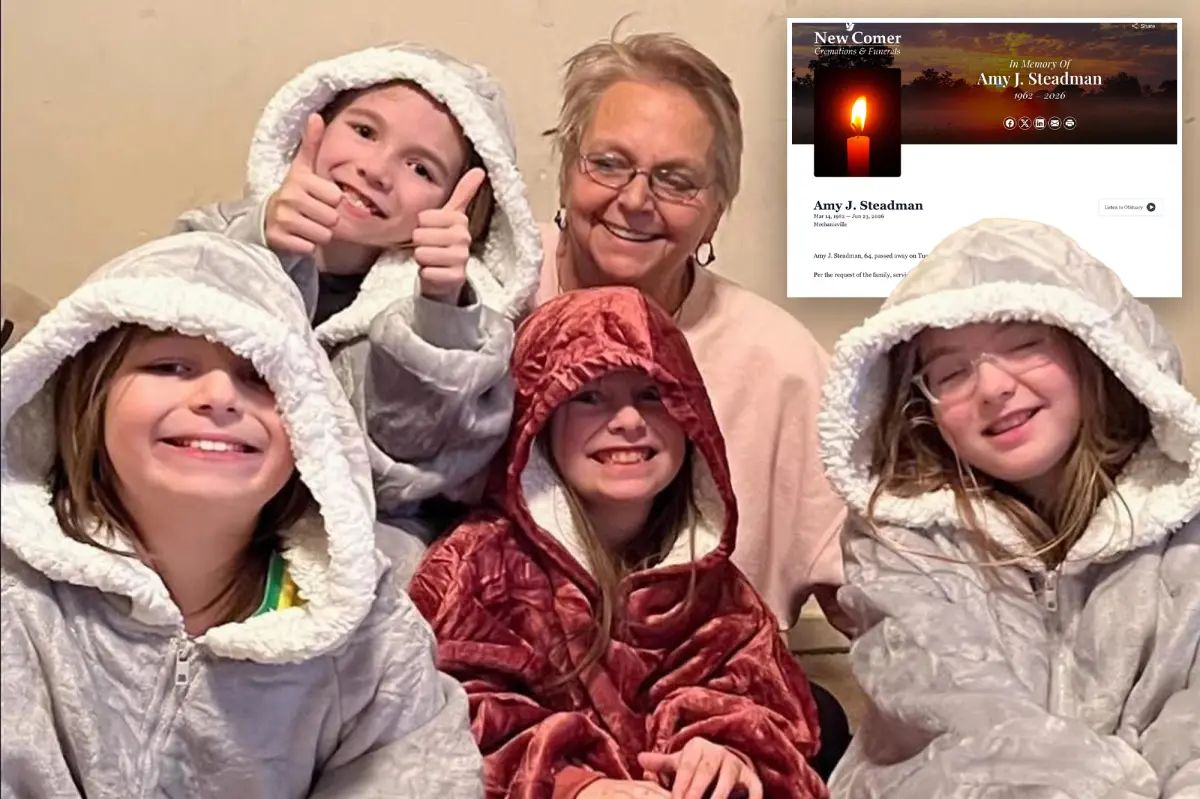
The language of grief is typically soft, filled with lingering memories, warm anecdotes, and expressions of eternal love that attempt to fill the sudden void left by a departed soul. Yet, when sixty-four-year-old Amy J. Steadman died in late June of 2026, her departure from this world was met with an icy, devastating silence that spoke volumes about the horrors she left in her wake. There were no photographs of a smiling grandmother, no list of surviving relatives, and no fond recollections of a life dedicated to family. Instead, her obituary, published by an Albany-based funeral home, was a cold, brutal, two-sentence notice that read: “Amy J. Steadman, 64, passed away on Tuesday, June 23, 2026. Per the request of the family, services were held privately.” This stark, deliberately empty text was a public act of disownership by her surviving family, a refusal to honor or even acknowledge a woman whose monstrous final acts shattered their world. By stripping her obituary of any human warmth, the family established a boundary of silence, refusing to let her memory cast a shadow of false sentimentality over a community that was still reeling from the shock of her actions. It stands as a chilling monument to betrayal, a literary door slammed shut on a woman who chose to end her own life only after systematically destroying the lives of those who trusted her most under her own roof.
The sheer scale of the horror came to light inside a quiet residence in Mechanicville, an upstate New York community where neighbors are accustomed to peace, not the unthinkable violence that unfolded behind closed doors. When local police officers arrived at the apartment for a routine welfare check, they crossed the threshold into a nightmare that would leave veteran first responders deeply shaken. Inside lay the lifeless bodies of three generations of one family: Amy Steadman; her forty-four-year-old daughter, Sarah Myers; and her four young grandchildren—thirteen-year-old Harper, eleven-year-old Hudson, and ten-year-old twins Gavin and Gracelynn Harmon. What initially appeared to be an inexplicable collective tragedy was quickly revealed to be a calculated act of domestic slaughter. Mechanicville Police Chief Bill Rabbitt told reporters that investigators recovered physical evidence strongly indicating that the grandmother had intentionally poisoned her daughter and grandchildren using a lethal combination of numerous prescription medications and over-the-counter drugs before taking her own life. To add to the unimaginable cruelty of the scene, sources revealed that one of the young children had also been brutally stabbed, a testament to a frantic, violent determination to ensure that no one in that household would ever walk out alive.
As investigators sifted through the physical remnants of the crime scene, a handwritten note left by Steadman began to shed light on the dark, twisted motives that could drive a grandmother to commit such an unspeakable act of violence against her own blood. The primary catalyst for this horrific event appeared to be a toxic cocktail of control, possessiveness, and a brewing custody battle that had reached a critical turning point. The children’s biological father, Brady Harmon, had recently succeeded in his legal efforts to secure custody, planning to take his beloved children with him back to his home in Utah for the summer. For a grandmother and mother who had constructed an isolated, insular world around these four siblings, the prospect of losing control over them to a father who had been kept at a distance for years was apparently intolerable. Rather than abide by the court’s decision and allow the children to experience the love of their father, Steadman chose a path of absolute annihilation, operating under the terrifying delusion that if they could not keep the children, then no one would. This extreme act of gatekeeping turned what should have been a joyful transition into a slaughter, transforming a custody dispute into a grim cautionary tale of how deep domestic pathology and unchecked resentment can fester until it explodes into violence.
The news of the murder-suicide struck Brady Harmon like a physical blow, dismantling years of hope, sacrifice, and endless legal maneuvering in a single, devastating instant. Having married Sarah in 2015 and separated just four years later, Brady had spent six and a half grueling years fighting a exhausting legal battle simply to be allowed to hold his children, hear their voices, and build a normal relationship with them. He had not seen Harper, Hudson, Gavin, or Gracelynn in person since the separation in 2019, relying on distant communication that was consistently strained, monitored, and thwarted by their mother and grandmother. When he spoke to Sarah on June 10, expecting to coordinate the long-awaited trip to Utah, he was met with evasions; Sarah claimed the children were too sick to travel—a deceptive stall tactic that hid a far darker truth. Hearing his children’s voices downplayed as “sick” while their grandmother plotted their demise is a source of haunting grief for Brady, who had spent years worrying about their safety while his warnings fell on deaf ears. The realization that he was just days away from wrapping his arms around his children after more than half a decade of separation, only to have them stolen forever by the very people who were supposed to protect them, is a tragedy of biblical proportions.
In the wake of this unspeakable loss, Brady has turned his focus to the systemic failures that allowed this tragedy to play out over several agonizing years. His grief has transformed into a powerful, heart-wrenching crusade against a family court system that he describes as fundamentally broken, dangerously slow, and detached from the urgent realities of child safety. He spent over six years navigating a labyrinth of legal procedures, motions, and delays, during which his children remained isolated under the influence of two women who grew increasingly desperate and unstable. Brady’s warnings about the children’s welfare and the toxic environment in the Mechanicville apartment were repeatedly brushed aside by the sluggish machinery of the court, which prioritizes bureaucratic process over swift, common-sense intervention. “The system is broken, it takes way too long to get anything done,” Brady lamented, his words echoing the frustrations of countless parents who find themselves trapped in legal paralysis while their children remain in harm’s way. This systemic failure to act quickly upon his well-founded concerns ultimately left his children vulnerable to their grandmother’s final, desperate act of malice, highlighting a critical and urgent need for reform in custody disputes where parental alienation and domestic instability are present.
Now, faced with an emptiness that no victory can ever fill, Brady’s sole purpose has shifted from fighting for custody to a deeply somber mission of honor, repatriation, and final peace. His immediate priority is to navigate the painful process of bringing his children’s remains home to Utah, far away from the New York apartment where they met their tragic end, and far from the memory of the maternal figures he now openly characterizes as “monsters.” He wants his children to rest in a place of beauty and safety, surrounded by the natural landscapes of the home he had prepared for them, rather than leaving them in the soil of a town defined by their betrayal. While the legacy of Amy Steadman has been reduced to a cold, two-sentence obituary devoid of love, the memories of Harper, Hudson, Gavin, and Gracelynn will be fiercely protected and beautifully preserved by a father who never stopped fighting for them. As the family prepares to lay these four beautiful children to rest, the community joins them in mourning, remembering the vibrant lives of the siblings who deserved a future full of summers in Utah, and hoping that their tragic story will finally spark the systemic changes needed to protect other families from such a devastating fate.