


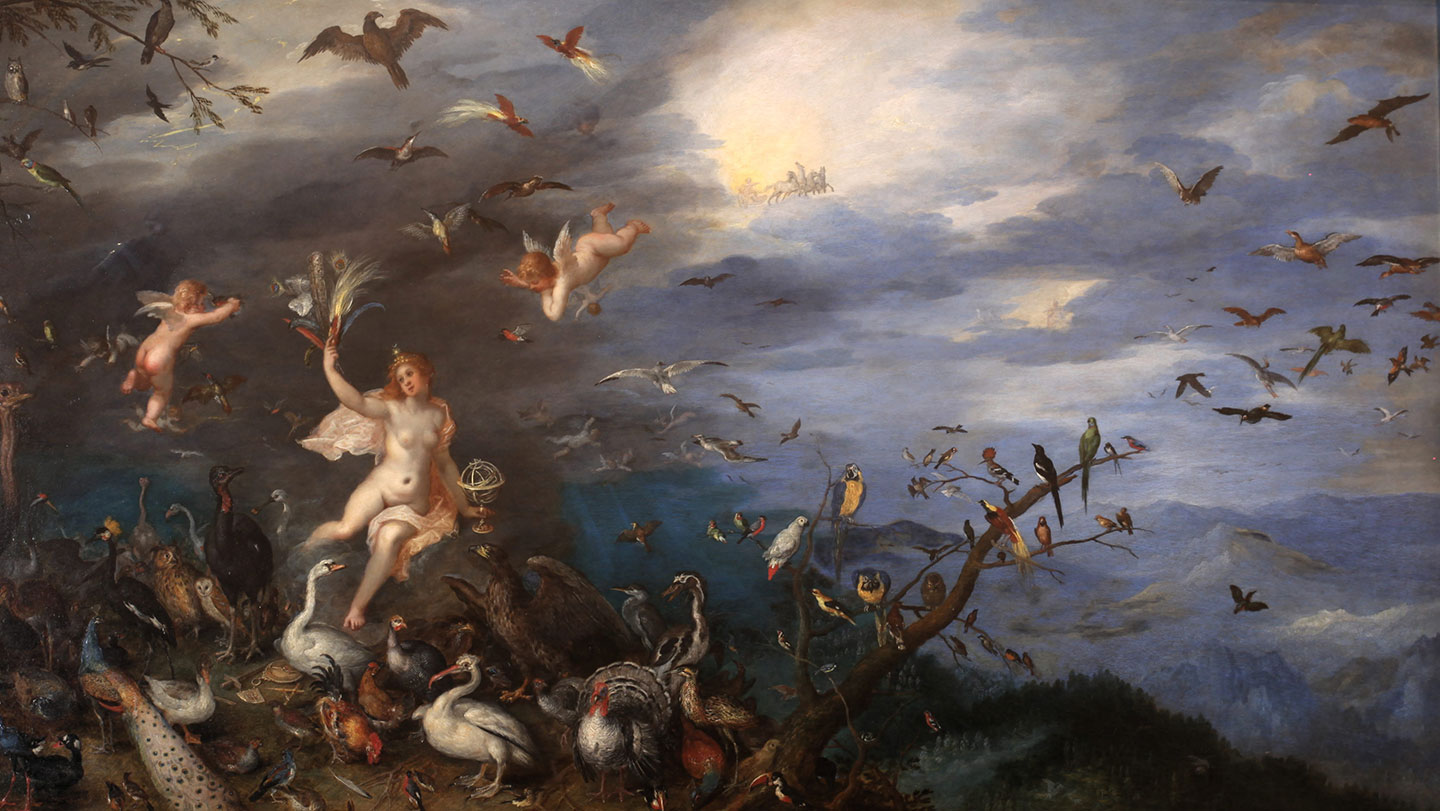
For centuries, the boundaries between artistic expression and scientific inquiry were fluid and porous. Polymaths, painters, and naturalists viewed the world with a unified sense of wonder, capturing nature’s secrets with whatever tools they had at hand. This cross-pollination is beautifully demonstrated by a recent revelation that connects a high-tech ecological discovery with a 413-year-old Flemish painting. Last fall, biologists celebrated a milestone when they officially documented the rare greater noctule bat (Nyctalus lasiopterus) snatching songbirds midflight, a predatory behavior once doubted or neglected by mainstream science. Yet, as detailed in a study published in the Proceedings of the National Academy of Sciences, this supposedly “new” behavior was actually captured with striking precision in 1611 by the Flemish master Jan Brueghel the Elder. In his allegorical masterpiece “Air,” the artist painted a bat with a limp songbird clenched firmly in its jaw, reminding us that classical human observation often pre-dates the accomplishments of modern technology.
Jan Brueghel the Elder was famous for his rich, microscopic precision, earning him the nickname “Velvet Brueghel” for his delicate touch. In “Air,” painted over four centuries ago, he sought to catalog the majesty of the heavens, populating the canvas with more than sixty distinct species of real and mythical airborne creatures. At the center of this swirling sky stands Urania, the Greek Muse of astronomy, flanked by the Roman deities Apollo and Diana guiding their celestial chariots across the heavens. Surrounding this divine assembly is a natural history museum come to life: parrots preen, swans glide, and, at the lower edges of the cloudscape, even a turkey and an ostrich make an appearance. It is in the upper right quadrant of the painting, however, that Brueghel left his true masterclass in biological observation. Flittering amongst the birds are four bats, the largest of which is a perfectly proportioned nocturnal hunter. With its rich, reddish-brown coat, rounded ears, and elongated, aerodynamic wings, the creature is unmistakably a greater noctule bat, clutching the silhouette of a tiny songbird in its oil-painted jaws.
The explorer who unlocked this historical secret was Pedro Romero-Vidal, a passionate ecologist at the Doñana Biological Station in Seville, Spain. Romero-Vidal belongs to a growing community of scientists who recognize that historical paintings are not just aesthetic treasures; they are ecological databases holding valuable clues about biodiversity, species distributions, and animal behaviors from bygone eras. During a project systematically scanning historical artwork for ecological hints, Romero-Vidal came across Brueghel’s piece and was completely mesmerized. Having examined thousands of classical paintings, he had never seen anything like this active predator-prey relationship immortalized in oil paint. His discovery highlights the exciting potential of historical ecology, which bridges the humanities and natural sciences, proving that Renaissance artists were reliable field biologists who preserved ecological truths with every stroke of the brush.
To appreciate the genius of the painting, one must understand how elusive the greater noctule bat truly is. As Europe’s largest bat species, Nyctalus lasiopterus is a formidable nocturnal hunter, yet its predation happens at such extreme altitudes and in such complete darkness that humans rarely witness it directly. In fact, many modern scientists were skeptical that bats could regularly hunt migrating songbirds in full flight. It wasn’t until recently that bioacousticians like Ilias Foskolos of Aarhus University in Denmark utilized highly sensitive recording equipment to capture the acoustic blueprint of these intense, high-energy encounters occurring hundreds of meters above the ground. The bat uses high-frequency echolocation to lock onto migrating songbirds, chasing them down with impressive speed and aerial agility. The fact that an artist from the 17th century managed to document this chaotic, sky-high interaction, which modern science has only recently verified with complex machinery, is nothing short of extraordinary.
But how did Brueghel know about this behavior? While the hunt occurs high in the night sky, the physical evidence eventually falls to earth. For decades, the primary clue that greater noctule bats ate birds was found in their guano; researchers starting in the early 2000s began discovering the distinct, undigested feathers of up to 31 different songbird species inside bat excrement. Humans of the Renaissance era lived close to nature and likely paid far closer attention to the nesting habits, roosting spaces, and droppings of local wildlife than we do today. While Brueghel spent much of his life in Brussels, his artistic journey took him to Italy, a region where the greater noctule bat hunts and resides. Whether Brueghel personally scaled high roosts to examine the mysterious feathers mixed in bat droppings or heard rural folk legends from local farmers who watched the night skies, he clearly gathered real, boots-on-the-ground ecological intelligence.
Ultimately, this delightful intersection of art history and evolutionary biology forces us to reconsider the boundaries we draw between disciplines. In an era where science is highly technical—dependent on satellites, genetic coding, and digital sensors—we can sometimes lose our direct, sensory connection to nature. Romero-Vidal emphasizes that while classical painters frequently utilized “artistic license,” populating their skies with symbolic Muses and divine charioteers, they also grounded their work in deep, lived observation. These paintings are time capsules, preserving the state of the planet before human modernization forever altered animal populations and migratory paths. By treating historical art as a vast, untapped library of biological observations, modern scientists can glean invaluable insights into the natural world’s past, reminding us that a tiny brushstroke might just solve a mystery that science is still trying to explain.