


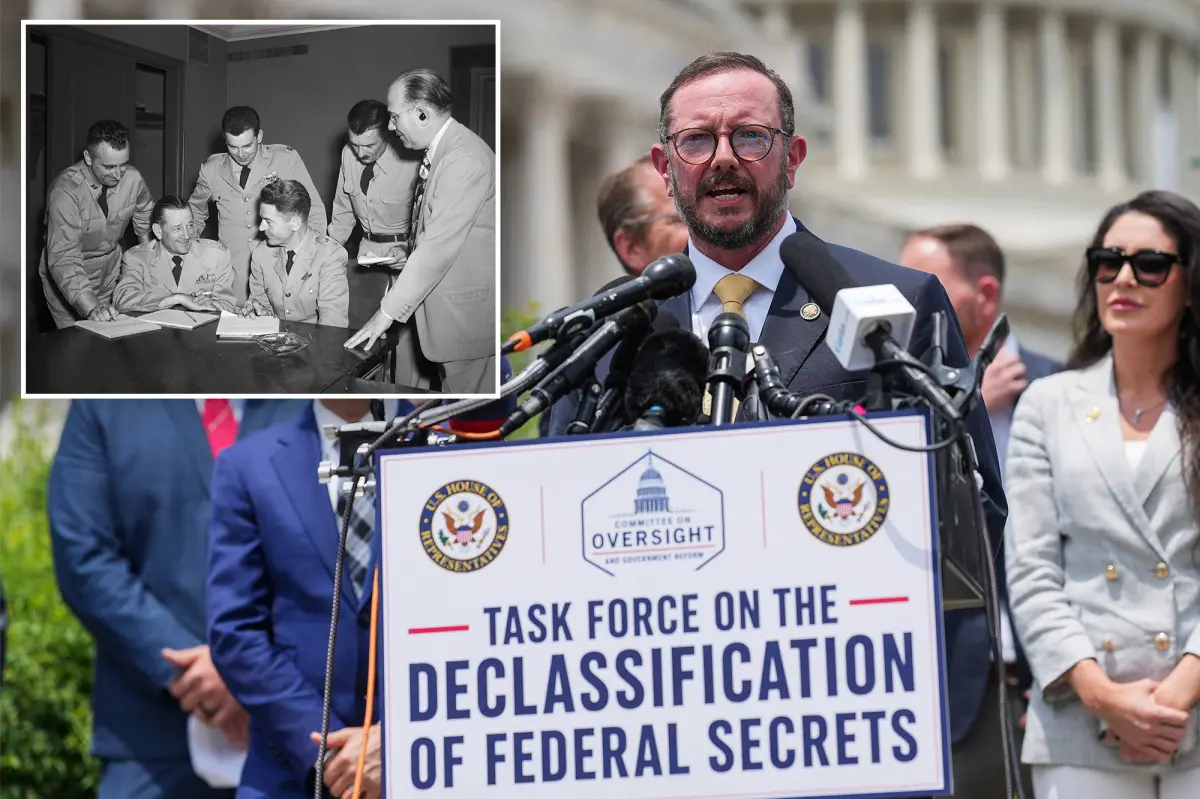
The collective heartbeat of the UFO transparency movement quickened to an unprecedented pace under the fluorescent lights of the Disclosure Forum 2026, a watershed moment in the tortuous history of aerial advocacy. Inside the packed, expectant auditorium, a palpable sense of historical gravity hung in the air as Representative Eric Burlison, a Republican from Missouri who has rapidly transitioned from a traditional lawmaker into one of the most dogged champions of cosmic accountability, took the stage to deliver a revelation that sent seismic shockwaves through the audience. Burlison did not merely offer the usual political platitudes or vague promises of future inquiries; instead, he directly confronted the secrecy paradigm by announcing the imminent public resurrection of a legendary, long-lost artifact: a pristine audio recording of a highly classified 1952 briefing between elite Air Force officials and top-tier scientists regarding the infamous “Invasion of Washington” UFO sightings. For decades, this elusive tape had existed solely as a whispered myth among historians and fringe researchers, a holy grail of ufology that many believed had been permanently erased or buried within the national security state. But according to Burlison, the era of polite, backroom inquiries has officially ended, and the relentless legislative pressure applied by a small but highly determined bipartisan coalition of congressmen has finally cracked the monolithic wall of government silence, guaranteeing that the public will soon hear the voices of mid-century officials grappling with the inexplicable. This stunning announcement was met with a mixture of stunned silence and thunderous applause from the gathered crowd of advocates, researchers, and ordinary citizens, all of whom recognized that the curtain of secrecy was not merely being nudged aside, but violently pulled back. The congressman’s bold declarations served as a stark reminder that behind the dry language of political oversight lies a deeply human struggle for truth, self-determination, and the dismantling of institutional paternalism that has kept humanity in the dark about its own skies for nearly three-quarters of a century.
The physical resting place of this historic magnetic tape adds a layer of Ivy League mystery and academic-military collusion to an already gripping narrative, as Burlison confirmed that the recording is currently held within the high-security confines of the Massachusetts Institute of Technology’s Lincoln Laboratory. Established in 1951 for advanced air defense, Lincoln Laboratory has long operated at the intersection of cutting-edge scientific innovation and highly classified defense research, making it the perfect, albeit highly controversial, repository for an artifact of such profound historical significance. The fact that a tape of this caliber—documenting a candid dialogue between the nation’s premier scientific minds and military leadership—has been sequestered within an academic institution rather than the National Archives highlights the complex, fragmented web of custody that has kept crucial UFO records out of the public domain. For generations, institutions like Lincoln Lab have functioned as silent curators of our collective destiny, guarding secrets under the guise of national security while leaving the public to rely on sanitized press releases and highly redacted documents. Burlison’s crusade to locate and liberate this specific audio file is a masterclass in modern legislative navigation, as he and his allies have bypassed standard bureaucratic channels to target the precise physical and digital vaults where these classified legacies are harbored. By identifying the exact coordinates of the tape and publicly demanding its release, Burlison has effectively cornered the administrators of the laboratory, transforming what was once a quiet academic custodianship into a major flashpoint for constitutional oversight and public accountability. This aggressive strategy has fundamentally changed the power dynamic between the researchers who hold the data and the public representatives who fund them, proving that no level of institutional prestige can forever shield historically vital information from the light of democratic scrutiny and human curiosity.
To truly understand the visceral impact of this impending release, one must journey back to the sweltering, anxiety-ridden summer of 1952, when the capital of the free world was thrown into a state of absolute existential panic during what is now known as the “Invasion of Washington.” In July, the skies above Washington, D.C., became a stage for an unprecedented and highly visible display of aerial defiance that completely bypassed the military’s most advanced defense networks. Air traffic controllers at Washington National Airport and Andrews Air Force Base watched in mounting disbelief as their radar screens lit up with clusters of glowing, fast-moving targets that moved with a speed and agility that defied the laws of known aerodynamics, executing impossible right-angle turns and outrunning the Air Force’s premier jet interceptors with effortless grace. Down on the ground, a collective shudder ran through the citizenry as commercial flight crews, police officers, and thousands of ordinary residents looked up to witness a fleet of luminous, hovering discs silhouetted against the iconic dome of the United States Capitol. This was not a subtle, midnight encounter in a desolate desert; it was a loud, public, and highly coordinated demonstration of technological superiority taking place directly over the heart of American political power during the height of the Cold War. The psychological shock to a nation already terrified of Soviet nuclear capabilities and the stealthy encroachment of communist technology was immediate and profound, triggering a wave of hysteria that reached the highest echelons of the Truman administration. The sheer helplessness of the military to intercept or even identify these craft shattered the illusion of American impregnability, transforming the night skies of July 1952 into a crucible of collective vulnerability and sparking a desperate search for answers that has remained unresolved to this day.
To quell rising public panic and restore faith in national defense capabilities, the United States Air Force hastily organized a historic, heavily attended press conference on July 29, 1952, led by Major General John Samford, which became a masterclass in bureaucratic obfuscation and psychological pacification. Standing before a room packed with skeptical journalists, military officials offered a highly elaborate and ultimately unconvincing explanation, attributing the dramatic radar contacts and visual sightings to a harmless meteorological phenomenon known as a temperature inversion. According to this official narrative, a layer of warm air had trapped cold air beneath it, causing the radar beams to bend and reflect off ground objects while simultaneously distorting light in the night sky to create the illusion of hovering alien spacecraft. While this scientific-sounding explanation succeeded in temporarily defusing the immediate media frenzy and restoring a semblance of order to the capital, it did nothing to pacify the eyewitnesses, commercial pilots, and radar operators who knew intimacy with the skies and recognized the active, intelligent flight patterns they had witnessed. The temperature inversion theory was widely perceived as a patronizing brush-off, an artificial shield erected by a military command structure that was deeply embarrassed by its inability to control its own airspace. This pivotal moment of official denialism marked the birth of modern UFO skepticism, sowing the initial, deep-seeded seeds of public distrust in federal authorities that have sprouted over the subsequent decades into a massive, global movement demanding genuine disclosure. The upcoming release of the 1952 tape promises to expose the stark contrast between the candid, anxious discussions that occurred behind closed doors among scientists and military leaders and the sanitizing, dismissive lies that were served to a naive public just hours later.
Standing at the cutting edge of this contemporary battle is Jordan Flowers, the uncompromising Executive Director of the Disclosure Foundation, who has emerged as a vital voice representing the collective frustration and hope of millions of transparency advocates worldwide. In a series of passionate interviews, including a landmark appearance on NewsNation, Flowers has articulated a profound shift in the tactics and philosophy of the disclosure movement, declaring that the time for polite requests and deferential petitioning has officially passed. Flowers highlighted the strategic significance of Burlison’s aggressive legislative push, noting that the congressman’s willingness to bypass traditional diplomatic politeness and target specific, hidden repositories represents a revolutionary shift in how the government’s UFO secrets are being dismantled. The advocacy community has rallied behind this confrontational approach, recognizing that the classification system has been weaponized for decades to hide truths that belong to the entirety of the human race rather than a privileged cabal of intelligence officials. Flowers’ poignant assertion that “the gloves are coming off” perfectly captures the defiant spirit of a modern public that is no longer content to accept heavily redacted documents or patronizing denials from unelected bureaucrats who operate without public oversight. This fight is no longer relegated to the margins of society or viewed as the domain of conspiracy theorists; rather, it has transformed into a sophisticated, legally and politically backed crusade for fundamental human rights, constitutional oversight, and democratic accountability. By framing the release of the 1952 tape as a massive win for civic transparency, Flowers and his peers are reminding the world that the ultimate goal of their movement is to reclaim the public’s right to know the truth about the world we inhabit.
As the anticipation for the release of this historic audio recording reaches a fever pitch, the broader human and philosophical implications begin to crystallize, signaling a profound shift in our relationship with the unknown. When the public finally hears the actual voices of 1952 Air Force commanders and elite scientists speaking in hushed, urgent tones about an undeniable, non-human presence over Washington, D.C., it will shatter the decades-old paradigm of ridicule that has long marginalized the study of unidentified aerial phenomena. This tape is not merely a dusty museum piece or a historical curiosity; it is a vital, missing link in the human story, a physical record of the exact moment our species officially confronted a reality that lay far beyond our technological and philosophical boundaries. By hearing the raw, human emotion, the confusion, and the genuine concern of the historical figures who witnessed the birth of the modern UFO phenomenon, we are invited to connect with our past in a deeply empathetic way, recognizing that our ancestors were not victims of collective delusion, but brave observers of an ongoing mystery. This impending release represents a triumph of open-source truth over compartmentalized secrecy, demonstrating that even the most heavily guarded institutional secrets cannot withstand the relentless, generational pursuit of human curiosity and democratic persistence. Ultimately, the liberation of the 1952 Washington briefing tape serves as a powerful testament to the resilience of the human spirit, paving the way for a future where science, governance, and citizens can join together in an honest, mature, and transparent exploration of our place within a vast, mysterious, and infinitely wondrous cosmos.