


The peaceful rhythm of daily life along Venezuela’s northern coast was violently shattered on what seemed like an ordinary Wednesday, when twin earthquakes of immense power, registering at a crushing 7.2 and 7.5 magnitude respectively, tore through the landscape. The catastrophic event occurred without warning, instantly transforming bustling coastal cities, sleepy seaside towns, and suburban neighborhoods into terrifying landscapes of unstable concrete, twisted metal, and rising dust. To comprehend the horror of that moment is to look at the stories of ordinary people caught in the chaos: players and thousands of screaming fans running for their lives as the tremors cracked open a professional baseball stadium in the middle of a game, or a former Major League Baseball pitcher narrowly escaping death in an elevator malfunction as the world collapsed around him. The physical devastation was absolute, but the emotional and human toll was far more devastating. Within days, official reports confirmed the heartbreaking reality that the death toll had climbed to a stunning 1,430 individuals, with a staggering 68,000 men, women, and children still reported missing across the country. In hard-hit regions like La Guaira and the sprawling urban center of Caracas, the air was quickly filled with a chaotic symphony of screaming sirens, the desperate cries of families digging through the debris with their bare hands, and the ominous, heavy silence of communities waiting for any sign of life. This sudden tragedy did not merely tear apart the physical infrastructure of a nation; it opened a deep, agonizing wound in the collective heart of Venezuela, leaving families to grapple with the terrifying reality that their loved ones were swallowed by the earth in a matter of seconds, and launching a frantic, nationwide, and international race against the ticking clock to pull survivors out of the dark before it was too late.
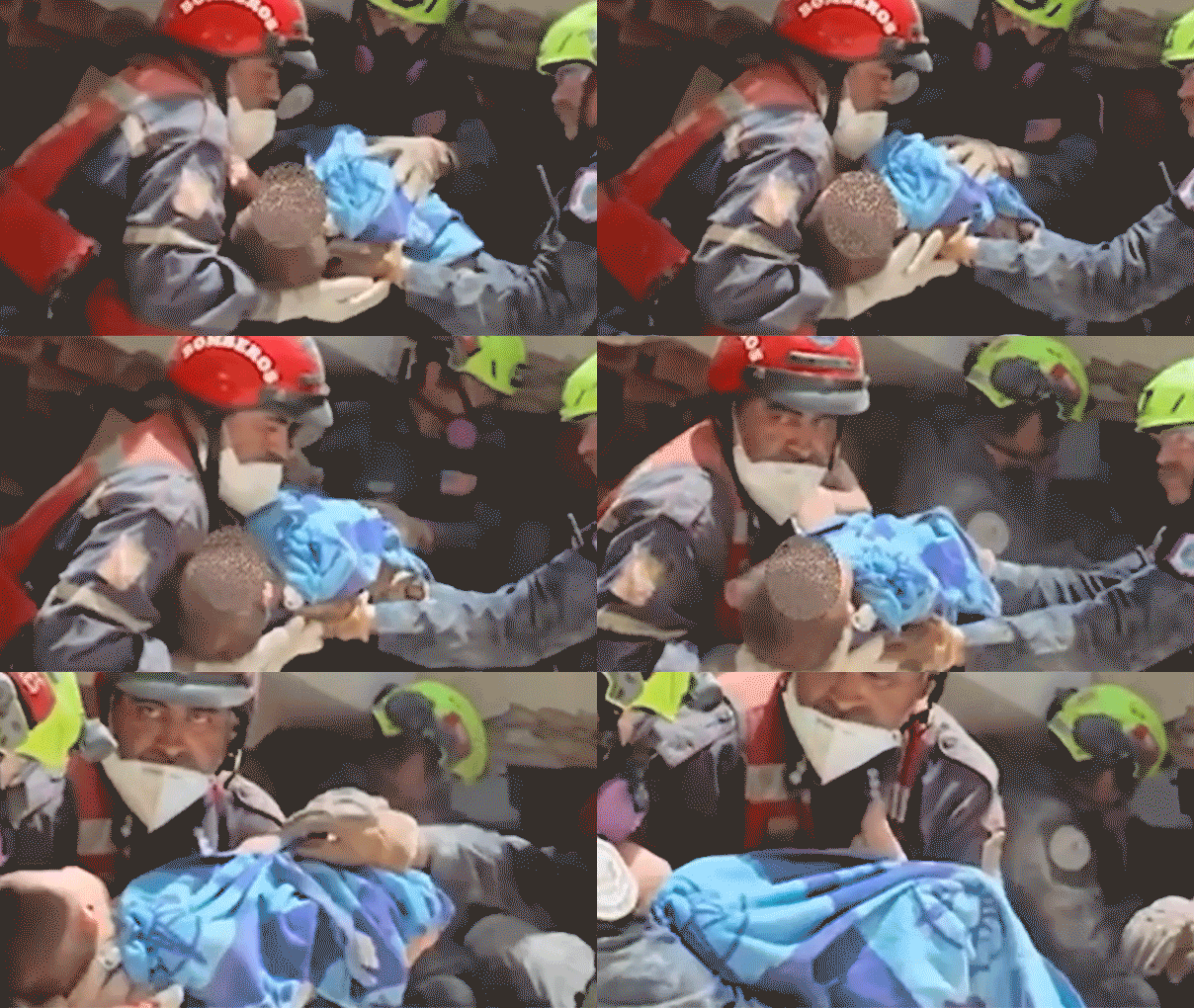
Yet, amidst this profound atmosphere of grief and the rapidly fading hope of the post-disaster timeline, a miraculous event unfolded in the coastal town of Catia La Mar that captured the hearts of people worldwide. More than seventy-two hours after her home had collapsed into a pile of pulverized concrete, a fragile nine-month-old infant girl and her mother were pulled alive from the jagged ruins, defying the bleakest scientific survival odds. This heroic rescue was executed by the highly specialized Fairfax County Urban Search and Rescue team, known internationally as USA-01, who had been rapidly deployed to Venezuela following an urgent activation by the United States Department of State. A touching video shared widely on social media platforms by the State Department and the White House captured the raw, emotional reality of the moment: exhausted American rescue workers, their faces covered in sweat and pulverized concrete dust, carefully and gently cradling the tiny baby, passing her hand-to-hand over the precarious mounds of wreckage to safety. Miraculously, despite spending days trapped in the dark and dusty void without food, water, or fresh air, both the infant and her mother suffered only minor physical injuries, a testament to the incredible resilience of the human body and the protective instinct of a mother. The State Department highlighted this incredible triumph on social media with the powerful message that “against impossible odds, hope endures,” while the White House praised the rescue as a beautiful representation of “America at its best.” The rescue of this tiny child became a global symbol of light, showing that even in the deepest ruins, life can find a way to persist if we refuse to stop searching, and this singular victory of life over death served as a powerful spark of hope for thousands of exhausted rescue workers.
The success of this rescue highlights the extreme stakes of what humanitarian aid groups call the critical “golden window,” which constitutes the first forty-eight to seventy-two hours following a structural collapse. During these initial, precious hours, the likelihood of finding survivors trapped in void spaces beneath the rubble is at its highest, but as the clock ticks past the three-day mark, the chances of survival begin to drop exponentially as dehydration, physical trauma, and lack of oxygen take a devastating toll. Despite these grim statistical realities, the rescue teams and local volunteers refused to allow the tick of the clock to dictate their efforts, transforming the disaster zones into twenty-four-hour battlefields where sleep was an unaffordable luxury. In the ruins of La Guaira, where entire mountainside neighborhoods crumbled into valleys of dust, the search efforts were characterized by intense, nerve-wracking silence as teams occasionally ordered all heavy machinery to halt so they could listen for any faint sound from below. Volunteers and family members worked alongside elite crews, using shovels, buckets, and sometimes nothing but their bleeding fingernails to claw through the debris in search of their missing children, parents, and friends. By Saturday evening, official reports indicated that 243 people had been successfully pulled from the wreckage, each rescue acting as a vital shot of adrenaline for the weary searchers. These hard-won victories proved that survival is not merely a matter of scientific probability, but of human endurance—showing that as long as there is even a sliver of air, a drop of moisture, or the sheer, stubborn will to live, those trapped below can survive against all rational expectations. It illustrates that behind every statistic of a disaster lies a heartbeat, a family, and a precious story that is worth fighting for until the very last pocket of stone has been thoroughly overturned.
Recognizing the immense scale of the disaster, the United States government mobilized a massive, highly technical search-and-rescue mission to support the overwhelmed Venezuelan emergency services. Three premier Urban Search and Rescue (USAR) teams from Virginia, California, and Florida were quickly mobilized and dispatched directly to the worst-hit areas, representing some of the most highly trained disaster-response professionals in the world. The American contingent consisted of 312 elite personnel, including structurally-focused firefighters, specialized trauma physicians, structural engineers capable of assessing building stability, and expert canine search specialists. Alongside these rescue experts were eighteen highly trained canine teams, consisting of dogs specifically trained to pick up the scent of live human beings trapped deep beneath heavy concrete where human senses and electronic equipment fail to reach. To assist them in their grueling task, these teams brought over 200,000 pounds of state-of-the-art rescue equipment, designed specifically for heavy concrete extraction. The Los Angeles County search-and-rescue team arrived equipped with massive concrete-breaking machinery, sensitive fiber-optic cameras that could slide into the narrowest crevices, and incredibly sophisticated acoustic listening devices capable of detecting the sound of a faint heartbeat or a desperate tap deep within the ground. The deployment of these sophisticated tools and dedicated personnel turned the chaotic rescue sites into highly systematic operations, providing the precise technical capability needed to carefully dismantle unstable buildings without causing further collapses, and ensuring that every possible effort was made to locate the tens of thousands still missing. These brave men, women, and search dogs left their own comfortable homes behind, flying into a country in crisis with a singular, beautiful mission: to bring comfort to the grieving and pull the living from the jaws of tragedy.
The devastating tragedy in Venezuela triggered an immediate, powerful wave of international solidarity, reminding a divided world of the shared humanity that unites us all in times of acute suffering. By Saturday, seventeen massive international transport flights had arrived at Venezuela’s airports, carrying over 1,600 highly specialized rescue personnel from various nations, all eager to lend their hands to the desperate search efforts. In addition to deploying its elite rescue teams, the United States government pledged $150 million in emergency financial assistance to support local and international relief organizations as they scrambled to provide food, clean water, medical care, and temporary shelter to the thousands of newly homeless survivors. This massive outpouring of aid occurred against a backdrop of complex international relations, demonstrating that when a human tragedy of this scale unfolds, political differences, historic grievances, and diplomatic borders must be set aside to prioritize the preservation of human life. Prominent political figures across the spectrum, including former President Donald Trump, publicly acknowledged the profound tragedy, with Trump noting that the earthquakes had caused a “devastating number of deaths” while affirming that the United States stood ready to assist the Venezuelan people in their hour of greatest need. This unified global response highlighted a fundamental truth about human nature: that in the face of nature’s most violent and unpredictable forces, the instinct to help, comfort, and rescue our fellow human beings is a powerful bond that transcends all political realpolitik, transforming a local disaster zone into a powerful focal point of global empathy and cooperation. It showed that when the earth shakes, the foundations of our shared human family remain completely unshaken, holding fast to the simple truth that no nation should have to weep and recover in isolation.
As the dust slowly settles over the scarred landscape of northern Venezuela and the emergency rescue phase begins to transition into the long, painful journey of recovery, the deep trauma of this catastrophe will remain felt for generations. The physical reconstruction of ruined neighborhoods, shattered highways, and collapsed public buildings will take years of arduous work and billions of dollars, but the emotional healing of a nation that lost thousands of its citizens in a single afternoon will take much longer. Yet, amidst the long shadow of this immense grief, the story of the nine-month-old baby girl pulled gently from the suffocating darkness of the Catia La Mar ruins will forever stand as an enduring symbol of hope, survival, and the beautiful potential of human cooperation. Her survival represents the ultimate triumph of life over destruction, a bright beam of light in one of the darkest chapters of the region’s modern history. It serves as an enduring reminder that when the international community unites—combining the technical expertise and bravery of American first responders with the resilient spirit and determination of the Venezuelan people—even the most earth-shattering disasters cannot fully extinguish the human flame. Ultimately, this tragedy reminds us that our true strength as a global community is not defined by our ability to prevent the unpredictable fury of nature, but by the love, courage, and unwavering compassion we demonstrate when we come together to lift each other out of the ruins, rebuilding our world piece by piece, life by life. Her soft breaths in the arms of her rescuers are a promise of tomorrow, proving that even after the ground beneath us crumbles, our shared humanity can build a path forward, guided by the light of the miracles we achieve together.