



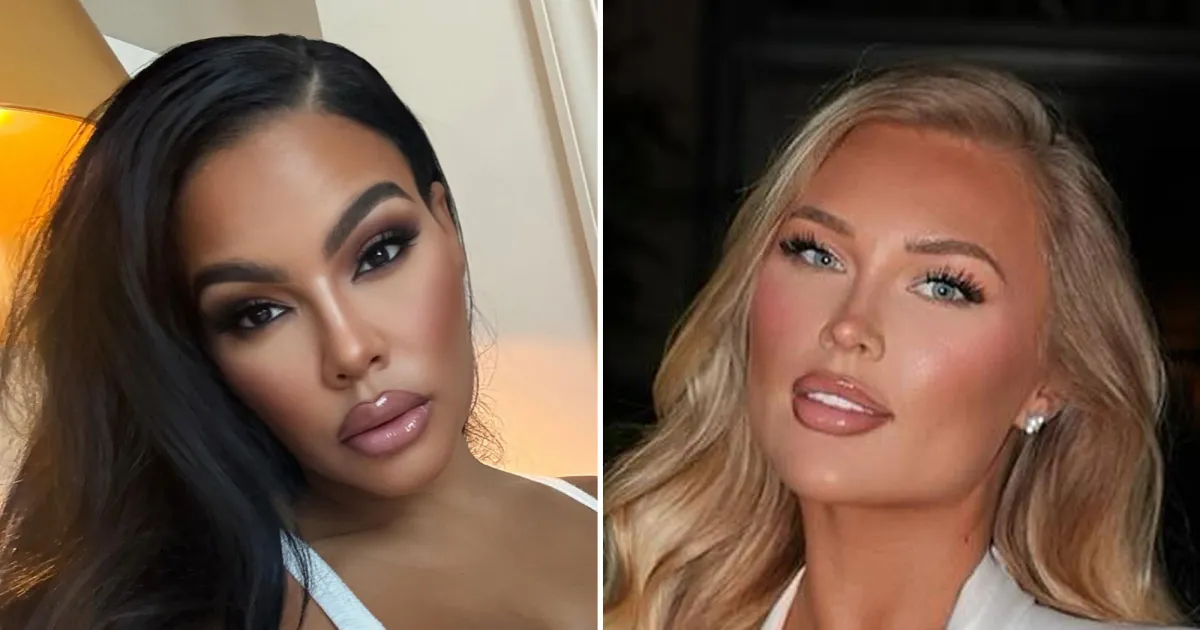
In an era where our digital avatars are often more polished, scrutinized, and curated than our actual physical selves, the pressure to maintain an illusion of effortless luxury has never been higher, especially for those who have tasted the intoxicating wine of reality television fame. This delicate balance between authenticity and performance lay at the heart of the recent social media wildfire surrounding Mia Thornton, the charismatic forty-one-year-old former star of The Real Housewives of Potomac. Known for her bold personality and unfiltered confidence on screen, Thornton suddenly found herself at the center of a bizarre modern controversy when hawk-eyed internet sleuths accused her of digitally grafting her own face onto the body of British fashion influencer Sophie O’Neill. The image in question featured a woman in a stunning, form-fitting white dress with a deeply plunging neckline, holding a matching designer handbag in an elegant, statuesque pose. However, what was presented as a glamorous moment in Thornton’s life quickly transformed into an embarrassing debate about digital identity theft when the original, identical photograph uploaded by O’Neill months prior resurfaced, exposing the stark reality of modern photo-manipulation and launching a wider conversation about the lengths to which public figures will go to project an image of flawless perfection.
The unraveling of this digital illusion highlights a fascinating human truth: in our interconnected world, nothing stays hidden for long, and the boundaries of digital consent are becoming increasingly fragile. When Sophie O’Neill caught wind of her body being used as a digital canvas for another woman’s head, her reaction was a mixture of bewilderment, vulnerability, and quiet outrage. Taking to Instagram to publicly address Thornton, O’Neill pointed out the sheer absurdity of the situation, expressing that superimposing oneself onto another person’s body made the world feel like a “very scary place” and pleaded with Thornton to take down the visual forgery. For O’Neill, the incident was not merely a harmless internet meme but an intrusive violation of her personal brand, her hard work, and her physical identity. This confrontation stripped away the polished veneer of influencer culture, revealing the raw human awkwardness that occurs when the curtain is pulled back to expose the gears of online deception, leaving audiences to grapple with the uncanny valley of seeing two different women claiming ownership over the exact same physical space in time.
Rather than retreating into protective silence or issuing a polished, public-relations-approved apology to soothe the tension, Mia Thornton chose a path of defiant self-preservation that is entirely characteristic of her reality television persona. She deleted the controversial image but replaced it with a sharp, triumphant message designed to reclaim the upper hand, asserting that while she had been off television for two seasons, the public was still obsessed with her every move. In a clever, albeit dismissive, attempt to redefine the narrative, Thornton claimed she was simply utilizing cutting-edge artificial intelligence to boost her financial bottom line, writing that she was “busy adding 000’s” to her wealth with AI technology. When a social media user gently urged her to stop “stealing” other women’s bodies, Thornton deflected the criticism with a patronizing compliment toward O’Neill, suggesting that by using her body, she had graciously handed the influencer her “twenty seconds of fame.” This response reveals a complex defense mechanism often seen in high-profile personalities: when faced with an undeniable blunder, the instinct is not to display vulnerability or contrition, but rather to weaponize arrogance, turning a moment of digital embarrassment into a performance of supreme business intelligence and social leverage.
As the controversy gained momentum, the internet did what it does best, transforming a potentially damaging celebrity slip-up into a shared, lighthearted theatrical event that united both fans and fellow reality television stars in collective amusement. Tamra Judge, the seasoned fifty-eight-year-old veteran of The Real Housewives of Orange County, leaped onto the trending topic with expert comedic timing, posting her own crudely photoshopped version of the infamous white dress photo. With her own face clumsily pasted over the original image, Judge jokingly captioned her post as being “completely untouched” and “definitely not AI,” signaling a sense of humor that defused the tension of the situation while mocking the absurdity of the original denial. This parodic reaction represents a unique characteristic of modern celebrity culture, where public figures use humor and self-deprecation to navigate scandals, reminding the public that beneath the high-stakes drama of reality television, there is a shared understanding of the ridiculousness of maintaining a pristine digital facade. Through satire, the community turned a moment of potential public shaming into a playful celebration of human fallibility, proving that sometimes the best way to survive an internet pile-on is to simply laugh along with the crowd.
Despite her initial attempts to brush the situation off as an AI-driven marketing play, the human desire for validation and the need to protect one’s personal credibility eventually drove Thornton to offer a secondary defense to prove her authenticity. In an effort to silence the skeptics who doubted she even owned the white garment, she uploaded a new photograph of herself in the exact same plunging white dress, this time pictured sitting in a cozy, intimate restaurant booth. Accompanying the photo was a defiant caption asserting that her name carried enough weight on its own and that she had “never needed clout,” followed by a preemptive, sarcastic swipe at O’Neill, wondering aloud if the influencer also had a photo of herself sitting down in that very same establishment. This follow-up post highlights the exhaustive, almost tragicomic labor required to maintain a digital reputation, where a person must produce physical “receipts” to defend their reality to a sea of cynical strangers. It exposes the deep-seated human need to be believed and respected, showing that even those who claim to be completely detached from the opinions of others are deeply affected by the threat of being labeled a fraud in the public square.
Ultimately, this bizarre saga involving Mia Thornton, Sophie O’Neill, and a contested white dress serves as a compelling mirror for our broader, contemporary relationship with technology, identity, and the fluid nature of truth on the internet. It forces us to look past the humor of a photoshopping blunder and confront a deeper, more unsettling human reality: as digital tools become more sophisticated, the line between what is authentically human and what is artificially constructed is permanently blurring. We live in a culture that rewards flawless aesthetics so highly that even successful, wealthy individuals feel compelled to borrow the physical forms of others to meet an impossible standard of perfection. While the internet laughed at the sheer audacity of the edit, the incident leaves us with a lingering contemplation about our own digital footprints, the fragility of our online identities, and the exhausting performance of keeping up appearances in a world where we are all, to some degree, trying to curate a version of ourselves that is just a little bit better than reality.