


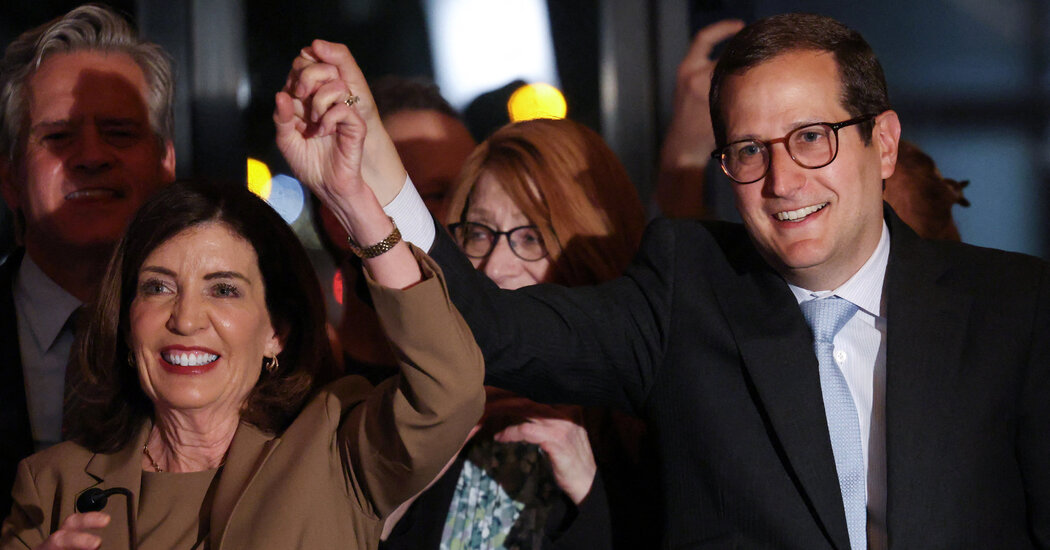
The atmosphere inside the victory party for Micah Lasher, a chosen son of the Manhattan Democratic establishment, was thick with the familiar comfort of institutional power, yet underscored by an undeniable, quiet anxiety. As Lasher celebrated his primary victory in New York’s 12th Congressional District, Governor Kathy Hochul stood close by, offering a brilliant but carefully controlled smile that seemed designed to project absolute confidence to the cameras. When City Comptroller Mark Levine took the microphone to enthusiastically declare to Lasher that his win proved political experience and traditional credentials still carried immense weight in modern Democratic politics, the crowd of party luminaries erupted in warm, self-reassuring applause. Yet, just beneath this veneer of establishment triumph lay a starkly different reality unfolding across the rest of the empire state. Even as Hochul stood silently in that Manhattan room, celebrating a rare victory for her preferred brand of moderate politics, she was undoubtedly aware that a very different kind of political rebellion was occurring simultaneously in neighborhoods just a few subway stops away. In the outer boroughs and working-class communities, the traditional Democratic machinery was not celebrating; instead, it was being systematically dismantled by an energetic, grassroots movement that rejected the status quo. This juxtaposition of establishment relief in one room and insurgent triumph in others painted a vivid picture of a deeply divided party. It revealed a governor caught between the celebration of her allies and the unmistakable sounds of a progressive vanguard knocking loudly at the gates of power, signaling that the old ways of governing New York through backroom compromises and moderate incrementalism were being actively challenged by a newly energized electorate. This shift represents more than just a temporary fluctuation in voter turnout; it is a fundamental realignment of how power is brokered, leaving Hochul to navigate a landscape where her traditional leverage is rapidly evaporating.
Across the sprawling neighborhoods of New York City, the political landscape was being aggressively reshaped by candidates championed by Mayor Zohran Mamdani, whose progressive alliance mounted a highly organized campaign that caught many mainstream incumbents off guard. Mamdani’s camp achieved a resounding series of victories, routing moderate candidates and sending long-serving incumbents packing, an outcome that dramatically consolidated the power of the city’s ascendant democratic socialist left. Among the triumphs were three congressional victories, including two candidates who are active members of the Democratic Socialists of America, individuals who soundly defeated moderate incumbents actively backed by Governor Hochul herself. This sweeping progressive wave sent a clear and potentially destabilizing message directly to the Executive Mansion in Albany. Strategists like Amit Bagga, a former member of the Hochul administration, pointed out that the socioeconomically and geographically diverse coalition of voters who delivered these victories proved that the electorate is hungry for the bold, transformative vision Mamdani championed during his mayoral campaign. Bagga warned that if he were in the governor’s shoes, he would be studying these primary results with intense scrutiny, particularly regarding how this newly energized base would alter her relationship with the State Legislature. With potentially sixteen new Democratic Socialists of America-backed legislators heading to Albany from all corners of the state, the political center of gravity has shifted. This influx of progressive lawmakers means Hochul can no longer rely on a compliant legislative body to rubber-stamp her moderate-leaning policies, forcing her to confront a caucus that is younger, more diverse, and possesses a robust popular mandate to push the state much further to the left than she has ever been willing to go. This emerging reality challenges the traditional assumption that upstate moderation must always temper downstate progressivism, rewriting the playbook for New York governance.
Governor Kathy Hochul now finds herself walking a perilous political tightrope as she prepares for a challenging re-election campaign against Bruce Blakeman, the Nassau County executive and a fierce admirer of Donald Trump who is eager to capitalize on any perceived weakness in the Democratic ranks. Hochul’s political identity has always been rooted in her moderate, pragmatic upbringing in Buffalo, where she watched her father’s career transform her family’s economic fortunes, instilling in her a lifelong belief in the power of economic development, business partnerships, and moderate compromise. These deep-seated beliefs have made her a beloved figure among the state’s business elite, who have flooded her campaign coffers with record-breaking donations, cementing her status as one of the most formidable political fundraisers in the nation. This moderate brand has historically helped her appeal to suburban swing voters who are often spooked by left-wing rhetoric, but it now puts her at direct odds with the ascendant left in her own party. While Hochul has previously demonstrated a remarkable, canny ability to navigate internal party warfare—famously neutralizing the primary challenge of her own Lieutenant Governor, Antonio Delgado, before his campaign could even gather momentum—the current progressive surge represents a much more formidable, systemic challenge. To survive the general election against a populist Republican opponent like Blakeman, Hochul must somehow energize the passionate, progressive base of her party without alienating the moderate suburbanites and business donors who form the financial backbone of her coalition. It is an incredibly difficult balancing act, made even more complicated by the fact that the progressive wing of her party is no longer content to merely fall in line, demanding instead a seat at the table and genuine concessions on major policy initiatives. The upcoming election is thus not just a battle between two parties, but a referendum on whether Hochul’s brand of centrist pragmatism can still hold a fractured coalition together.
At the heart of the impending clash between Governor Hochul and the empowered progressive wing are fundamental disagreements over tax policy and the role of municipal government in the lives of everyday New Yorkers. New York City is currently staring down a massive future budget deficit, yet it simultaneously faces the urgent need for a permanent, reliable funding stream to support the ambitious childcare expansions that Hochul and Mayor Mamdani jointly pushed through earlier this year. Beyond childcare, Mamdani and his progressive coalition have laid out an expensive, highly ambitious agenda that includes pioneering programs like free municipal bus service across the city and the creation of city-run grocery stores to combat food deserts. Funding these initiatives will require a massive influx of capital, and the left has made it abundantly clear that they expect this money to come from taxing the state’s wealthiest residents and corporations. Hochul, however, has consistently resisted any proposals to raise taxes, repeatedly warning that such measures should only be used as an absolute last resort to avoid driving wealthy individuals and businesses out of the state. This ideological divide goes beyond basic economics; it represents two entirely different visions of society. While Hochul envisions a pro-business environment where economic growth naturally lifts all boats, Mamdani’s allies see a city where the government must actively intervene to redistribute wealth and guarantee basic human services to working-class families. This fiscal standoff promises to dominate the upcoming legislative session in Albany, with a newly emboldened progressive caucus ready to withhold their support for the budget unless the governor agrees to tax the rich to fund their social programs. With sixteen DSA-backed legislators holding significant leverage, the annual budget battle will no longer be a series of quiet backroom negotiations, but a highly public ideological war over the state’s financial priorities.
Despite these deep ideological divides, Hochul’s allies quickly point out that she is far from defenseless and has already demonstrated a sophisticated capability for strategic engagement with the progressive wing. Former City Council Speaker Christine Quinn, a key figure on the Democratic executive committee, has highlighted Hochul’s willingness to collaborate with Mamdani on key issues—such as the landmark tax on second homes valued at over five million dollars—as an effective blueprint for how moderate executives can successfully work with progressive lawmakers. Quinn warns that anyone who underestimates Hochul’s political instincts and survival skills does so at their own peril, noting that she has consistently found creative ways to appease progressives without entirely surrendering her political leverage. This productive but tense cooperative relationship was on display during Mamdani’s post-primary press conference, where he praised the newly elected progressive candidates as valuable future partners in his legislative battles but pointedly downplayed any personal rivalry with the governor. When journalists asked Mamdani if the primary results had permanently altered the balance of power between City Hall and Albany, he chose to frame the victory not as a personal triumph over Hochul, but as a victory of working-class families over corporate special interests. Yet, even as Mamdani sought to keep the peace, other leaders on the left were far less conciliatory, with Grace Mausser of the New York City Democratic Socialists of America publicly advising the governor to abandon her current political strategy, warning that running on a record that fails to resonate with the material needs of everyday people is a recipe for political disaster. This direct warning from the DSA indicates that the left’s patience is wearing thin, setting the stage for a dramatic policy battle next year.
As the internal struggle for the soul of the Democratic Party intensifies, New York Republicans are already seizing on the division, eager to weaponize the progressive victories to peel away moderate suburban voters ahead of the November elections. State Republican Party Chairman Ed Cox wasted no time in issuing a blistering statement accusing Hochul of being entirely captive to Mamdani and his radical progressive agenda, using highly inflammatory language to paint the newly elected democratic socialist candidates as extremists who seek to dismantle traditional American values and institutions. Cox’s aggressive rhetoric is a clear preview of the Republican strategy for the general election: convince moderate and independent voters that a vote for any Democrat is ultimately a vote for radical, polarizing policies. Mamdani, however, dismissed these Republican attacks as desperate, familiar fear-mongering, confidently arguing that the rise of working-class champions in government would ultimately strengthen, rather than weaken, the Democratic ticket in November by giving ordinary people a genuine reason to show up at the polls. For her part, Governor Hochul has attempted to defuse the growing tension by framing the progressive surge as a healthy sign of a diverse and energetic political party. Reflecting on her lifelong involvement in Democratic politics, Hochul noted that the party has never been a monolithic entity united behind a single voice or ideology, and she welcomed the diverse perspectives that the new primary winners would bring to the table. Whether this inclusive rhetoric can translate into stable, effective governance in Albany remains to be seen, but one thing is certain: the old consensus is dead, and the future of New York politics will be decided by how these two competing Democratic factions choose to navigate their shared power. As the state approaches a pivotal election, this delicate internal dynamic will be tested like never before, shaping New York’s destiny for years to come.