


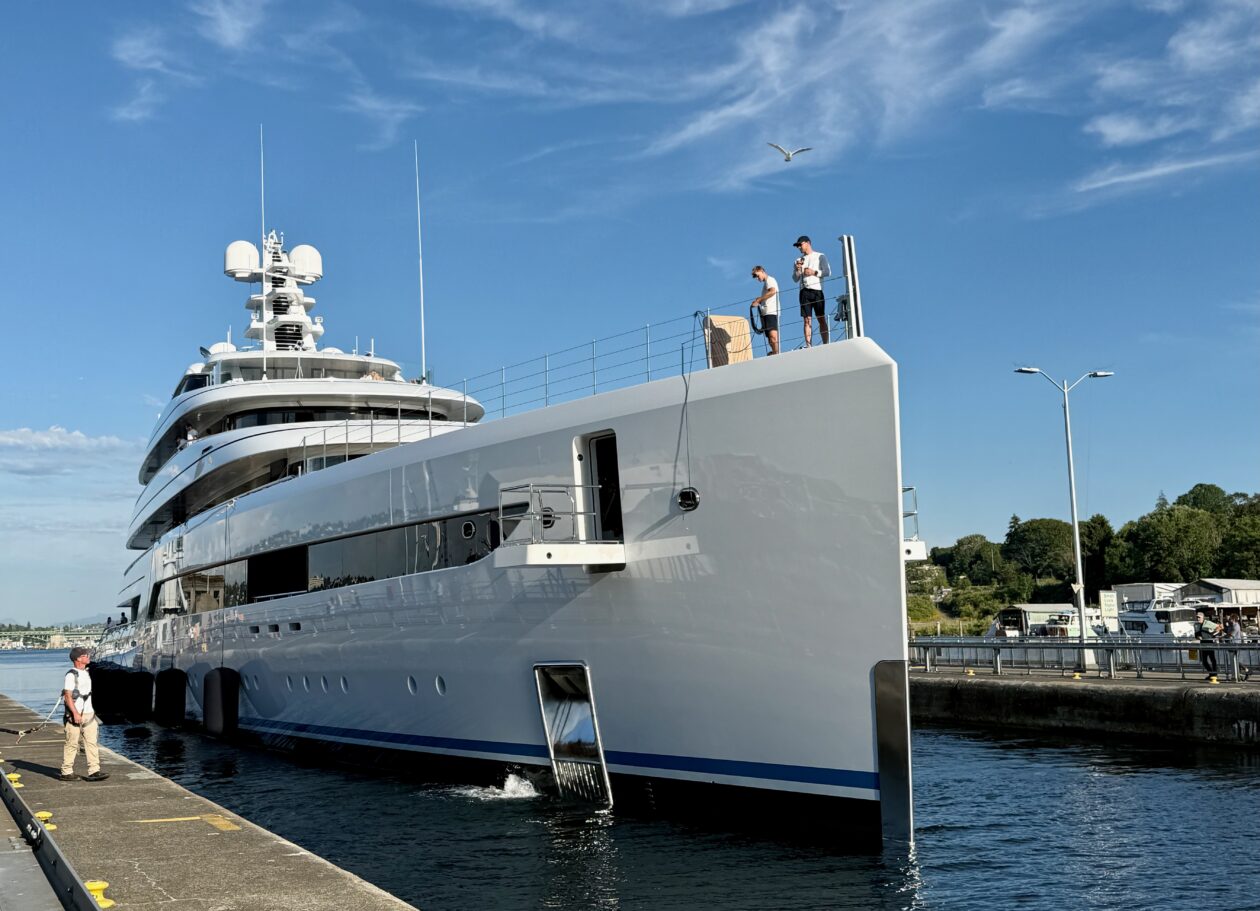
On a crisp Tuesday evening in Seattle, as the golden hour cast a warm glow over the Pacific Northwest, a collective hush fell over the crowds gathered at the historic Hiram M. Chittenden Locks in Ballard. The Ballard Locks, usually a scenic spot for watching local fishing boats, tugs, and kayakers navigate the transition between freshwater and saltwater, suddenly became the grand stage for an extraordinary maritime spectacle. Gliding with quiet majesty into the narrow concrete chamber was the Zen, a breathtaking 289-foot custom superyacht that commanded the immediate and undivided attention of everyone along the railings. Just weeks after Meta CEO Mark Zuckerberg’s gargantuan vessel, Launchpad, had captivated local onlookers, Seattle was once again treated to a front-row view of extreme global wealth. Though Zen is roughly one hundred feet shorter and one hundred million dollars less expensive than Zuckerberg’s floating palace, its entrance was no less dramatic, serving as a reminder of how the emerald waters of Puget Sound have become a favored playground for the world’s ultra-wealthy.
The pristine white vessel, flying the flag of the Cayman Islands with its port of registry proudly displayed as George Town on its stern, is reportedly owned by Wu Guangming, a self-made Chinese billionaire. Wu is the visionary founder of Jiangsu Yuyue Medical Equipment and Supply, a massive conglomerate that manufactures essential healthcare devices ranging from rehabilitation equipment and diagnostic tools to oxygen concentrators. Forbes currently lists Wu at rank number 1,251 on its global billionaires list, with an estimated net worth of approximately $2.6 billion, a fortune built on providing life-enhancing medical technology to millions. While it remained a mystery whether Wu himself was relaxing in one of the yacht’s luxurious staterooms or if he had chartered the vessel out to other elite travelers, marine tracking data revealed that the ship was on a grand northern voyage with its ultimate destination set for the rugged, scenic coastlines of Alaska. The contrast was striking: a vessel built on the profits of global healthcare, flying a Caribbean flag of convenience, passing through a working-class Seattle neighborhood, bound for the wild frontiers of the north.
Sailing a vessel of this magnitude through the Ballard Locks is a high-stakes choreographic dance that requires absolute precision and seamless collaboration between the boat’s crew and local workers. As the Zen eased into the canal, a dozen or so crew members, impeccably dressed in matching crisp white shirts and black shorts, lined the decks to tend to the massive fenders and heavy mooring lines. U.S. Army Corps of Engineers employees stood on the lock walls, calmly guiding the $200 million masterpiece through the system that safely connects the elevated freshwater of Lake Washington, Lake Union, and Salmon Bay to the tidal saltwater of Puget Sound. When asked if the locks had been unusually busy with mega-yachts lately, one seasoned lock worker smiled and remarked, “Tis the season,” noting that while Zen was an impressive sight, the locks were built with immense capacity. In fact, the lock chambers are so cavernous that they could easily swallow Seattle’s iconic 600-foot Space Needle if it were laid down flat on its side.
This delicate dance of heavy machinery and high finance was a source of endless fascination for the locals lining the walkways, including Matt Sunday, a resident of Seattle’s Green Lake neighborhood who had paused his evening bicycle ride to marvel at the ship. As a director of engineering at Boeing, Sunday viewed the spectacular vessel through a highly technical lens, admiring the sheer physics and engineering prowess required to pilot such a behemoth through a tight squeeze. He pointed out the captain’s skillful use of the bow thrusters to keep the ship aligned, noting that while the gap seemed generous to casual observers on the shore, the clearance was undoubtedly tighter than the captain would have preferred. Yet, even with his professional appreciation for complex machinery, Sunday found himself grappling with the sheer economic reality of what he was witnessing. Like many others standing on the concrete pathways of the locks, he admitted that the level of wealth required to own and maintain such a vessel was almost incomprehensible, ultimately describing the floating mansion as nothing more than a “$200 million toy” for the global elite.
Constructed in 2021 by the prestigious Dutch shipyard Feadship—the very same master shipbuilders responsible for crafting Zuckerberg’s Launchpad—the Zen currently ranks as the 141st largest yacht in the world. Designed to offer the pinnacle of luxury, the vessel is capable of accommodating up to 16 privileged guests across its opulent suites, while requiring a dedicated, highly trained crew of 25 to manage daily operations, navigation, and hospitality. The sheer scale of the labor required to keep the vessel operational highlights the irony of its name; while “Zen” evokes images of effortless peace, simplicity, and quiet meditation, the actual existence of the ship relies on a ceaseless, complex logistical network of human effort, mechanical power, and financial fuel. For the onlookers who watched the crew quietly hustle across the teak decks, the yacht represented a fascinating, self-contained ecosystem—a private island of luxury insulated from the rest of the world, designed specifically to turn the oceans into a personal, boundary-free backyard.
As the lock doors slowly parted and the Zen finally slipped out into the open waters of Shilshole Bay, heading toward the vast expanse of Puget Sound, it left behind a quiet trail of white foam and a crowd of lingering spectators whispering in its wake. The sudden influx of these massive vessels highlights a growing trend of Seattle serving as a critical refueling and scenic stopover for global travelers embarking on luxury expeditions to the Alaskan wilderness. For a brief moment, the lives of ordinary Seattleites, tech workers, and public employees intersected with the secretive world of global billionaires, separated by only a few yards of concrete and water. As the sun began to set behind the Olympic Mountains, painting the sky in deep shades of orange and purple, the Zen shrank against the horizon, heading north toward the icy fjords of Alaska, leaving those on the shores of Ballard to walk back to their cars and bikes, dreaming of the distant, wealthy shores that lie just beyond the reach of the everyday world.