



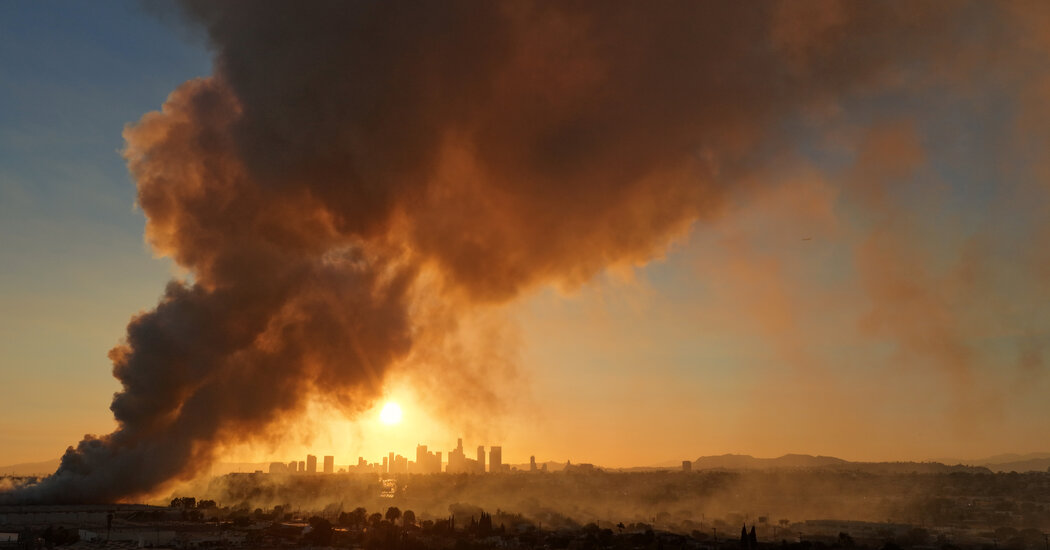
For five agonizing days, a thick, suffocating shroud of ash and toxic vapor has hung heavily over the working-class neighborhood of Boyle Heights, transforming the iconic Los Angeles skyline from its usual sun-drenched horizon into a grim, dystopian landscape of gray misery. While the billowing black plume that initially sat east of the downtown skyline has slightly thinned to a diluted haze, the relief is purely visual; for the families living in its shadow, the air remains a hostile force that invades their sanctuary, burning their throats, stinging their eyes, and inducing relentless, throbbing headaches. During the worst of the blaze, the community experienced an eerie, midday twilight where the sun was choked out entirely, reducing visibility on residential streets to mere car-lengths and rendering simple acts of stepping outside a dangerous hazard. Among those trapped in this environmental nightmare is eighty-year-old Consuelo Granadas, who stands outside her home, her voice heavy with the exhaustion of enduring what she calls an endless “hell” of unyielding, putrid odors. Like many in this tight-knit community, her survival strategy is dictated not by convenience, but by love; despite the overwhelming urge to escape the toxic atmosphere creeping through the cracks of her doors, she refuses to abandon her beloved cat and two dogs, choosing instead to stay and breathe the foul air alongside the loyal companions who rely on her for survival.
Just a few blocks away, in the vibrant but economically vulnerable pocket of East Los Angeles, the daily rhythm of life has been thoroughly upended as residents grapple with the harsh financial realities of a sudden disaster. Mayra Grijalva, a sixty-year-old remote worker, describes a domestic life under siege where even the borders of her home have surrendered to the invasive smell of smoke, prompting her to tape her door frames in a desperate, yet largely futile, attempt to seal out the elements. Stepping out into her yard during a brief lunch break, she wears the modern armor of survival—a tight-fitting white N-95 mask and sunglasses—looking less like a suburban resident and more like an evacuee in an active disaster zone. As a county worker maneuvers down the street distributing government-funded air purifiers to masked neighbors waiting anxiously at their gates, the receipt of a free air purifier brings only minor comfort in the face of mounting financial strain. Having already drained over six hundred dollars of her hard-earned savings to secure a brief, pet-friendly hotel stay during the height of the smoke, Grijalva faces the terrifying prospect of financial exhaustion, unable to afford another costly night away from her home and deeply uncomfortable with the thought of taking her cherished pets to crowded, unfamiliar emergency shelters.
Below the choking haze, the physical battle to extinguish the source of the neighborhood’s misery remains a grueling, slow-motion war of attrition waged by the Los Angeles Fire Department. The source of the disaster is a monumental, 500,000-square-foot cold-storage warehouse operated by Lineage, a massive Michigan-based logistics firm, which at the time of the fire held an staggering forty-two thousand, five hundred tons of frozen food products. For days, the fire burned deep within the heavily insulated, thick exterior walls of the facility—structures engineered specifically to keep heat out, which ironically served to lock the destructive fire in, rendering traditional extinguishing methods completely useless. According to Captain Jacob Raabe of the LAFD, firefighters finally made a breakthrough over the weekend by shifting their tactics to a heavy-machinery offensive, using specialized tools to pry open the reinforced exterior shells of the building. This painstaking and dangerous demolition work has allowed crews to finally direct high-pressure water cannons and massive hose lines deep into the smoldering, previously inaccessible core of the facility, though the structural instability means that heavy water streams must be continually deployed from a distance to prevent a catastrophic collapse.
As the smoke slowly clears, the anger and anxiety of the local populace have turned toward the systemic questions of how such a colossal industrial giant was permitted to operate in such intimate proximity to human lives and multigenerational homes. Lineage, the warehouse operator, issued a public statement acknowledging the profound distress of the Boyle Heights community, emphasizing that the warehouse was used exclusively for frozen meat, bread, and other ordinary grocery items rather than hazardous chemical materials. While the company has taken proactive steps to ease the immediate suffering of its neighbors—providing masks, air purifiers, and food supplies, as well as importing specialized firefighting equipment from out of town—its corporate messaging has also focused on redirecting blame away from its own practices. Lineage alleges that the fire was not a result of its warehouse operations or personnel, pointing instead to a potential electrical failure during diagnostic tests conducted by Altus Power, the third-party company that owns and operates the sprawling solar panel array installed on the building’s massive roof. Altus Power has remained conspicuously silent in the immediate aftermath of these accusations, leaving residents caught in a frustrating limbo of corporate finger-pointing while they continue to inhale the singed remnants of thousands of tons of decaying food.
Despite the assurances that no explicitly hazardous materials were housed in the facility, the scientific assessment of the smoke paints a far more alarming picture for the long-term health of the surrounding community. The South Coast Air Quality Management District felt compelled to extend its public health warnings, registering “very unhealthy” air quality levels specifically centered over Boyle Heights even as neighboring areas began to see gradual environmental recovery. The unique danger of this event lies in the highly complex chemistry of industrial structural fires, which produce a cocktail of toxins that far exceed the health risks of routine city smog. As Suzanne Paulson, a professor of atmospheric and oceanic sciences at the University of California, Los Angeles, points out, standard urban air quality meters are designed to measure predictable, “garden-variety” metropolitan pollution like car exhaust and industrial baseline emissions. When a massive building constructed of modern building materials, insulation, plastics, and highly concentrated organic matter burns, the resulting smoke is exponentially more toxic, carrying fine particulates that can penetrate deep into human lung tissue and enter the bloodstream, posing a severe threat to children, the elderly, and those with pre-existing respiratory vulnerabilities.
For the residents of East Los Angeles and Boyle Heights, this environmental crisis is not viewed as an isolated accident, but rather as another chapter in a long history of environmental injustice visited upon working-class, primarily Latino communities. Walking through these vibrant streets, where the American and Mexican flags fly proudly side-by-side, the physical signs of systemic neglect are visible in the cracked, weed-choked sidewalks and the dense configuration of multigenerational households struggling to survive in one of the nation’s most prohibitively expensive metropolitan areas. Adrian Rolon, whose family home sits directly adjacent to the smoldering facility, voices the collective frustration of a community that feels systematically discarded by urban planning decisions that place high-risk commercial operations right next to bedrooms and backyards. While those with financial means can easily flee to air-conditioned hotels or distant relatives’ homes—as Rolon’s brother did, traveling two hours away to escape the fumes—vulnerable residents like Rolon’s ailing father have no such luxury. Ultimately, the fire highlights a painful socioeconomic divide: while the wealthy can purchase safety and clean air, the poorest residents of Los Angeles have no choice but to tape their windows shut, hunker down in the heat, and pray that they can survive the toxic air until the smoke finally clears.