


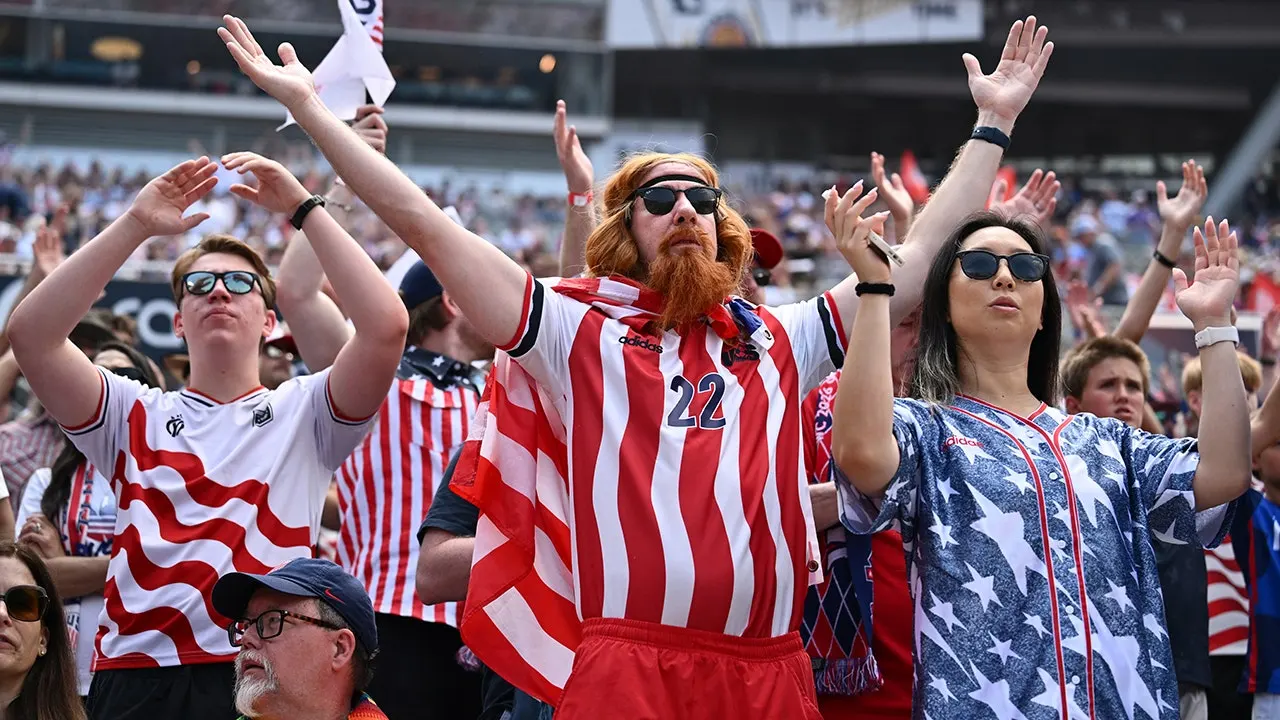
As the final whistle blew at Lumen Field this past Friday, the sound did not merely signal the end of ninety minutes of intense, breathtaking athletic competition; it served as the fuse for an extraordinary explosion of collective human joy. The United States Men’s National Team had just battled their way to a monumental 2-0 victory over a formidable Australian squad, a triumph that officially cemented their place in the prestigious knockout rounds of the World Cup. For the tens of thousands of passionate fans who had packed Seattle’s iconic stadium to its absolute limits, the victory was a moment of profound relief and unbridled celebration. But as the initial, deafening roars of triumph began to settle, a curious and beautiful transformation took place within the stadium. The thumping, synthesized beats of modern pop music and electronic dance anthems that typically dominate soccer stadiums were nowhere to be heard. Instead, a warm, organic acoustic guitar riff began to drift over the stadium speakers, followed by the unmistakable, nostalgic voice of folk icon John Denver singing the opening lines of “Take Me Home, Country Roads.” Within seconds, the sixty-thousand-strong crowd stopped their individual celebrations and united as one massive, echoing choir. They drowned out the stadium speakers entirely, belting out the heartwarming lyrics with a passion and intensity that seemed to shake the very foundations of the Pacific Northwest. It was a deeply moving spectacle as players on the pitch, exhausted from their physical exertions, stood in absolute awe of the auditory embrace raining down on them from the stands. This sudden, viral tradition of singing an old-school country-folk song at a high-stakes international soccer match may have seemed unexpected to casual observers, but it represented a carefully crafted, deeply human attempt to forge a unique identity for American soccer—one rooted in shared memory, nostalgia, and a collective yearning for home.
The genesis of this heartwarming musical tradition lies in a highly structured, yet surprisingly collaborative, initiative organized by soccer’s global governing body, FIFA. Ahead of the tournament, FIFA reached out to all participating member nations, requesting that they submit customized playlist options to be played at specific moments throughout the competition—including pre-match warmups, goal celebrations, and, most crucially, the highly coveted post-victory slot. Rather than delegating this task to a detached corporate marketing agency or a team of cold, analytical algorithms, the leadership at U.S. Soccer decided to approach the assignment as an opportunity to connect deeply with the heart and soul of the team. The federation initiated a democratic, organization-wide consultation process, seeking direct input from the players themselves, as well as the coaching staff, equipment managers, and physical therapists who form the quiet backbone of the national team. They were looking for songs that possessed a very specific set of characteristics: they needed to be widely recognized tracks created by iconic American artists, but more importantly, they had to feature infectious, easy-to-sing-along melodies that could easily transition from a car radio to a massive, cavernous sports venue. The goal was to find music that transcended generations, bridging the gap between the youthful, highly cosmopolitan roster playing on the pitch and the incredibly diverse tapestry of fans residing in the stands. In a country often defined by its cultural, geographic, and political fragmentation, finding a singular piece of music that could unite everyone under one emotional banner was no small feat, forcing the organization to dig deep into the rich history of the American songbook to find anthems that felt genuinely authentic, nostalgic, and universally welcoming to all who heard them.
The brainstorming sessions yielded a spectacular list of timeless American classics, but the process of securing these musical identities on the world stage proved to be a masterclass in soft power and cultural diplomacy. Highly favored anthems like Neil Diamond’s infectious, crowd-pleasing “Sweet Caroline” and the grand, introspective Oasis masterwork “Wonderwall” were quickly crossed off the list, as they had already been officially claimed and trademarked as victory anthems by the English national team, a country with a famously rich and deeply territorial history of terrace singing. This left the United States with a refined, yet potent, selection of classic tracks, including Bon Jovi’s adrenaline-pumping 1980s rock anthem, “Livin’ on a Prayer.” While the Jersey Shore rock classic remained a staple of the team’s locker room rotation, it was a profound, highly intuitive intervention by Amy Hopfinger that ultimately elevated “Take Me Home, Country Roads” to its current legendary status. Hopfinger, a former, highly respected U.S. Soccer executive who had transitioned into a crucial leadership role within FIFA, possessed a rare, innate understanding of how fleeting moments of crowd psychology can define the entire legacy of a sports tournament. She recognized that while high-energy rock songs are excellent for generating short-term excitement, they often lack the deep, emotional resonance required to foster a true sense of community and shared destiny. Hopfinger championed the John Denver masterpiece, arguing that its sweeping, melodic chorus and sentimental themes of homecoming and belonging were precisely what the American sporting public needed to anchor their collective soul. Her executive decision to lock the track in as the definitive post-match victory anthem would soon prove to be an absolute masterstroke, setting the stage for some of the most emotionally charged and culturally significant scenes of the entire World Cup.
The true magic of Hopfinger’s visionary decision was realized almost instantly when the beautiful game transitioned from theoretical planning to the hard, unforgiving reality of the tournament pitch. The tradition initially sparked to life in the sunny, sprawling metropolis of Los Angeles, where the USMNT delivered an absolutely dominant, breathtaking 4-1 performance to dismantle a highly physical Paraguay team in their opening fixture. As the final whistle echoed through the Southern California air and the familiar, rustic notes of “Country Roads” began to filter through the stadium’s sound system, the crowd’s spontaneous, passionate response sent shivers down the spines of everyone in attendance. However, it was in the emerald, rain-kissed city of Seattle where this burgeoning musical phenomenon truly solidified its place in the annals of American soccer folklore. Under the cool, gray skies of the Pacific Northwest, the forty-thousand-plus supporters did not merely sing along; they completely hijacked the song, their voices rising in a powerful, synchronized wave that rendered the stadium’s massive, multimillion-dollar audio system entirely obsolete. On the pitch, players who had spent the previous ninety minutes sprinting, tackling, and enduring immense physical pain stopped in their tracks, looking up at the towering stands with expressions of pure wonder, disbelief, and profound gratitude. They clapped, swayed, and waved to the crowd, completely enveloped in a warm, resonant blanket of human connection. For these elite athletes—many of whom spend their professional lives playing in distant, pressure-packed European leagues far away from their families—the simple, heartfelt lyrics about returning home served as a deeply comforting, grounding reminder of the deep roots they represent and the proud nation standing firmly at their backs.
Beyond the emotional and cultural triumphs echoing through the stadium concourses, the USMNT’s brilliant performances on the pitch have put them in an enviably commanding position as the tournament progresses. Their hard-fought, tactically supreme victory over Australia did far more than just capture the imagination of the public; it mathematically secured their highly coveted spot in the knockout stages and guaranteed them the top spot in Group D with a game to spare. This spectacular achievement has bestowed a rare and precious gift upon the young squad: the luxury of approaching their final, highly anticipated group-stage match against a tough Turkish side with absolutely zero competitive anxiety. With the immense pressure of potential elimination completely lifted from their shoulders, the head coach and his coaching staff can utilize this upcoming fixture against Türkiye as a highly valuable tactical laboratory. They can rest key starting players who have carried a heavy physical workload, give crucial tournament minutes to hungry reserve players, and implement experimental systems without the terrifying fear of catastrophic consequences. Regardless of what transpires on the pitch against Türkiye, the Americans have already earned their ticket to Northern California. The squad will soon be heading to the beautiful, breezy Bay Area to begin their intense, meticulous preparations for a high-stakes Round of 32 matchup. There, they will face a battle-tested, highly motivated third-place finisher emerging from the chaotic, unpredictable group-stage dogfights of Groups B, E, F, I, or J, carrying with them the formidable momentum of a team that has not only won on the scoreboard but has also captured the hearts of an entire nation.
In the grand, historical tapestry of international soccer, the most iconic and enduring tournaments are rarely remembered solely for the clinical tactical formations deployed on the pitch or the statistics recorded in the official archives; instead, they are immortalized by the rich cultural phenomena and human connections that sprout organically in the stands. From the deafening, hypnotic buzz of the vuvuzelas during the historic 2010 World Cup in South Africa to the hopeful, melancholy choruses of “Three Lions” echoing through crowded English pubs, music has always served as the true, emotional heartbeat of the world’s game. Through their spontaneous, passionate embrace of John Denver’s timeless folk masterpiece, the USMNT and their rapidly growing, intensely loyal fan base have discovered a powerful, unifying piece of folklore that belongs uniquely to them. As the team prepares to leave the cozy group-stage confines of Seattle and Los Angeles to enter the unforgiving, high-stakes pressure cooker of the single-elimination knockout rounds, this simple song has transcended its status as a mere stadium playlist entry. It has evolved into a beautiful, potent symbol of home-field advantage—a melodic reminder of community, resilience, and national pride. The young American squad marches forward into the unknown, buoyed not just by their exceptional athletic conditioning and sharp tactical masterplans, but by the tangible, inspiring power of an entire country singing back to them in perfect harmony. They will take to the pitch in the Bay Area and beyond, fueled by the collective hope that their historic World Cup journey will continue long enough to hear those beautiful, familiar country roads lead them all the way to ultimate glory.