




In the autumn of 1969, the air over Staten Island carried the scent of salt water, burning leaves, and the restless energy of a changing New York. Inside the drafty hardwood gymnasium of Blessed Sacrament Roman Catholic Church, two adolescent boys, Doug Bertinelli and Pat Hannafin, crossed paths for the first time as teammates on the parish basketball team. They were young, quick-footed, and possessed an intense, quiet dedication to the game that immediately bonded them. That winter, under the harsh hum of fluorescent lights and the watchful eyes of parish coaches, they fought their way to a local championship, establishing a rhythm of teamwork and mutual trust that would define the rest of their lives. Basketball was more than a sport to them; it was the language through which they deciphered the world around them. As the Verrazzano-Narrows Bridge loomed large in the background of their childhoods, symbolizing a connection to the grander stage of the five boroughs, the two boys spent their free hours dreaming of the professional arena across the harbor. They learned to read each other’s movements on the court without speaking, establishing a telepathic friendship that survived the transition from childhood innocence to the grit of young adulthood. Little did they know, as they hoisted their very first trophy together, that they had just initiated a lifelong pact centered around the orange leather of a basketball and the fortunes of a single professional franchise.
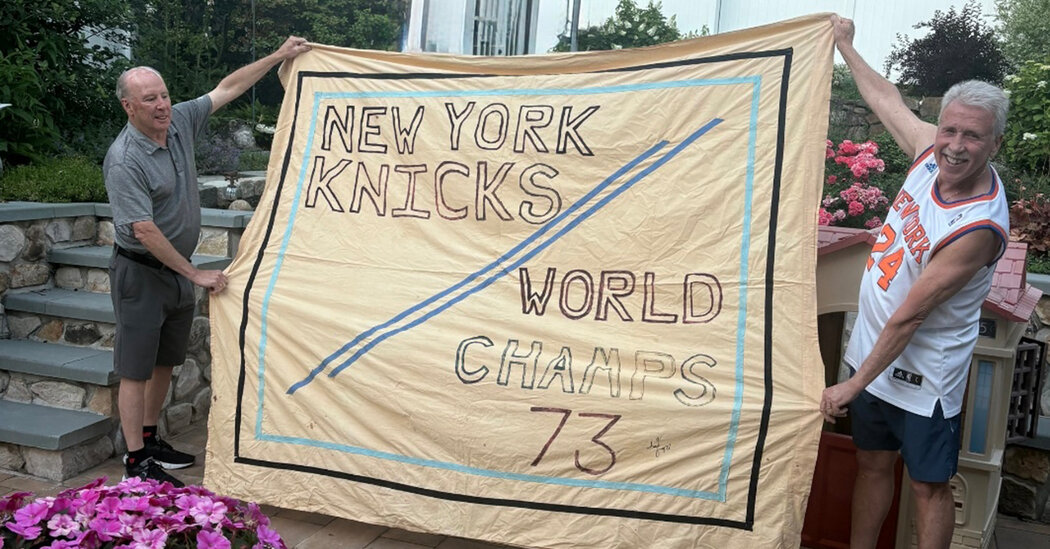
By 1970, their shared passion had naturally gravitated toward the Madison Square Garden, where the legendary New York Knicks were marching toward greatness. As teenagers, Doug and Pat proved their devotion by waiting overnight on the cold, concrete sidewalks of Eighth Avenue, huddled in heavy jackets, just to secure tickets to watch their heroes capture a historic title. Three years later, in 1973, they were high school seniors at St. Peter’s Boys High School, navigating the exciting, uncertain precipice of adulthood. Money was scarce, but Doug scraped together every penny he earned from his grueling part-time shifts as a grocery store cashier and stock boy to ensure they could return to the Garden to watch the Knicks secure a second championship. To commemorate the triumph, Pat raided his family’s linen closet for a plain white bedsheet and, with the bold, permanent strokes of a black magic marker, fashioned a homemade banner to carry through the joyous, chaotic victory celebrations in Manhattan. Clutched tightly between the two best friends, that simple piece of cotton became a sail catching the wind of their youth. It was a physical manifestation of their shared passion, representing a moment of pure, unadulterated triumph that they paraded through the roaring canyons of Midtown, believing with the naive optimism of youth that such victories would always be just around the corner.
But as the vibrant, golden era of the 1970s Knicks began to fade, so too did the immediate opportunities for celebration, forcing the young men to confront the sobering realities of working-class adulthood. Both Doug and Pat found employment with the New York City Sanitation Department, embarking on careers defined by heavy lifting, pre-dawn winter winds, and the physical toll of keeping a massive metropolis clean. Despite working in different boroughs—Pat conquering the competitive, early-morning commercial routes of Manhattan, while Doug climbed the ranks to become a respected supervisor on Staten Island—their lives remained deeply synchronized. They welcomed their first daughters into the world just three days apart, anchoring their families in a parallel timeline of domestic joy and sleepless nights. Whenever Pat was scheduled to work on Staten Island, Doug would use his managerial leverage to ensure they were paired together, spending long, exhausting shifts sharing the cab of a sanitation truck, trading stories and debating team rosters over the rumble of the diesel engine. Through it all, Pat stubbornly refused to adopt modern technology, never purchasing a mobile phone and keeping the exact same landline phone number for over fifty years. It was a number that Doug memorized so deeply that it became a permanent fixture of his mind, a direct line to a bygone era of reliable, analog friendship.
As the years rolled on, the Knicks’ championship drought stretched from winters into decades, transforming their youth into memories and their children into adults. Doug eventually retired and relocated to the quiet coastal town of Barnegat, New Jersey, while Pat remained on Staten Island, transitioning into a self-described sports memorabilia hoarder whose attic became an archive of ticket stubs, faded programs, and historical markers of New York sports. The physical distance between New Jersey and Staten Island could have easily eroded a lesser friendship, but the bond between the two retired sanitation workers remained completely impenetrable. Whenever the Knicks showed a flicker of hope, the old patterns immediately resurfaced, transcending the miles and the decades. When the team fell behind in a critical Game 3 of a recent playoff run, Doug did not hesitate to make the hour-plus drive from New Jersey to Pat’s home, just to sit on the same couch, order a greasy pizza, and lament the agonizing loss together. It was a comforting ritual that felt entirely unchanged from their teenage years, proving that the true value of their friendship lay not in the victories they celebrated, but in the shared resilience that allowed them to endure the losses side-by-side.
Then, against all odds, the long-awaited miracle finally occurred, and the New York Knicks captured the championship once more, sending a jolt of electricity through the aging hearts of the two lifelong friends. The peak of their excitement came when Pat ascended the creaky stairs of his attic, pulled aside decades of accumulated sports history, and unearthed the original 1973 bedsheet banner, carefully wiping away fifty-three years of New York dust to reveal the bold, hand-drawn lettering of their youth. Holding the fabric together again, the weight of their long journey settled over them; the banner was no longer just a piece of sports memorabilia, but a sacred shroud of their enduring brotherhood. Doug gladly drove up from New Jersey once more, picking up his oldest friend to make the sentimental journey to the championship celebration. Together, they boarded the Staten Island Ferry, just as they had done as teenagers in the early seventies, watching the familiar Manhattan skyline rise from the harbor. Clutched in their weathered, calloused hands—hands that had thrown basketballs, hauled heavy sanitation bags, and raised children—was the very same bedsheet, a relic of a lifetime of loyalty that had survived the relentless passage of time.
Standing amidst the roaring, modern crowd at the ticker-tape parade in Manhattan, surrounded by a new generation of fans clutching smartphones and wearing pristine, factory-made jerseys, Doug, 71, and Pat, 70, stood out as living monuments to devotion. The celebration was massive, far larger and louder than the intimate victory parades of their youth, but the core of their experience remained intensely personal. Although the physical distance of their retirement years meant they could no longer see each other as often as they liked, the ancient, wrinkled banner they held high above their heads proved that their connection to the team, and to each other, was entirely unbroken. As the confetti rained down like snow through the steel canyons of the city, catching in their gray hair and sticking to the old cotton sheet, the two men looked at each other and smiled with the same youthful exuberance they shared in 1969. Fifty-three years after they first carried their handmade sign through these very streets, they had returned as champions once more, illustrating that while players, seasons, and cityscapes will inevitably change, a true, blue-collar New York friendship is built to last forever.