


The Shattered Hull of the Narwhal: A Fearful Castaway on Korea’s Forbidden Shores
In the early spring of 1851, a year after her departed journey from the bustling port of Le Havre, the French whaling ship Narwhal met her violent end against the jagged, fog-shrouded rocks guarding the southwestern coast of the Korean Peninsula. Having braved the unforgiving gales of the Atlantic, rounded the notoriously tempestuous tip of Cape Horn, and negotiated the vast expanse of the Pacific Ocean via Tahiti and Honolulu, the vessel was ultimately betrayed by the volatile, shifting waters of what is now Shinan County. When the splintered wooden hull finally gave way to the sea, one crewman was lost to the deep, leaving twenty-nine weary, terrified survivors to drag themselves onto the powdery, rock-rimmed beaches of Bigeum Island. In the mid-nineteenth century, shipwrecked Westerners had every reason to fear the worst; rumor mills in distant maritime ports painted East Asian waters as realms of unchecked cannibalism, and Korea—historically known to outsiders as the fiercely isolationist “Hermit Kingdom”—had gained a reputation for lethal hostility toward foreigners. Only years prior, the ruling Joseon Dynasty had aggressively turned away Western merchant vessels and ordered the public execution of French Catholic missionaries who had entered the country illegally. Paralyzed by the grim prospect of execution or torture, nine of the surviving sailors made a desperate, high-stakes gamble: they repaired a small, damaged whaleboat and rowed into the open sea, successfully navigating the perilous yellow waters all the way to Shanghai. There, they alerted the French consul, Charles de Montigny, who immediately mobilized an armed rescue expedition, hoisted sail on a Chinese merchant lorcha, and charted a course back to Bigeum Island, braced for a bloody military confrontation with a hostile local populace.
The Repas Pittoresque: How Chilled Champagne and Milky Makgeolli Broke the Ice
Instead of the anticipated massacre, the heavily armed rescue party was met with an extraordinary diplomatic compromise that Charles de Montigny would later immortalize in his official dispatches to Paris as a repas pittoresque—a picturesque and profoundly peaceful meal. The islanders of Bigeum, bounded by a centuries-old Confucian code of hospitality that mandated the humane treatment of shipwrecked travelers, chose compassion over conflict, greeting the heavily armed, blue-eyed foreigners not with spears and arrows, but with abundant tables of local food and earthenware jugs filled with makgeolli, Korea’s signature milky, sweet-sour rice wine. To return the gesture, the French consul opened his personal store of fine wines and cracked open bottles of Champagne, marking the very first time in recorded East Asian history that a Korean delegation tasted the effervescent sparkling wines of France. This unprecedented cross-cultural exchange, characterized by the light-hearted clinking of clay bowls against European glassware under the spring sun, prompted the delighted consul to write in his journals, “Rarely have I seen men drink as Koreans do.” Eyewitness accounts published by James MacDonald, an English merchant traveling with the French expedition, and preserved in the archives of Shanghai’s North-China Herald, painted a scene of vibrant curiosity where local women watched the strangers from behind dirt dikes like timid ducks, and villagers eagerly picked up French nouns like soleil and terre while trading local tobacco. Royal records from the Joseon court backed up these charming Western accounts, noting with clinical fascination that the castaways had hair like “sheep’s wool” and eyes resembling “blue and yellow glass,” but praising their peaceful demeanor as the islanders helped them build mock ships out of hand gestures to communicate their desire to return home. When the French rescue ship finally departed Bigeum Island, it carried away not only the twenty-eight rescued whalers but also several traditional Korean clay makgeolli jugs, three of which survived the journey to Europe and remain preserved to this day in the National Ceramics Museum in Sèvres, France, as quiet monuments to a forgotten peace.
Echoes Across a Century and a Half: The Modern Champagne-Makgeolli Festival of Bigeum Island
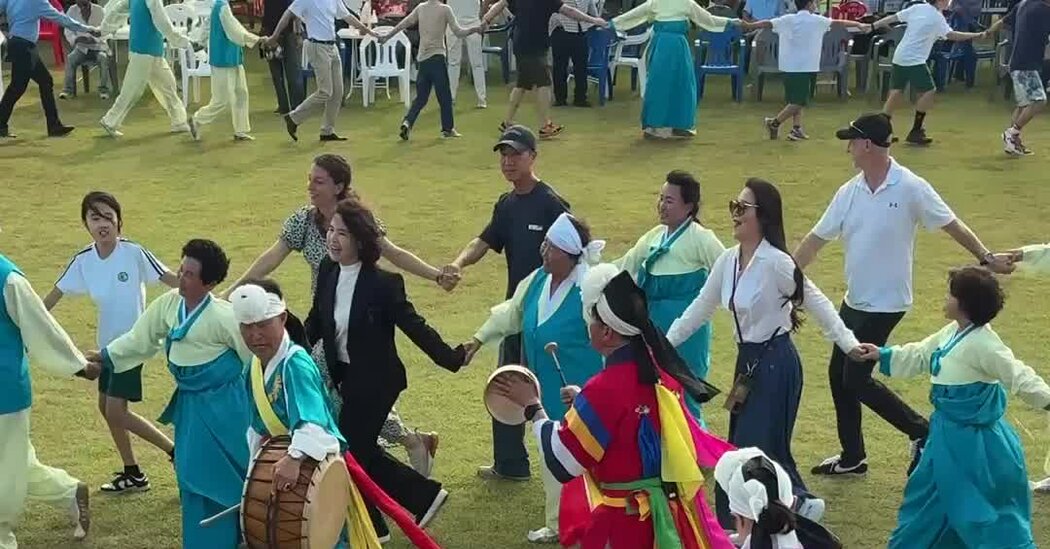
Some 175 years after the Narwhal ran aground, the descendants of those insular 19th-century islanders gathered alongside a diverse cohort of European expatriates, local officials, and curious tourists to celebrate the third annual Champagne-Makgeolli Festival on a sun-drenched lawn on Bigeum Island. Where ancestors once eyed foreigners with defensive caution, modern residents welcomed their guests with open arms, clinking premium French sparkling wines against rustic, traditional bowls of local Korean rice wine in a noisy, joyful display of historical reconciliation. Under the brilliant afternoon sky, the air filled with the sounds of laughter and music, as children visiting from a French international school in Seoul belted out classic French chansons like “Les Champs-Élysées” and “La Vie en Rose,” before joining hands with elderly islanders to perform the Ganggangsullae, a traditional, UNESCO-recognized Korean circle dance that has been performed on the southern coast for centuries. For local salt farmers like 66-year-old Noh Myong-jin, who watched the lively international crowd dance across the grass, the festival was a deeply emotional affirmation of his community’s place in global history, proving that even the smallest, most isolated regions can hold a rich international legacy. “Our small island is finally getting recognition,” Mr. Noh reflected with visible pride, “all thanks to the humanity and kindness that our ancestors showed to those stranded French sailors so long ago.” Today, this unique festival serves as a living bridge between a closed, defensive past and a highly globalized present, transforming what could have been a tragic footnote of naval history into a vibrant,每年 (annual) celebration of cross-cultural friendship and diplomatic hospitality.
A Sea of Silence: Depopulation and the Quiet Crisis of the Shinan Archipelago
However, beneath the festive music and the flowing wine lies a sobering, modern reality: Bigeum Island and the broader Shinan archipelago in South Jeolla Province are facing an existential crisis of demographic collapse that threatens their very survival. The surrounding waters remain as wild, beautiful, and treacherous as they were when the Narwhal foundered, with hundreds of islands rising and falling like mountain ranges through the dense coastal fog and vast, muddy tidal flats appearing and disappearing with the heavy tides. For generations, this harsh but abundant marine environment sustained a thriving local economy based on the harvesting of mud crabs, octopuses, and premium sea salt, but decades of aggressive urban migration to Seoul and plummeting national birthrates have hollowed out these rural communities. When salt farmer Noh Myong-jin was a child, Bigeum Island boasted five bustling primary schools filled with local children; today, only two remain open, their classrooms mostly empty and quiet. Many villages appear entirely deserted during the day, populated only by elderly residents riding motorized mobility carts and Southeast Asian migrant workers who have arrived to tend the region’s sprawling spinach and onion farms. Public image problems have also plagued the region, stemming from historical labor exploitation scandals on some of Shinan’s remote salt farms, making the islands a place that few young South Koreans choose to visit, let alone call home. “We won’t have any children left here at all without foreign families and brides like me,” warned Alma A. Barbarona, a native of the Philippines who fell in love and married a local Shinan salt farmer in 2003, highlighting the demographic shift that is quietly transforming the social fabric of rural Korea.
Reimagining the Archipelago: From Traditional Salt Flats to a Global Art Sanctuary
Recognizing that agricultural commodities alone cannot save the region from fading into obscurity, the local government of Shinan County has launched an ambitious cultural rescue mission, pivoting toward history, public land art, and eco-tourism to reinvent the identity of the islands. Orchestrated by visionaries like Kang Hyoungkee, the chairman of Shinan’s Arts Island Foundation and the creative architect behind the Champagne-Makgeolli Festival, the county has set out to transform its scattered islands into a massive, open-air “art archipelago.” “You can only go so far with onions and spinach,” Mr. Kang observed, emphasizing the need for creative economic development. “We want Shinan to be a unique global destination offering profound sensory and cultural experiences that Seoul and other hyper-dense cities simply cannot replicate.” To achieve this, the local government has invited world-renowned international architects and artists to install permanent, site-specific installations across the islands, including masterworks by Icelandic-Danish artist Olafur Eliasson, British sculptor Antony Gormley, and Swiss architect Mario Botta. Just this month, celebrated Japanese installation artist Yukinori Yanagi began work on a thought-provoking piece where live ants tunnel through national flags constructed from vibrant sand, carrying colored grains across artificial borders to symbolize unity and migration. “Borders are artificial constructs created by politics and history,” Mr. Yanagi remarked, reflecting on the historical parallels of the project. “But nature, much like the ants and the ocean, knows no borders.”
Lessons from the Hermit Kingdom: Why an 1851 Shipwreck Still Matters in an Interconnected World
The remarkable, long-forgotten narrative of the Narwhal and its peaceful rescue was only recently recovered from historical obscurity, thanks to the meticulous archival research of Pierre-Emmanuel Roux, a professor of East Asian history at Université Paris Cité. Professor Roux’s newly published academic history of the incident, coupled with a popular Korean graphic novel adaptation released earlier this year, has shed fresh light on how the Joseon Dynasty maintained a surprisingly humanitarian, legalistic approach toward shipwrecked foreigners, despite its official state policy of aggressive isolationism. While historical standard-textbooks often present the 19th-century Hermit Kingdom as a xenophobic regime that viewed Westerners as “foreign barbarians,” the peaceful resolution on Bigeum Island proves that human empathy and international codes of maritime rescue frequently triumphed over nationalistic ideology. For young visitors like 32-year-old French national François Alonso, who traveled to Bigeum Island to attend the cultural festival, the historic encounter holds a powerful, timely message for our modern, hyper-connected yet deeply divided world. “They had absolutely no shared language, no internet, and no prior knowledge of each other’s existence, and yet they managed to find common ground and share a beautiful moment of peace,” Mr. Alonso observed, gesturing toward the celebrating crowd. “Today, we have all the information in the world at our fingertips, yet we are still fighting all the time.” Ultimately, the enduring legacy of the Narwhal shipwreck—preserved in the historic clay jugs of Sèvres and celebrated in the annual toasts of Bigeum Island—remains a powerful testament to the timeless, borderless capacity of human kindness.