

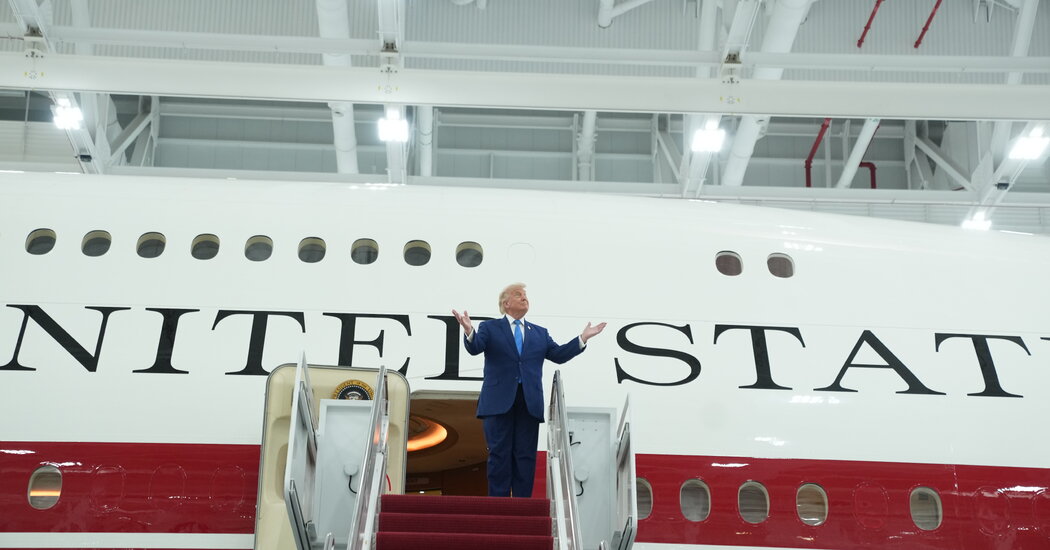
Standing inside a massive, newly constructed hangar at Joint Base Andrews, President Donald Trump formally closed a thirty-year chapter of American aviation history by unveiling a striking new vision for Air Force One. The iconic, soft pastel-blue and white aesthetic that has defined the flying symbol of the American presidency since the administration of George H.W. Bush has been set aside in favor of a bold, highly polished red, white, and blue livery. This dramatic change in visual identity represents more than just a fresh coat of paint; it acts as a physical manifestation of the president’s long-standing desire to reshape the classic symbols of American statehood in a style tailored to his personal taste. Addressing the crowd, the president expressed his pride in the sleek lines of the massive Boeing 747, explaining that the transition was born out of a realization that other international leaders were traveling in aircraft that far outclassed the aging American fleet. To accommodate this larger, more imposing dual-deck aircraft, the government had to construct an entirely new hangar facility, transforming the tarmac into a stage for a new era of global diplomacy. For the president, the vibrant new colors are not merely decorative but are a direct statement of national prestige, signaling strength, modernization, and a clean break from the visual traditions of the late twentieth century.
While the physical transformation of the aircraft has captured public attention, the complex geopolitical and financial story behind its acquisition has sparked intensive debate across Washington. For over a decade, lawmakers from both sides of the political isle had quietly agreed that the twin baby-blue Boeing 747-200B aircraft, which had served faithfully since 1990, were suffering from persistent, costly maintenance issues and desperately needed replacing. However, the path to obtaining a replacement took an unexpected turn when the United States accepted a modern, luxury Boeing 747 jetliner donated directly by the government of Qatar—an incredibly valuable asset estimated by industry experts to be worth approximately $200 million. This unusual gift immediately drew sharp scrutiny from congressional ethics watchdogs and lawmakers, who questioned whether the prominent Middle Eastern nation was attempting to garner improper influence over American foreign policy. Brushing aside these ethical concerns with his characteristic business-minded pragmatism, the president warmly praised the Qatari government for their generosity, characterizing the donation as a timely solution to a bureaucratic “logjam” that had stalled the production of two other Boeing 747-8 aircraft ordered in 2018. Because those primary replacements are delayed and unlikely to be fully operational before the end of his second term, this high-end Qatari jetliner was brought in as a vital “bridge” plane to prevent the executive branch from being left without reliable, state-of-the-art transportation.
Beneath the polished exterior of this donated luxury jet lies a complex engineering challenge, as military officials work tirelessly to convert a civilian passenger craft into a secure command center capable of operating during a national crisis. Defense experts and congressional representatives have voiced intense concern over whether the Air Force has been given sufficient time to fit the aircraft with the highly advanced defensive systems required to protect the commander-in-chief from modern threats. Transforming a commercial airliner into a high-security aerial fortress is an incredibly specialized process, with Troy Meink, the Air Force secretary, previously testifying that such extensive modifications would cost upwards of $400 million. These critical upgrades include installing highly sophisticated countermeasures against incoming anti-aircraft missiles, hardening the plane’s electrical systems against the devastating electromagnetic pulses generated by a nuclear blast, and setting up secure, encrypted communication networks that allow the president to command the armed forces from mid-air. Despite the immense pressure from a White House eager to deploy the aircraft as soon as possible, defense engineers have been working around the clock since September to ensure that the plane can pass its upcoming “initial commissioning flights,” which serve as a rigorous final exam before the military signs off on carrying the president.
Stepping inside the cabin of this redesigned flying White House reveals an environment where high-stakes global politics meets extreme executive luxury. The interior design of the aircraft has been completely overhauled, replacing the utilitarian, corporate feel of previous decades with a warmer, highly customized aesthetic dominated by supple leather and an elegant palette of gold and rich tan tones. The heart of the plane features a spacious executive conference room centered around a clean, square desk flanked by four plush captain’s chairs, designed to host intense, closed-door strategy sessions with cabinet members and foreign dignitaries high above the clouds. A modern television screen dominates one wall, while another features a carefully chosen, framed print of a wild duck peacefully swimming in the Reflecting Pool in Washington, showcasing a highly personalized touch of Americana amidst the high-tech surroundings. This interior redesign is the latest in a series of steps by the president to put his distinct hallmark on the architectural and design landmarks of the presidency, echoing his previous aesthetic interventions in the Oval Office, the White House ballroom, and the historic grounds of the National Mall.
As the administration prepares to take delivery of this modern marvel, a wave of nostalgia has swept through the West Wing as officials bid a fond farewell to the historic aircraft that carried American leaders through some of the most critical moments of the modern era. The president revealed that his late-night return flight from a high-profile dinner with French President Emmanuel Macron at the legendary Palace of Versailles represented the final official journey for the iconic, older presidential planes. For the diplomatic staff, security personnel, and journalists who spent countless hours working within those blue-and-white walls, the retirement of the fleet marks the end of a deeply personal era of shared history and sleepless transatlantic journeys. White House Communications Director Steven Cheung took to social media to express the collective sentiment of the administration, writing “well done, good and faithful servant” in tribute to the retired aircraft. Recognizing the immense cultural and historical value of these retired machines, which watched over the world during the end of the Cold War and the turbulent decades that followed, the president confirmed that they will not be sold for scrap but will instead be preserved in a museum, allowing future generations of Americans to walk through the cabins where history was made.
Looking forward, the stage is set for a highly theatrical and patriotic debut that will showcase the brand-new Air Force One to the American public and the wider world. The president announced his grand plan to have the gleaming red, white, and blue flagship lead a massive, ceremonial flyover of the nation’s capital on the Fourth of July, flanked by a protective escort of cutting-edge F-22 and F-35 military fighter jets. This planned aerial display is designed to serve as a powerful assertion of American military capability and technological progress, blending the pageantry of national celebration with the practical realities of executive power. As the Air Force technicians prepare to conduct the final safety sweeps and flight trials over the coming weeks, the new aircraft stands as a symbol of the intersection of international diplomacy, domestic political debate, and aesthetic transformation. Whether viewed as an unnecessary luxury, a controversial diplomatic gift, or a much-needed upgrade to national security, the new red, white, and blue 747 is officially ready to carry the heavy weight of the presidency into a new and unpredictable chapter of history.