


For as long as humans have navigated the vast expanses of our globe, Australia’s geographical isolation has served as both a defining character of the continent and an intimidating hurdle for international travel. In the mid-twentieth century, embarking on a journey from the sun-drenched harbor of Sydney to the historic, rain-swept streets of London was less of a routine flight and more of an epic, grueling saga. When Qantas first established the legendary “Kangaroo Route” in 1947, the trip was a multi-day test of endurance, requiring passengers to stop seven separate times across various continents to refuel, rest, and repair. Each stopover represented a logistical challenge, an interruption in momentum, and a heavy physical toll on those strapped into the noisy, unpressurized cabins of the era. Over the next eight decades, the driving force of human innovation and a relentless desire for closer connections steadily chipped away at these barriers, with every consecutive generation of aircraft successfully eliminating another stop from the itinerary. Today, we stand on the precipice of the ultimate realization of this historical quest: Project Sunrise. This ambitious initiative is poised to completely banish the stopover to the history books, bridging the final gap in global aviation. Qantas Group CEO Vanessa Hudson recently celebrated this milestone as the single most significant leap in the airline’s storied 105-year history. Her words remind us that the company was founded on the fundamental belief that physical distance should never stand in the way of human connection. By finally conquering this “final frontier” of long-haul travel, the airline is fulfilling a promise first articulated in 2017, proving that with enough determination, we can rewrite the rules of geography.
The crown jewel of Project Sunrise is the newly confirmed Sydney-to-London direct flight, which is officially scheduled to make its historic commercial debut in October 2027. Covering a mind-boggling distance of more than 16,000 kilometers across massive mountain ranges, vast deserts, and deep oceans, this flight will keep travelers airborne for between 19 and 22 hours, representing a true marvel of modern scheduling and pacing. The absolute convenience of this flight cannot be overstated; it fundamentally alters the mental and emotional landscape of international travel. Imagine boarding a state-of-the-art jet beneath the afternoon warmth of New South Wales, settling in as the plane climbs to cruising altitude, sleeping, reading, watching movies, and eventually stepping off into the chilly morning air of the United Kingdom without ever having to navigate the stressful maze of a mid-way transit airport. For decades, the journey between these global hubs has been defined by midnight layovers in foreign airports, frantic dashes to connecting gates, and the persistent anxiety of lost luggage in distant transit hubs. By offering a continuous, uninterrupted aerial passage, Project Sunrise replaces physical fatigue and travel anxiety with a seamless journey. This London connection is merely the opening chapter of a bold new travel era, as Qantas has confirmed that a non-stop Sydney-to-New York route will quickly follow, with official launch timelines for the American route slated for release next year. For families separated by massive oceans, business leaders managing tight calendars, and adventurers seeking to make the most of their precious time, this development means a world where loved ones and opportunities are closer than they have ever been.
To fully appreciate the scale and ambition of Project Sunrise, we must look at the current competitive landscape of ultra-long-haul commercial aviation. Presently, the crown for the world’s longest regularly scheduled non-stop passenger flight belongs to Singapore Airlines and its celebrated route between Singapore and New York. This route spans an incredible 15,349 kilometers, keeping passengers aloft for just under 19 hours. However, a significant operational and philosophical difference exists between Singapore Airlines’ strategy and the path Qantas has chosen to forge. Singapore’s flagship flight is configured exclusively for premium passengers, featuring only business and premium economy cabins while completely omitting standard economy seats to keep the aircraft light and spacious. In contrast, Qantas is charting a far more democratic course. Currently, the longest direct commercial flight that actually accommodates standard economy passengers is Qantas’ own route between London and Perth on Australia’s west coast, covering 14,499 kilometers over 16 to 18 hours. This Perth-to-London sector served as a critical psychological and physical proof of concept, proving that ordinary travelers are highly eager to trade the interruptions of a physical stopover for an uninterrupted, albeit exceptionally long, journey. Project Sunrise is designed to push past this established threshold, extending the physical boundary by more than 1,500 additional kilometers and stretching maximum flight times by up to four hours more. It is a bold, calculated gamble on human resilience and modern industrial design, forcing a complete rethinking of how we manage sleep, hydration, nutrition, and mental health when suspended eleven kilometers above the earth for nearly a full day.
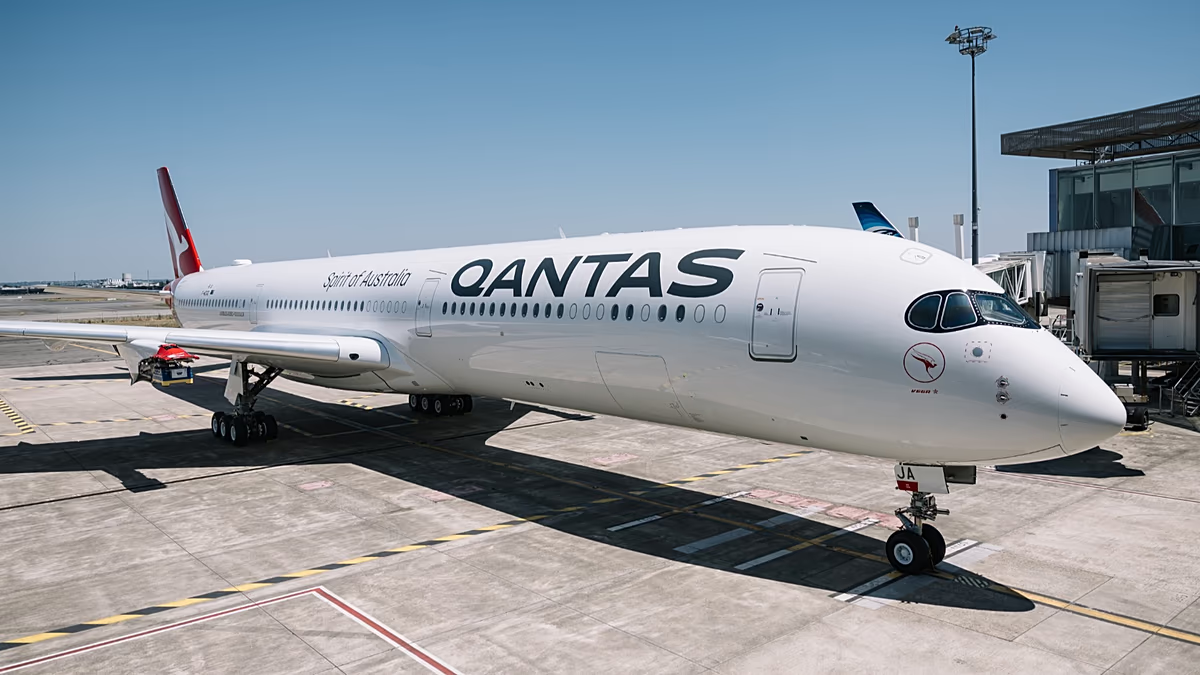
At the technical heart of this historical program is an extraordinary masterpiece of modern aerospace engineering: the specially customized Airbus A350-1000ULR (Ultra Long Range). A standard, commercially configured Airbus A350-1000 is a massive twin-aisle widebody jet typically designed to carry up to 480 passengers in high-density seating. However, to make the impossible possible, Qantas and Airbus had to completely redesign the interior weight distribution and fuel capacities of the aircraft. The Project Sunrise variant will carry a maximum of just 238 passengers, heavily restricting the payload to offset the immense weight of the fuel necessary to sustain such a massive journey. To keep the aircraft flying over 16,000 kilometers non-stop, Airbus has outfitted the A350-1000ULR with a specially designed 20,000-liter auxiliary fuel tank integrated directly into its fuel system. This incredible addition grants the jet the unique ability to stay airborne for up to 22 hours, even when battling strong headwinds across changing weather systems. Qantas has committed to taking delivery of a specialized fleet of 12 of these cutting-edge aircraft, each meticulously engineered to balance weight, luxury, and passenger physical health across four distinct cabin classes. The manufacturing reality of Project Sunrise is already rapidly advancing; the airline has proudly unveiled the first of these specialized aircraft, while a second twin-engine jet is currently undergoing an intensive, eight-week safety testing and certification program after successfully completing its maiden flight earlier this month. Every component of these aircraft is being pushed to its absolute structural and software limits during these rigorous evaluations, representing a collaborative high point between European manufacturing and Australian ingenuity.
Beyond the complex equations of weight, drag, and jet fuel, the ultimate success of Project Sunrise rests entirely upon the human experience. Spending nearly an entire day inside a pressurized cabin is a physical and psychological trial that tests the comfort and endurance of the human body. Recognizing this absolute reality, Qantas has taken a revolutionary approach to cabin layout, departing from the cramped, high-density configurations that define modern commercial aviation. Out of the 238 total seats available on the A350-1000ULR, Qantas has dedicated 140 specifically to economy class travelers, refusing to reserve ultra-long-haul travel only for those with premium ticket budgets. However, flying economy for up to 22 hours requires a radical rethinking of space, movement, and wellness. To help passengers survive and thrive, Qantas and its industrial design partners have integrated dedicated wellness zones directly into the aircraft’s architecture. These specialized spaces will serve as communal areas where economy passengers can leave their seats to stretch their limbs, practice guided physical movements to maintain healthy blood circulation, hydrate at built-ins, and converse with fellow travelers in a bright, open environment. The lighting, air purification systems, and cabin acoustics have also been scientifically calibrated to align with human circadian rhythms, helping passengers transition naturally between wildly different time zones. By prioritizing physical and mental well-being, Qantas is acknowledging that long-haul travel is a deeply human experience, establishing a new standard for how we care for human bodies on their long journeys home.
In the grand sweep of human history, progress is measured by our ability to overcome the raw physical limitations of the natural world, and Project Sunrise stands as one of the most spectacular monuments to this enduring quest. When the inaugural non-stop commercial service rolls down the runway in Sydney in October 2027, climbing into the skies bound for London, it will signal far more than just a successful commercial route or a luxury service. It will mark the dawn of a truly integrated global community, a historic moment where the geographic isolation that has defined the Australian identity for generations is permanently dismantled. This milestone is a living tribute to a century of collective dreaming, bold engineering, and the quiet bravery of aviation pioneers who once traversed oceans in fragile, open-cockpit planes. By reducing an exhausting, multi-stop voyage to a single, continuous, elegant flight, Qantas is not merely saving travelers hours of transit; they are fundamentally altering our relationship with time and space. The physical distances that once forced families to spend years apart and made international collaboration a slow, difficult task are being dissolved in real-time. As Project Sunrise expands to link Australia’s east coast directly with New York and other faraway metropolises, the planet will effectively grow smaller, more intimate, and vastly more accessible. This endeavor serves as a beautiful, powerful reminder that no horizon is truly unreachable and no frontier is final when met with the relentless force of human curiosity, determination, and technological execution.