



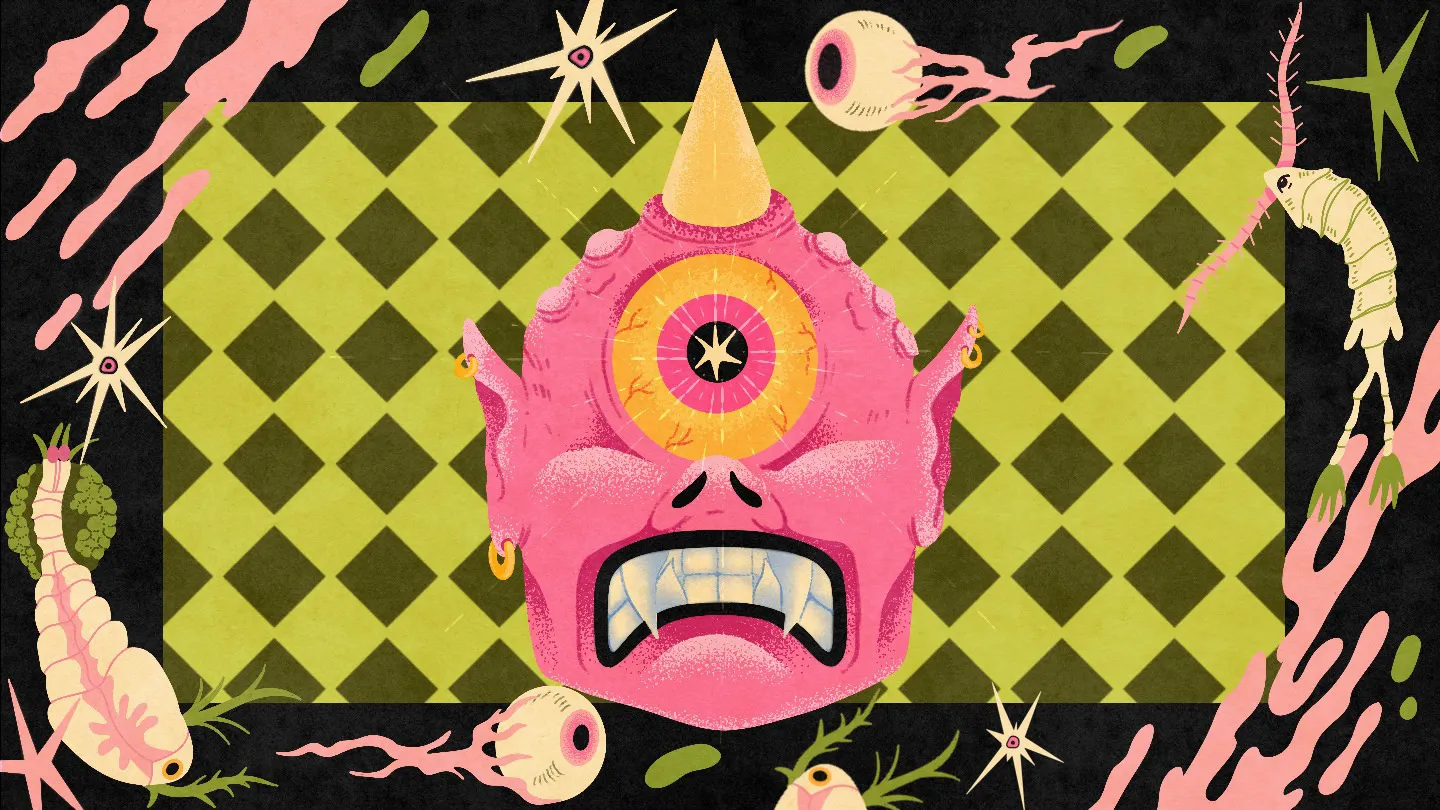
This July, moviegoers around the globe will step out of the summer heat and into the cool darkness of theaters to witness a cinematic rebirth of Homer’s epic, The Odyssey. Amidst the tempestuous seas, scheming gods, and legendary heroes, audiences are eagerly anticipating the return of cinema’s most terrifying and tragic antagonist: the Cyclops. This towering, one-eyed giant has haunted the human imagination for nearly three millennia, representing raw, untamed nature and the monstrous extremes of isolation. Yet, as Hollywood prepares to bring this mythological titan to life with cutting-edge visual effects, modern science offers a startling revelation that turns our understanding of this iconic beast completely upside down. Rather than sharing a genetic or evolutionary lineage with humans or other terrestrial vertebrates, the true counterpart to the legendary Cyclops is not to be found among giant anomalies or prehistoric humanoids. Instead, the real-world masters of the single-eyed existence are microscopic, dwelling quietly in our oceans, lakes, and even backyard puddles. These tiny water critters, known scientifically as copepods, possess a biological design that mirrors the ancient monster in ways that are both scientifically fascinating and deeply humbling to our human-centric view of the natural world.
To truly appreciate the bridge between these tiny aquatic marvels and the cinematic giant of The Odyssey, we must first look at the psychological and narrative weight that the Cyclops carries in our collective storytelling history. In Homer’s ancient text, Polyphemus the Cyclops is not merely a mindless engine of destruction; he is a complex character of profound isolation, a lonely shepherd who tends to his flocks in a secluded cave, speaking to them with unexpected tenderness before his violent encounter with Odysseus. This duality—of immense, frightening power juxtaposed with a vulnerable, isolated existence—makes the character prime for a modern cinematic reimagining. Visually, the single central eye has always challenged our deeply ingrained human instincts; our brains are hardwired from infancy to recognize and seek comfort in bilateral facial symmetry, particularly the two-eye configuration that allows us to read emotions and establish trust. When we look at a Cyclops, that biological expectation is dramatically disrupted, plunging us into the uncanny valley where fear and a strange, melancholic curiosity coexist. By presenting a monster that lacks the very visual cues we rely on to navigate social connections, filmmakers have long used the Cyclops to explore the fear of the unknown, of a beings that see the world through a radically different lens than our own.
Yet, if you shrink your perspective down from the towering cliffs of ancient Greece to the microscopic scale of a single drop of pond water, you will find a creature that has mastered this exact form of vision for hundreds of millions of years. This is the realm of the copepod, a class of tiny crustaceans that are among the most abundant multicellular organisms on Earth, outnumbering almost all other multicellular animals on the planet. Belonging to a group that includes the famously named genus Cyclops, these miniature wonders are characterized by a single, brilliantly colored eye located dead center on their foreheads. Known as a naupliar eye, this organ is not a complex, image-forming lens like the human eye; rather, it is a elegant, primitive sensory tool composed of a few light-sensitive cells shielded by a cup of dark pigment. For the copepod, this single eye is an exquisite masterpiece of evolutionary adaptation, acting as a highly efficient compass that detects changes in light intensity and direction. It allows them to engage in the largest daily migration on Earth, swimming upward to the ocean’s surface under the cover of night to feed on algae and retreating into the dark, protective depths of the abyss as the sun rises to escape the gaze of visual predators.
The evolutionary divergence between the binocular vision of humans and the monocular simplicity of these tiny water critters highlights a beautiful truth about how life adapts to its environment. On land, creatures like humans and predatory mammals evolved two forward-facing eyes to gain binocular depth perception, a critical necessity for calculating distances, hunting, and navigating a complex three-dimensional landscape filled with obstacles. For a microscopic organism drifting in an expansive aquatic medium, the physics of survival are entirely different. At the millimeter scale, the water around a copepod behaves less like a fluid and more like thick syrup, where molecular forces and light scattering dominate. A second eye would not offer any survival advantage; indeed, the biological cost of developing and maintaining a complex dual-eye visual system would be a wasteful expenditure of energy for a creature that primarily needs to distinguish between light and shadow, safety and danger. Thus, while a human with a single eye loses critical depth perception and spatial awareness, the copepod with its single naupliar eye is a perfectly optimized biological machine, navigating a vast and fluid world with a streamlined elegance that puts our bulkier, energy-intensive sensory organs to shame.
The human connection to this ancient mystery goes even deeper when we examine how our ancestors first came to imagine the Cyclops, a puzzle that bridges the gap between paleontology, mythology, and our innate desire to explain the inexplicable. Scholars and classicists have long theorized that the legend of the one-eyed giant was born when ancient peoples discovered the fossilized remains of prehistoric dwarf elephants that once roamed the islands of the Mediterranean, including Sicily and Crete. These ancient elephant skulls featured a massive, central nasal cavity where the trunk attached to the skull—a cavernous void that early humans, unfamiliar with living elephants, easily mistook for a single, giant eye socket situated in the middle of a humanoid forehead. This beautiful historical misunderstanding demonstrates how the human mind possesses an extraordinary capacity to weave stories around fragments of the natural world, transforming fossilized bones and ecological mysteries into immortal legends. It reveals a profound truth about ourselves: we are a species driven to find meaning in the earth beneath our feet, creating monsters to personify our fears of the wild, untamed forces of nature that we could not yet scientifically explain or control.
As the lights dim in theaters this July and the roar of the cinematic Cyclops echoes through the sound system, we are invited to look at this ancient monster with a renewed sense of wonder and connection that transcends simple Hollywood thrills. The journey of the Cyclops from the pages of Homer’s epic to the silver screen, and finally to the microscopic depths of our oceans, reminds us of the beautiful, invisible threads that connect the grandest human myths to the humblest reaches of biology. It challenges us to look beyond our own narrow, human-centric scale of existence and appreciate the diverse ways in which life perceives the universe. When we gaze upon the towering, CGI-rendered titan of The Odyssey, we are not just looking at a fantasy creature born of ancient imagination; we are looking at a giant, poetic reflection of the tiny, resilient copepods that navigate the global oceans every day. By understanding the science behind the myth, we humanize the monster, transforming our fear of the alien and the unknown into a profound respect for the endless creativity of nature, proving that the most extraordinary cinematic legends are often rooted in the quiet, microscopic wonders of our own physical world.