



A Royal House Divided: Japan’s Quest to Save the Chrysanthemum Throne
Behind the ancient, stone-walled moats of the Tokyo Imperial Palace, the world’s oldest continuous hereditary monarchy is facing a quiet but existential emergency. Japan’s imperial family, which has preserved an unbroken, male-only lineage of emperors stretching back more than two millennia, is rapidly running out of heirs to sustain its ancient traditions. In a historic and desperate attempt to avert a looming succession crisis, the nation’s legislature, the National Diet, has recently advanced a highly unusual legislative proposal. The government’s plan centers on a novel recruitment strategy: allowing the imperial household to officially adopt distant male relatives from noble lineages that were stripped of their royal status after the Second World War. By reintegrating these long-severed branches of the family tree back into the monarchy, conservative lawmakers hope to replenish the dwindling pool of potential heirs to the legendary Chrysanthemum Throne. Yet, this radical proposal has exposed deep fractures within Japanese society, laying bare a bitter ideological battle between traditionalists determined to protect patriarchal customs at all costs and a modern public that increasingly views these rigid rules as completely detached from the values of contemporary Japan.
The Daughter of the Emperor: Public Hopes and the Glass Ceiling of State Politics
The legislative push to adopt distant male commoners has sparked intense backlash from critics, activists, and progressive politicians, who argue that the government is ignoring a far more natural, popular, and uncomplicated solution: allowing women to ascend the throne. Amidst a rapidly modernizing society, continuous public opinion polls reveal that an overwhelming majority of the Japanese public—often hovering around eighty percent—fully supports the concept of a sovereign female empress. The face of this public hope is twenty-four-year-old Princess Aiko, the only child of the reigning Emperor Naruhito and Empress Masako. Princess Aiko has recently stepped into the public spotlight with great poise, capturing the nation’s heart during high-profile international engagements, including a widely praised diplomatic visit to Laos. “Many citizens want a female emperor now,” notes Kiyomi Tsujimoto, a prominent lawmaker with the opposition Constitutional Democratic Party who has vocally opposed the adoption bill. Tsujimoto emphasizes that everyday citizens regularly approach her to voice their support for the young princess, viewing her as the natural and logical successor to her father. However, within the highly conservative, male-dominated halls of Japan’s ruling Liberal Democratic Party (LDP), the prospect of a reigning empress is treated as an absolute nonstarter. Even highly influential female politicians, such as the prominent conservative leader Sanae Takaichi—who shattered political glass ceilings as a frontrunner to lead the domestic government—have stood firmly alongside the party’s old guard, insisting that the preservation of an uninterrupted male-only lineage is a sacred, non-negotiable tenet of imperial legitimacy.
By the Numbers: The Rapid Shrinkage of a Sacred Lineage
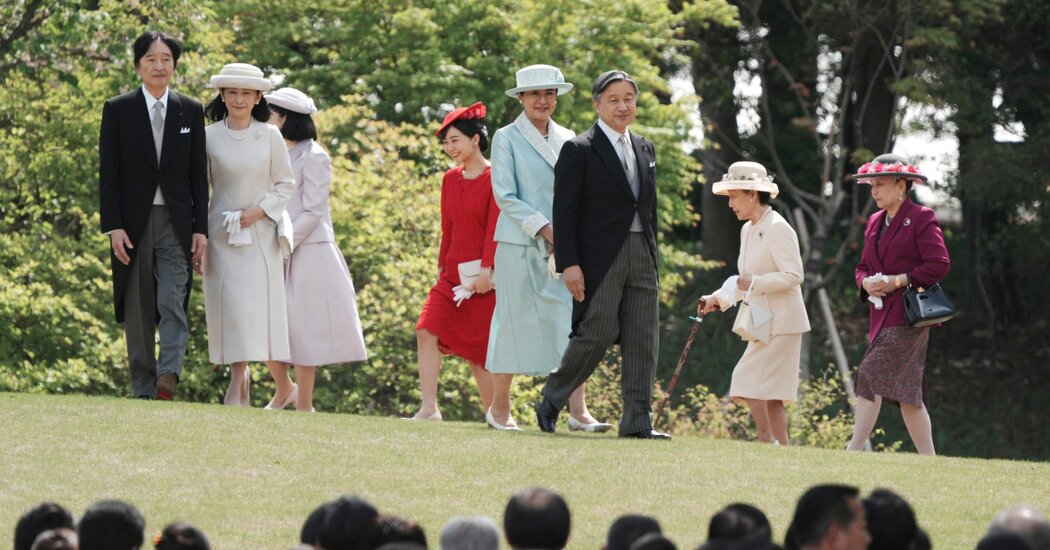
This stubborn adherence to patrilineal succession has driven the monarchy into a severe demographic bottleneck, reflecting the broader population crisis that currently plagues the rest of modern Japan. Today, the once-expansive imperial family has shrunk to a mere sixteen members, consisting of just five men and eleven women—a staggering twenty-five percent decline in size since 1990 alone. This severe depletion of personnel has made it increasingly difficult for the family to fulfill its heavy rotation of ceremonial and public duties, including welcoming foreign dignitaries, conducting sacred Shinto rites, and representing the nation on state visits abroad. There are simply not enough working royals left to share the load. The line of succession has dwindled to just three eligible heirs: the Emperor’s ninety-year-old uncle, Prince Hitachi; the Emperor’s sixty-year-old brother, Crown Prince Akishino; and the Emperor’s nineteen-year-old nephew, Prince Hisahito. The current monarch, sixty-six-year-old Emperor Naruhito, is the 126th ruler in a legendary lineage that traces its mythological origin back to 660 B.C. and the nation’s mythical founder, Emperor Jimmu, who was said to be a direct descendant of the sun goddess Amaterasu. This heavy historical burden to produce male heirs has historically taken a devastating psychological toll on the family; most notably, the Harvard-educated former diplomat Empress Masako suffered from a highly publicized, decades-long battle with severe depression and stress-induced adjustment disorder, fueled by the relentless domestic and official pressure to give birth to a male Crown Prince.
The Shadow of 1947: How Post-WWII Reforms Created a Modern Succession Trap
To fully understand the origins of this modern royal crisis, one must look back to the transformative years immediately following the conclusion of the Second World War. During the Allied occupation of Japan, the United States, led by General Douglas MacArthur, sought to demystify and drastically weaken the socioeconomic and political power of the Japanese imperial family, whose members had previously been revered by the public as living deities. Under the sweeping reforms of the 1947 Constitution imposed by the American administration, the Emperor was stripped of all political and governing authority, redefined instead as a purely symbolic figurehead representing “the state and the unity of the people.” In a bid to curtail the family’s influence and drain its vast financial reserves, the occupation authorities forced eleven prestigious cadet branches of the imperial family to permanently renounce their royal status, transforming sixty-seven high-ranking royals into ordinary commoners overnight. This dramatic historical amputation immediately shrank the official family down to sixteen members, effectively cutting off the various lateral branches of the family tree that had historically served as vital safety nets during previous succession crises. It is this historical wound that the current Diet proposal seeks to open and re-stitch, looking back to those very cadet branches abolished by postwar authorities to find a biologically compatible, patrilineal solution to their twenty-first-century emergency.
Salarymen to Sovereigns: The Audacious Plan to Recruit New Princes
Under the complex guidelines of the proposed legislation currently advancing through Parliament, the state would select eligible young men descended from the historical Kuni, Higashikuni, Kaya, and Takeda houses—the prominent noble branches severed from the monarchy in 1947—and allow them to be formally adopted back into the reigning imperial family. If enacted, this policy would create a bizarre, unprecedented social dynamic, as several young men who have spent their entire lives living as ordinary citizens, working standard corporate jobs in Tokyo’s hyper-competitive media, life insurance, and advertising industries, would suddenly be elevated to royalty. Although the government has yet to clarify the exact vetting process or establish how many individuals would qualify for adoption, legal experts have noted that the male offspring of these newly adopted princes would theoretically become eligible to inherit the Chrysanthemum Throne. This strategy, however, has met with deep skepticism from the Japanese public, with many questioning whether modern citizens could ever truly respect or accept a corporate salaryman as a divinely sanctioned royal figurehead. Recognizing the sensitive nature of the debate, Emperor Naruhito carefully addressed the ongoing discussions, expressing a quiet hope during a recent press conference that any proposed legislative solution would ultimately be “understood and accepted by the people” of Japan.
A Compromise of Convenience: The Limits of Reform and the Path Ahead
As a minor concession to progressive critics, the current legislative proposal does offer a modest, historic nod to the women of the family: imperial princesses would finally be permitted to retain their official royal titles, duties, and state status even if they choose to marry commoners—a direct reversal of current laws which force royal women, such as the Emperor’s niece Mako, to forfeit everything upon marriage. However, many gender equity advocates and historians argue that these half-measures are merely temporary band-aids that fail to address the core structural prejudices of the system. Critics point out that Japan is no stranger to female rulers, having successfully been governed by eight different reigning empresses throughout its rich history, including the influential Empress Go-Sakuramachi, who ruled with great authority during the late eighteenth century. According to Hideya Kawanishi, a distinguished expert on the imperial family at Nagoya University, the refusal to embrace a female successor like Princess Aiko is a symptom of deeply ingrained patriarchal attitudes that persist within the nation’s political elite despite rapid wider societal changes. Kawanishi warns that by stubbornly relying on outdated adoption schemes and excluding women from the line of succession, the government is marching toward an inevitable collapse, stating bluntly that if the ruling class continues to lament the birth of daughters over sons, the oldest monarchy in the world will ultimately become completely unsustainable.