




In the high-pressure cauldron of international soccer, where every second is measured in frantic heartbeats and the collective hopes of a passionate nation rest squarely upon the shoulders of remarkable young athletes, moments of pure magic are rare, transcendent events that linger in the cultural memory long after the stadium lights have faded. For the United States Men’s National Team, their latest World Cup encounter was already shaping up to be a resounding statement of tactical dominance and athletic prowess, but it was the 98th minute of play that transformed a convincing 4-1 victory into an unforgettable theater of raw human emotion and breathtaking physical brilliance. Gio Reyna, the twenty-three-year-old virtuoso who has carried the heavy burden of immense national expectation since his early teenage years, did far more than simply punctuate the American squad’s triumphant performance with a late goal; he grabbed the global spotlight and utilized it to paint a masterpiece of instinct, family legacy, and profound personal joy. As the clock ticked deep into stoppage time, with players on both sides fighting heavy physical exhaustion and the opponent’s defense scrambled in a desperate, chaotic bid to minimize the damage, Reyna received a pass in a pocket of space that most ordinary players would have found far too congested to navigate. Instead of opting for a safe, conservative pass to run down the remaining seconds of the game, Reyna chose absolute audacity. With a fluid, almost casual grace that defied the frantic energy swirling around him, he struck the ball cleanly with the outside of his right foot—a highly technical and notoriously difficult soccer skill known in the international sport’s lexicon as a “trivela.” The ball carved a beautiful, mathematically precise arc through the humid air, completely bypassing the outstretched, desperate dive of the opposing goalkeeper before settling comfortably into the far corner of the net. It was a goal of breathtaking aesthetic quality, a physical manifestation of supreme confidence that ignited the entire stadium and served as a thunderous declaration that this American team is ready to play with unprecedented flair, passion, and world-class vision on the grandest stage of them all.
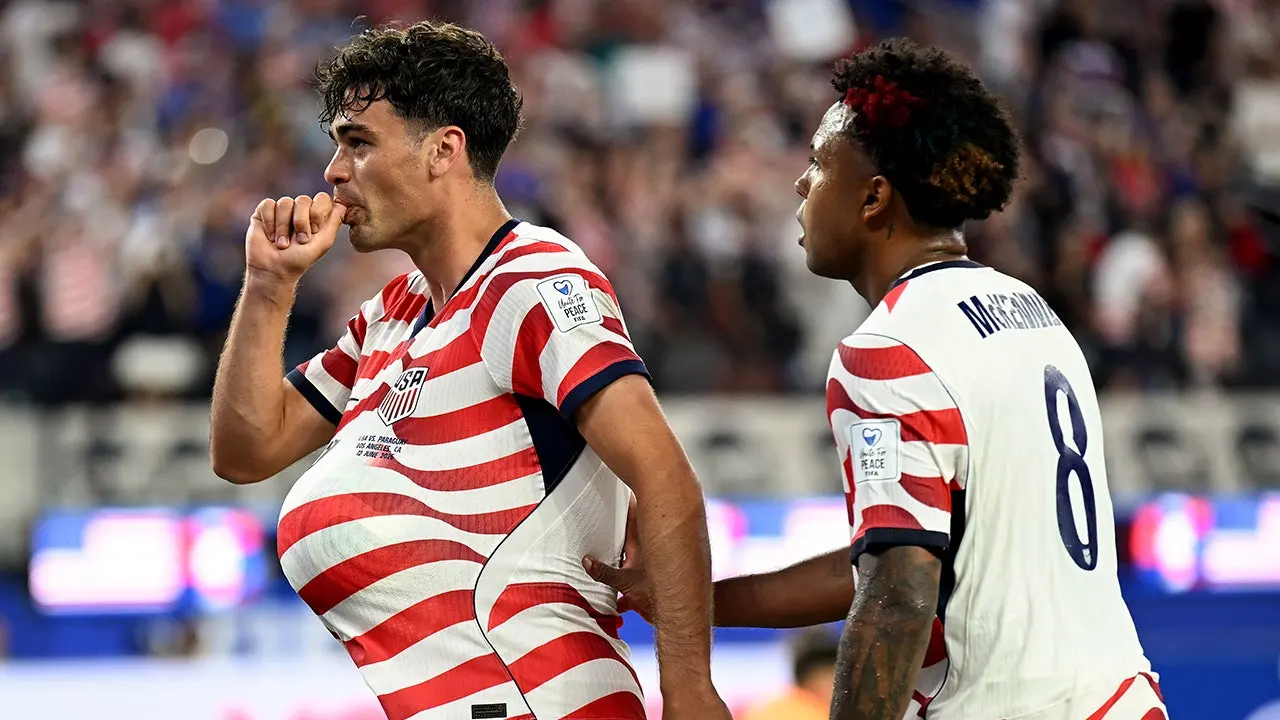
Yet, as spectacular as the trivela goal was from a purely analytical and sporting perspective, the sequence of events that unfolded immediately afterward captured the true depth of human emotion, instantly turning a clinical athletic achievement into an intimate family celebration witnessed by millions of viewers across the globe. After initially covering his ears in a classic gesture of triumphant defiance and being buried under a chaotic, joyous avalanche of ecstatic teammates who rushed from all corners of the pitch to mob him, Reyna broke away from the huddle with a distinct, deliberate purpose. He retrieved the match ball from the back of the net, tucked it securely beneath his jersey to mimic a pregnant belly, and gently placed his thumb into his mouth—a classic, universally understood soccer celebration that has crossed generations of footballers to announce an impending pregnancy to the world. In that singular, tender moment, the fiercely competitive and hostile environment of the World Cup completely melted away, replaced by the vulnerability and immense joy of a young man stepping across the threshold into the life-altering realm of fatherhood. Postgame, a radiant Reyna confirmed the wonderful news to reporters, his usual guarded press demeanor giving way to a wide, genuine smile as he revealed that his beloved wife, Chloe, was indeed pregnant. Holding onto such life-altering, monumental news for a couple of months while simultaneously navigating the intense physical, mental, and emotional demands of preparing for a high-stakes global tournament is no small feat of emotional containment. Reyna admitted that he had been quietly holding this beautiful secret extremely close to his chest, waiting patiently for the absolute perfect moment to share it with the world, and there was no denying that an exquisite, last-minute goal on the grandest stage of international sports felt like a destiny-aligned opportunity to welcome his future child into the world’s consciousness.
This deeply personal milestone carries an even more unique and poetic resonance when viewed through the rich lens of family legacy and the multigenerational ties that bind American soccer history together. Gio Reyna is not just any talented midfielder; he is the son of Claudio and Danielle Reyna, both of whom are legendary former U.S. international soccer pioneers who helped lay the concrete foundation for the modern growth of the sport in the United States. Growing up under the shadow of such an illustrious, highly scrutinized athletic lineage can often be a crushing psychological burden for a young athlete, but for Gio, his family has always remained a sanctuary of quiet wisdom, unconditional love, and constructive, honest support. In the tense lead-up to this historic match, it was his parents and his wife, Chloe, who offered the crucial piece of psychological advice that ultimately unlocked his match-winning brilliance: they implored him to shoot more often and to embrace a necessary level of healthy, productive selfishness on the pitch. For a player naturally gifted with elite playmaker vision and a selfless tactical awareness, Reyna’s default instinct has frequently been to seek out his teammates and facilitate the collective flow of the attack, sometimes at the crucial expense of his own goal-scoring opportunities. By encouraging him to step completely out of his comfortable playmaking shell and demand the goal-scoring spotlight, his family gave him the emotional permission to trust his own lethal finishing ability. When he finally unleashed that spectacular trivela shot, it was not just a testament to his individual kinetic skill, but a direct fulfillment of the collective faith his family had placed in him, showing how the quiet, loving conversations around the kitchen table often dictate the loudest, most triumphant moments in a packed stadium.
When pressed by journalists in the post-match press room to dissect the precise mechanics and tactical decision-making behind his miraculous goal, Reyna’s humble, candid response highlighted the fascinating, often inexplicable psychology of elite athletes operating in a state of absolute flow. He confessed that these highly analytical questions are always quite difficult for him to answer because, when he is in the heat of competition, his conscious mind completely disengages, leaving room for raw, unadulterated instinct and muscle memory to take over the controls. “Honestly, when I’m playing, I’m not really thinking,” Reyna explained with a refreshing level of honesty that beautifully demystified the often over-analyzed and hyper-engineered nature of modern sports science. He did not step onto the field with a pre-meditated plan to execute a trivela, nor did he run complex geometric calculations in his mind as the ball fell to his feet; instead, he simply recognized a favorable pocket of space, received a brilliant pass from a teammate, caught a fleeting glimpse of the far-post angle, and let his body do exactly what it had been meticulously trained to do since he was a young boy kicking a ball in his backyard. This total reliance on natural reaction and deep muscle memory is precisely what separates the merely good players from the truly exceptional; it represents the transition from rigid adherence to technical coaching drills to the realm of creative, spontaneous performance art. By trusting his instinct over analytical intellectualization, Reyna achieved a level of playing harmony where his body became a vessel for pure physical expression, resulting in a goal that felt less like a calculated labor and more like an effortless, joyful extension of his inner love for the beautiful game.
The sheer emotional weight of Reyna’s goal and his subsequent baby announcement reverberated far beyond the pitch, igniting a powerful wave of unity and passion that surged all the way to the technical area, where newly appointed U.S. head coach Mauricio Pochettino couldn’t contain his excitement. In a magnificent moment that perfectly encapsulated the infectious energy and renewed sense of joy defining this current era of American soccer, the world-renowned Argentine manager abandoned his tactical boundaries and sprinted enthusiastically down the sideline to join his players in their chaotic, joyful celebration. This highly visible display of unvarnished passion from Pochettino represents a significant cultural shift for the national team, signaling a modern coaching philosophy that is as much about building deep, empathetic human connections as it is about implementing complex defensive shapes or high-pressing tactical systems. Under Pochettino’s charismatic and empathetic guidance, the team appears to be shedding the rigid, mechanical burdens of past tactical systems and embracing a vibrant, expressive style of play that allows individual personalities to shine through within a unified collective framework. Seeing their world-class manager run to actively participate in a player’s personal triumph sent a clear, highly resonant message of solidarity to the entire squad, demonstrating that they are not just coworkers chasing professional accolades, but a tightly knit, emotional brotherhood that celebrates each other’s life milestones with the exact same intensity as they celebrate hard-earned points on the scoreboard. This integration of human empathy into tactical development has fostered an environment where players feel safe to take creative risks and show their true selves on the pitch, creating a powerful cultural foundation that could propel this young, extremely talented group of US soccer stars to unprecedented heights as they build momentum for future campaigns.
As the dust finally settles on this euphoric, emotional opening match and the U.S. Men’s National Team shifts its tactical focus toward their upcoming clash against Australia, the future looks exceptionally bright, framed by the dual promise of career-defining athletic campaigns and the profoundly transformative journey of new life. The upcoming fixture, scheduled for next Friday at 3 p.m. ET, will undoubtedly present new tactical challenges and require intense physical focus, but the squad will head into the match buoyed by an undeniable momentum and a sense of shared joy that only moments like Reyna’s can foster. For Gio Reyna himself, this tournament has already become a monumental, unforgettable chapter in his personal epic, a beautiful intersection where his professional legacy as a world-class soccer athlete and his private path as a devoted husband and future father have harmoniously merged. The global soccer world will continue to closely watch his evolution on the field, tracking his spectacular goals, his clever assists, and his tactical growth under Pochettino’s watchful eye, but back home, a far more meaningful and beautiful adventure awaits him and Chloe as they prepare to welcome the next generation into the legendary Reyna lineage. Ultimately, this match was a vivid, heartwarming reminder of why we fell in love with sports in the first place: not merely for the cold statistics, the tactical breakdowns, or the trophy cases, but for those rare, magical moments of human connection where a simple game becomes a grand canvas for life’s most profound, beautiful, and lasting celebrations of family, love, and new beginnings. It highlights the undeniable truth that behind every elite athlete is a complex human being navigating the same joys, fears, and hopes as the fans cheering in the stands. As Reyna steps into this new, exciting chapter of fatherhood, he does so with the support of a loving family, a passionate coach, and a nation that stands ready to cheer him on both on the pitch and in the quiet, sacred moments of domestic life.