



Under the oppressive, unrelenting sun of southern Iran, where summer temperatures regularly soar past a punishing 100 degrees Fahrenheit, water is not merely a convenience of modern life; it is the absolute boundary between survival and disaster. In the quiet coastal village of Bemani and its surrounding communities, located near the strategically volatile Strait of Hormuz, this delicate boundary was violently shattered early one Wednesday morning. More than 20,000 ordinary citizens woke to dry taps and a sudden, terrifying reality as a vital drinking-water facility lay in ruins following a series of military airstrikes. The immediate human consequence of this destruction was a desperate, community-wide scramble to secure hydration in a landscape where the atmosphere feels like an open oven, transforming a geopolitical skirmish into an intimate human emergency. For the families living in these rural enclaves, the high-altitude decisions of foreign militaries translated directly into dry throats, dust-choked streets, and the immediate, frightening question of how to keep their children safe and hydrated in the blistering desert heat.
The disruption began when the engines of U.S. Air Force and Navy fighter jets roared through the night sky, conducting what the U.S. Central Command later described on social media as precision strikes near the critical maritime shipping corridor of the Strait of Hormuz. While military commanders in Washington analyzed digital maps and celebrated the tactical success of their “precision munitions,” the explosive reality on the ground was far less abstract as the strikes tore directly through local life-support systems. Iranian state media and regional officials quickly raised the alarm, pointing out that the American ordnance had not neutralized a military threat, but had instead obliterated storage units holding the community’s lifegiving water supply. This stark contrast between high-altitude military objectives and the immediate, basic needs of thousands of innocent civilians serves as a sobering reminder of how easily the critical infrastructure of daily human survival can be swept up in the destructive gears of international conflict.
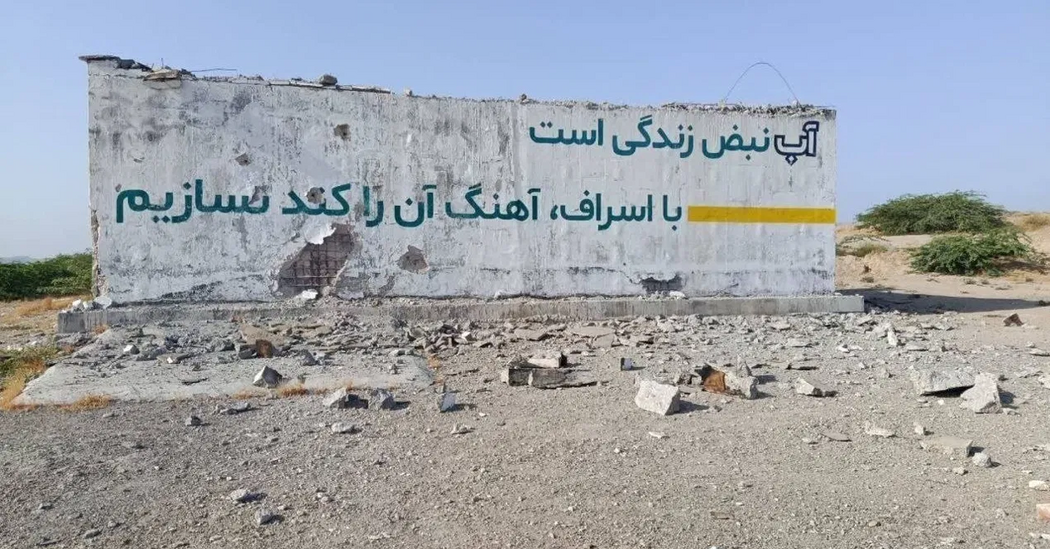
A forensic reconstruction of the site by visual journalists and independent researchers soon revealed the undeniable trail of the disaster, drawing a clear picture of what transpired on that quiet hillside outside Bemani. Satellite imagery captured just days prior to the strike showed two modest, remote structures standing alone on a hill, marked clearly by bright blue piping—representing the universal infrastructure signature of water storage and distribution systems. Visual evidence gathered from the aftermath showed a devastating clean hole punched directly through the concrete roof of the larger facility, while the smaller building’s roof had collapsed entirely under the kinetic force of the blast. Fragments recovered from the debris by local authorities were analyzed by ordnance databases and identified as remnants of a GBU-39 Small Diameter Bomb, a highly sophisticated, 250-pound class precision-guided glide weapon. This specific munition is designed specifically to hit targets with pinpoint accuracy, leaving little doubt that the buildings were intentionally targeted, even if the weapon systems’ operators were entirely ignorant of what was actually stored inside those blue-piped walls.
This troubling revelation raises profound ethical and legal questions regarding the standards of modern intelligence-gathering and the rules of engagement in high-tech warfare. Under long-established international humanitarian law, including the Geneva Conventions, the deliberate targeting of civilian infrastructure—especially facilities indispensable to the survival of the civilian population, such as drinking water installations—is strictly prohibited and can constitute a war crime. Whether the U.S. military actively knew they were targeting a community’s water supply or suffered a catastrophic intelligence failure that misidentified the remote utility buildings as military assets remains unclear, leaving a shadow of moral accountability hanging over the operation. When questioned about the disturbing reports and the photographic evidence of the weapon fragments, Captain Tim Hawkins, a spokesperson for U.S. Central Command, offered a brief statement noting that the military was aware of the allegations and was looking into them, leaving the affected population with little immediate comfort or explanation.
Yet, in the shadow of this high-tech destruction, a deeply moving story of human resilience, local solidarity, and rapid mobilization began to unfold on the dusty ground of Iran’s southern coast. Rather than succumbing to despair, Abdolhamid Hamzehpour, the dedicated head of the provincial water authority, immediately marshaled his utility crews and resources to mount an emergency response to save the community from dehydration. Under the scorching midday sun, a fleet of mobile water tankers was quickly organized and dispatched to deliver emergency drinking water directly to the residents of the affected town and nearby villages. Meanwhile, under grueling physical conditions, engineering crews worked tirelessly for twelve consecutive hours, physically constructing a brand-new service bypass line around the shattered ruins of the concrete storage tanks, successfully restoring the flow of running water to the local population in less than half a day.
Ultimately, the strike on Bemani’s water facility serves as a powerful parable about the profound detachment of modern aerial warfare, where decisions made in comfortable command rooms thousands of miles away manifest as severe, physical crises for civilian families. While military spokespeople utilize sterile terms like “precision strikes” and “collateral damage” to describe their operations, the reality on the ground is measured in the sweat of local utility workers and the dry mouths of children. The true heroes of this harrowing event were not the pilots commanding sophisticated stealth jets, but the local water engineers who raced against the clock and the elements to restore life to their community. Their quick triumph over destruction stands as an enduring testament to human resilience, reminding us that amidst the chaotic crossfire of global geopolitics, the preservation of human life and dignity remains the most vital battle of all.