



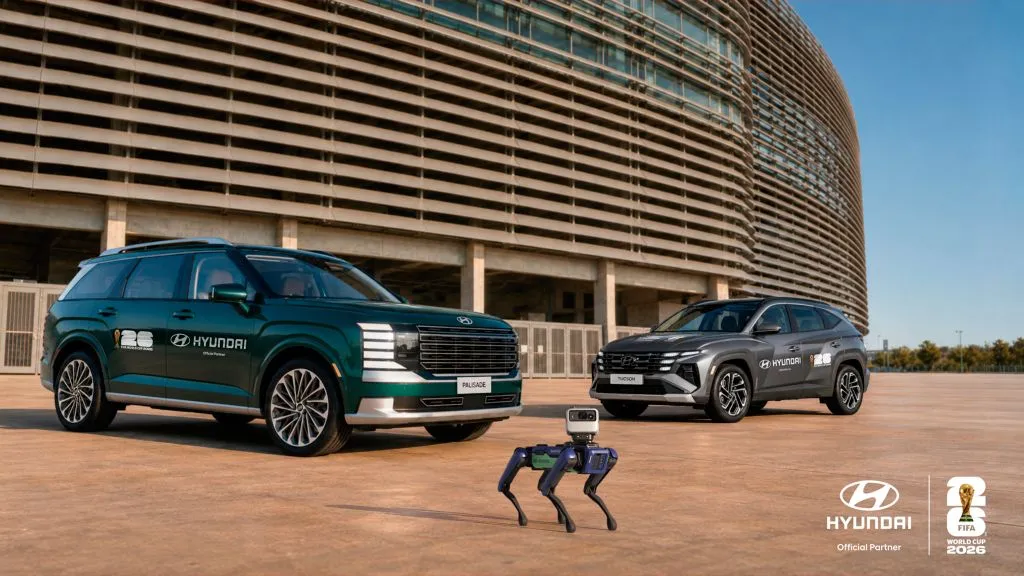
The FIFA World Cup has historically served as a fascinating, grand-scale mirror reflecting both the cultural aspirations and the technological triumphs of its host nations and corporate partners. Every four years, as the international sports community gathers to witness the absolute pinnacle of athletic achievement, the sponsors of the tournament seize this supreme global stage to demonstrate their boldest, most innovative visions for the immediate future. For the highly anticipated 2026 World Cup, spanning the vast landscapes of Canada, Mexico, and the United States, South Korean automotive giant Hyundai is planning something completely unprecedented and truly remarkable. Having nurtured a deeply collaborative, solid twenty-seven-year official partnership with FIFA, Hyundai has long been established as the reliable backbone of tournament transportation, recognized globally for providing high-quality passenger vehicles that keep the administrative machinery of the event moving seamlessly behind the scenes. However, as the 2026 tournament fast approaches, Hyundai is stepping far beyond the conventional boundaries of simple automotive manufacturing to showcase a dramatic, highly futuristic technological evolution. The true highlight of their upcoming, record-breaking corporate activation is not merely a fleet of clean electric cars or efficient hybrid shuttles, but rather the deployment of highly advanced, four-legged autonomous robot companions. By integrating these state-of-the-art machines into the very fabric of the world’s most-watched sporting event, Hyundai is signaling a monumental paradigm shift, transforming itself from a traditional car manufacturer into a comprehensive smart mobility and robotics pioneer. This strategic move is meticulously designed to capture the collective imagination of millions of viewers worldwide, effectively turning modern sports stadiums into living, breathing showcases of how human civilization might constructively interact with autonomous technology in the decades to come. Through this daring, high-profile initiative, the company aims to prove that the future of mobility is not just about rolling rubber on asphalt, but about creating an interconnected, intelligent ecosystem where mechanical ingenuity serves directly to elevate, support, and protect the human experience in public spaces. This sets an entirely new standard for corporate sponsorship, proving that a brand can actively contribute to the infrastructure and peaceful atmosphere of an event, rather than simply plastering its logo on stadium billboards and commercial broadcasts.
At the absolute center of this highly ambitious, futuristic deployment are four customized, state-of-the-art Spot robots developed by Boston Dynamics, the legendary robotics firm acquired by Hyundai in 2021. Rather than being relegated to simple promotional side-show attractions, playful novelties, or corporate mascot acts meant to dance for the amusement of arriving crowds, these unique quadruped machines are being assigned serious, highly critical physical responsibilities. They will be actively deployed to support FIFA’s safety operations, stationed at two of the tournament’s most vital, high-security, and sensitive locations: the bustling, high-traffic International Broadcast Center located in Dallas, Texas, and the massive, iconic New York–New Jersey Stadium. The visual of a highly agile, metallic four-legged creature navigating a crowded modern sports venue is bound to evoke a wide array of human reactions, ranging from genuine, wide-eyed fascination to a subtle, instinctive sense of uncertainty. Acknowledging the delicate psychological impact of introducing semi-autonomous robots into dense public gatherings, both Hyundai and Boston Dynamics have taken meticulous care to clarify the precise operational nature and limitations of Spot’s capabilities. Most notably, an official company spokesperson emphasized that these specific robots do not possess any facial recognition technology, ensuring that they will not be used as tools for invasive database surveillance or personal privacy infringement. By carefully defining Spot as a non-intrusive, highly specialized security assistant rather than a surveillance tool, Hyundai hopes to normalize the presence of these machines among the public, proving that they are designed not to watch, judge, or track human behavior, but to support the existing human security infrastructure with an unwavering, non-threatening diligence that makes these massive, joyful international celebrations substantially safer and more secure for the global family of fans. In this way, they hope to transition the public’s perception of robotics from cold sci-fi dystopia to warm, helpful reality, bridging the emotional gap between cutting-edge technology and everyday human safety.
To appreciate the true value of these Spot robots, one must understand that they are built to function as highly specialized, electronic “working dogs” rather than cold, emotionless science-fiction sentinels. Operating on a highly sophisticated Enterprise Asset Management kit that features industrial-grade inspection software applications, these machines are exceptionally well-suited for the demanding, repetitive, and often hazardous nature of physical security operations. Their primary duties during the 2026 World Cup will involve conducting routine, highly detailed perimeter sweeps, patrolling complex architectural boundaries, and assisting human security officers in investigating potentially high-risk situations, such as suspicious, unattended baggage or other hazardous materials. In a world where event security personnel must constantly stay vigilant against unpredictable environmental and physical threats, having a mechanical partner that can confidently walk into a potentially dangerous area to gather real-time data is an invaluable asset. By sending a resilient, sensor-rich robot to perform the initial, critical assessments of suspicious objects, human security teams can significantly reduce their direct exposure to physical harm, effectively preserving human life in moments of extreme crisis. This practical application demonstrates the profound utility of collaborative robotics in the modern age, revealing a collaborative future where machines do not replace human workers but instead act as protective shields, taking on the dirty, dangerous, and monotonous tasks so that human specialists can focus on critical decision-making, compassionate crisis resolution, and direct public engagement with confidence and peace of mind. Ultimately, this turns what could be perceived as a cold technological invasion into a warm, reassuring partnership that places human physical safety above all else, redefining our expectations of public labor. By taking the brunt of risk, these robotic guardians serve as silent, dutiful allies in the ongoing global effort to protect open society and enable people to gather in peace and celebration.
While the sight of these walking robots is guaranteed to dominate media coverage and capture the public’s curiosity, they represent only a small, highly visible fraction of the massive logistics and transportation ecosystem that Hyundai is preparing to deploy across North America. To smoothly facilitate the unprecedented scale of a tournament hosted simultaneously across three sovereign nations and sixteen wildly distinct host cities, Hyundai is mobilizing a staggering fleet of physical vehicles that highlights their legendary transport capabilities and engineering excellence. This colossal fleet consists of exactly 994 passenger vehicles and 506 specialized buses, which will be tasked with the incredibly complex operation of transporting national teams, referees, tournament officials, administrative staff, and global media personnel across vast geographic distances. Coordinating the rapid, secure movement of thousands of people in real-time across the vast expanses of the United States, Canada, and Mexico is a logistical challenge of historic proportions, demanding absolute mechanical reliability and a flawless organizational strategy from beginning to end. By deploying such an expansive, highly coordinated fleet of modern, efficient cars and buses, Hyundai is demonstrating that their commitment to traditional mobility remains as fierce and reliable as ever, even as they boldly explore the wild frontier of advanced robotics. This massive effort proves that physical transport and autonomous robotics are actually two sides of the same coin, showing that a truly modern transportation provider must be capable of moving a single administrative official across a sprawling metropolis with the same precision, care, and intelligence that a robotic dog uses to safely navigate a crowded stadium hallway. Through this incredible double-layered effort, the company is demonstrating that progress does not mean abandoning our foundational systems, but rather augmenting them with the brilliant possibilities of automated intelligence, keeping the entire continent unified under a single, flawlessly executed transportation network.
This harmonious, deliberate blend of traditional automotive logistics and futuristic robotic assistance is the direct, tangible realization of a visionary corporate strategy that Hyundai has been meticulously crafting for several years. When Hyundai first acquired a controlling stake in Boston Dynamics in 2021, many industry observers and automotive enthusiasts wondered how a classic, high-volume car manufacturer would integrate such advanced, highly experimental robotics into its core consumer business model. The answer became crystal clear in 2023 when Hyundai officially renewed its long-standing partnership with FIFA, securing the deeply symbolic and prestigious title of FIFA’s Official Robotics Partner for the tournament. The upcoming 2026 World Cup will serve as the first major global activation under this renewed designation, functioning as a high-profile, real-world proof of concept for the corporation’s grand philosophical mission, which they eloquently refer to as “Progress for Humanity.” By integrating these incredibly complex Boston Dynamics robots directly into the actual security and daily operations of a premier sporting event, Hyundai is showing the world that their multi-billion-dollar investments in artificial intelligence, engineering, and automation are not merely theoretical laboratory exercises. Instead, they are highly practical, commercially viable solutions designed to solve real-world logistical, industrial, and safety challenges today, illustrating how a progressive global brand can gracefully transition from a traditional manufacturing powerhouse into a holistic, technology-driven lifestyle brand that actively shapes the future of human society. At its core, this partnership represents the convergence of sport and technological evolution, proving that top-tier entertainment and safety can be elevated simultaneously through the thoughtful application of modern science, changing how major international organizations view corporate support. By using the World Cup as their canvas, Hyundai is making advanced robotics approachable, transforming a highly complex branch of computer science into a comforting and visible part of human culture.
As the global community counts down the days to the tournament’s highly anticipated kick-off on June 11, 2026, extending all the way through the final whistle on July 19, the active presence of these autonomous patrol robots will undoubtedly invite deep reflection on the increasingly intimate relationship between humans and machines. For some fans walking through the stadium gates, the sight of Spot working diligently alongside local law enforcement will provide a profound sense of safety and reassurance, demonstrating how cutting-edge innovation can be harnessed to protect our most cherished cultural gatherings. For others, it may trigger a slight, reflective pause, prompting a quiet contemplativeness about the speed at which technology is integrating into our daily public squares and normal routines. Regardless of where one stands on this technological spectrum, Hyundai’s pioneering deployment ensures that the 2026 FIFA World Cup will be remembered as a monumental milestone in the history of public technology. It serves as a gentle, highly controlled introduction to a new era where the dividing line between science fiction and everyday life fades away, encouraging us to embrace a cooperative future. Ultimately, this tournament will show that while the athletes on the pitch continue to inspire us with their raw human talent, the quiet, mechanical guardians patrolling the perimeters are a beautiful testament to human ingenuity, working tirelessly behind the scenes to keep our entire world moving safely forward. As the final whistle blows and fans return to their home countries, the memories of majestic goals will be forever intertwined with the image of these yellow-and-black sentinels, reminding us that we are stepping into a future where technology and humanity march forward hand-in-hand, paving the way for a safer, more connected global community.