


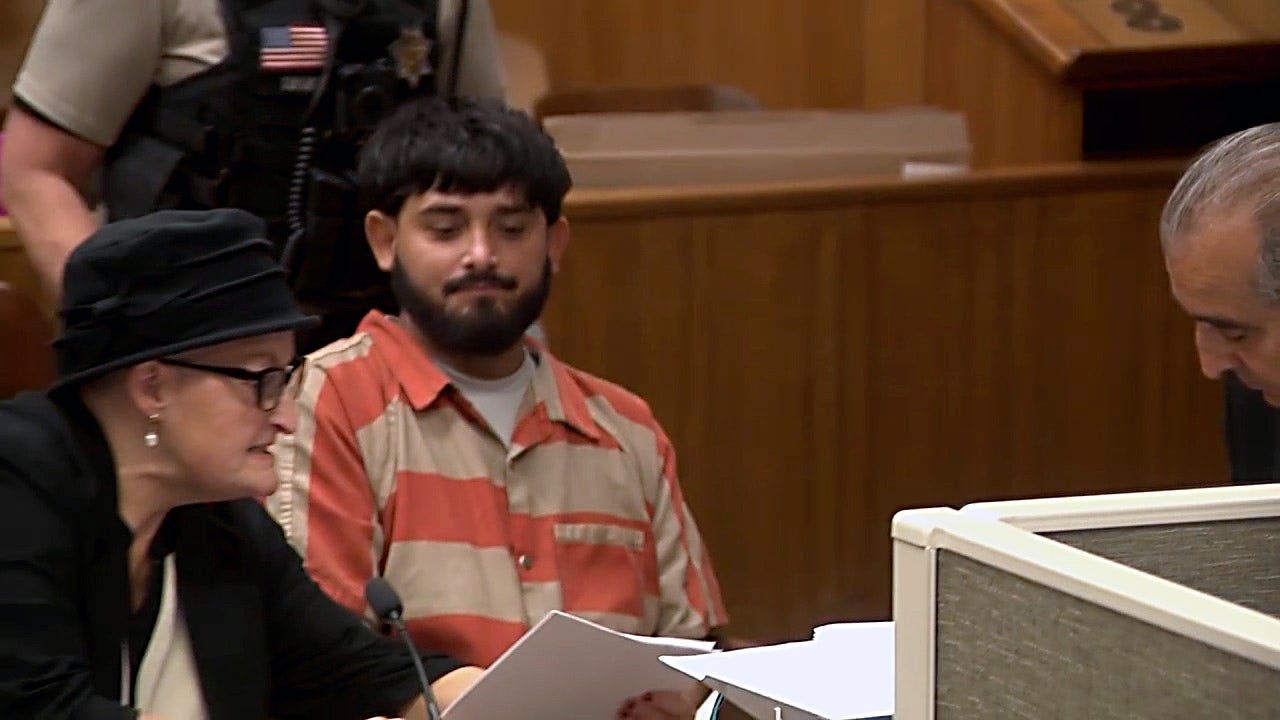
The quiet, somber atmosphere of the Stanislaus County Superior Court was shattered by a display of shocking audacity when 28-year-old Joaquin Escoto made his initial appearance, facing charges for a crime that has devastated both a local community and a nation. As Escoto was escorted into the courtroom, the heavy clinking of his wrist and ankle shackles echoed in the quiet room, a stark contrast to his bright orange-and-white jail jumpsuit. Flanked by his defense attorney and a Spanish-language interpreter, the suspect did not project the gravity or remorse expected of someone accused of extinguishing three innocent lives. Instead, he flashed a chilling, unmistakable grin directly toward the gallery, where the surviving relatives of the victims sat huddled together in grief. This defiant smirk, captured during the brief proceedings, felt like a physical blow to a family already hollowed out by an unspeakable tragedy. For the grieving loved ones looking on, the sight of the suspect smiling in the face of their profound misery was an agonizing display of cruelty, highlighting the steep disconnect between the cold reality of the legal process and the raw, bleeding trauma of those left behind to pick up the pieces of their broken lives. The brief courtroom interaction served as a harsh preview of the long, painful legal road ahead for a family looking for answers, only to be met with a cold, unfeeling smirk from the man accused of stealing their entire world.
At the heartbreaking center of this legal storm are three generations of a family whose futures were violently and abruptly stolen. The victims—54-year-old Sylvia Nunez-Villalobos, her 23-year-old daughter Fabiola Gonzalez-Nunez, and Fabiola’s newborn son, baby Mateo Gonzalez, who was only two weeks old—represent a lineage of love and aspiration cut down in its prime. Family members have struggled to articulate the depth of their loss, describing Fabiola as a young mother vibrant with hope, whose life was only just beginning to unfold. “He cut her wings,” her devastated aunt, Maria Nunez, shared in a tearful interview, recalling a young mother who had clear goals, bright dreams, and an endless reservoir of affection for her children. The tragedy is compounded by the survival of Fabiola’s three-year-old child, who was present during the horrific event and now must grow up without a mother, a grandmother, or a baby brother. The surviving family members remain completely bewildered by the violence, noting that Escoto had been welcomed into their lives and treated with nothing but love, respect, and shelter. This ultimate betrayal has left them searching for answers in a silent void, unable to comprehend what dark motivations could lead someone to destroy the very people who had offered him warmth, kindness, and unconditional support.
The legal machinery of Stanislaus County is now moving to address the horrific nature of the crimes, with prosecutors levying a host of severe charges against Escoto. He stands accused of three counts of first-degree murder, accompanied by special-circumstance allegations for multiple victims, which could carry the state’s harshest penalties. Additionally, he faces a knife enhancement penalty, reflecting the brutal, close-quarters nature of the stabbings, as well as charges of child abuse resulting in the death of a child under the age of eight and child endangerment regarding the surviving three-year-old. While the actual courtroom hearing lasted merely a few minutes—marked by administrative handoffs and the scheduling of future dates—the brevity of the session contrasted sharply with the lifetime of sorrow imposed on the victims’ family. The court proceedings offered no explanations or closure, only a clinical reading of charges that failed to capture the immense human suffering behind the legal jargon. As the defense and prosecution prepared their arguments, the family sat in the gallery, realizing that while the court system seeks to assign guilt and mete out punishment, it can never restore the dreams of a young mother or give a two-week-old baby the chance to experience life, leaving a permanent gap in their family tree that no legal outcome can ever repair.
Beyond the immediate familial tragedy, this case has reignited a fierce national debate regarding federal immigration enforcement, public safety, and the real-world consequences of localized sanctuary policies. According to records released by the Department of Homeland Security, Escoto is a Mexican national whose history in the United States is marked by repeated unlawful entries and a mounting list of criminal offenses. Having initially entered the country illegally in 2018, Escoto was deported during the first Trump administration, only to surreptitiously re-enter the country at an unknown time and location. Over the years, his presence in the United States went largely unchecked despite accumulating an alarming criminal record that included four separate arrests for driving under the influence (DUI). The most critical turning point came in June 2025, when Escoto was arrested for his latest DUI offense. At that time, Immigration and Customs Enforcement (ICE) lodged a formal immigration detainer with local law enforcement, requesting that he be held and transferred into federal custody for deportation proceedings. However, local authorities, adhering to California’s rigid sanctuary laws, ignored the detainer and released Escoto back into the community without notifying federal agents, creating a direct path to the deadly events that would soon unfold and claim three innocent lives.
This bureaucratic failure has drawn fierce condemnation from federal officials, who argue that the loss of three innocent lives was entirely preventable had local sanctuary policies not interfered with federal law enforcement. In a biting statement, Acting DHS Assistant Secretary Lauren Bis did not hold back, labeling Escoto a “monster” whose heinous crimes could have been averted if California politicians had prioritized public safety over political ideology by cooperating with ICE. Bis emphasized that local sanctuary policies continue to actively endanger American communities by systematically shielding criminal illegal immigrants from deportation, allowing dangerous individuals to be released back onto the streets rather than being handed over to federal immigration authorities. This sentiment has resonated deeply across the country, transforming a local triple homicide into a powerful symbol of the ongoing battle between federal immigration authority and local municipal resistance. For critics of sanctuary laws, the needless deaths of Sylvia, Fabiola, and baby Mateo serve as a tragic and undeniable proof of the risks posed when local jurisdictions refuse to collaborate with ICE, leaving innocent citizens to bear the catastrophic human cost of systemic political friction and ideological division.
As the political and legal debates swirl on the national stage, the reality remains that a family has been permanently shattered, and their long, arduous journey toward justice has only just begun. Joaquin Escoto remains behind bars, held without bail at the Stanislaus County Jail, as federal immigration authorities have once again lodged a detainer to secure custody of him should he ever be released. His next highly anticipated appearance in the Stanislaus County Superior Court is scheduled for July 28 at 8:30 a.m., where the judicial process will slowly grind forward. For the surviving Nunez and Gonzalez family members, the upcoming legal battles offer little comfort as they face the daunting reality of a future without their beloved matriarch, their aspiring mother and sister, and a newborn baby who barely had the chance to draw breath. The physical wounds of that horrific day may have closed, but the emotional scars will linger across generations, serving as a solemn reminder of a systemic failure that allowed an operating threat to remain in their midst. In the end, as the legal system prepares to adjudicate this terrible crime, the community is left to mourn three lives cut tragically short, united in their grief and a shared demand that such a preventable disaster never be allowed to happen again.