


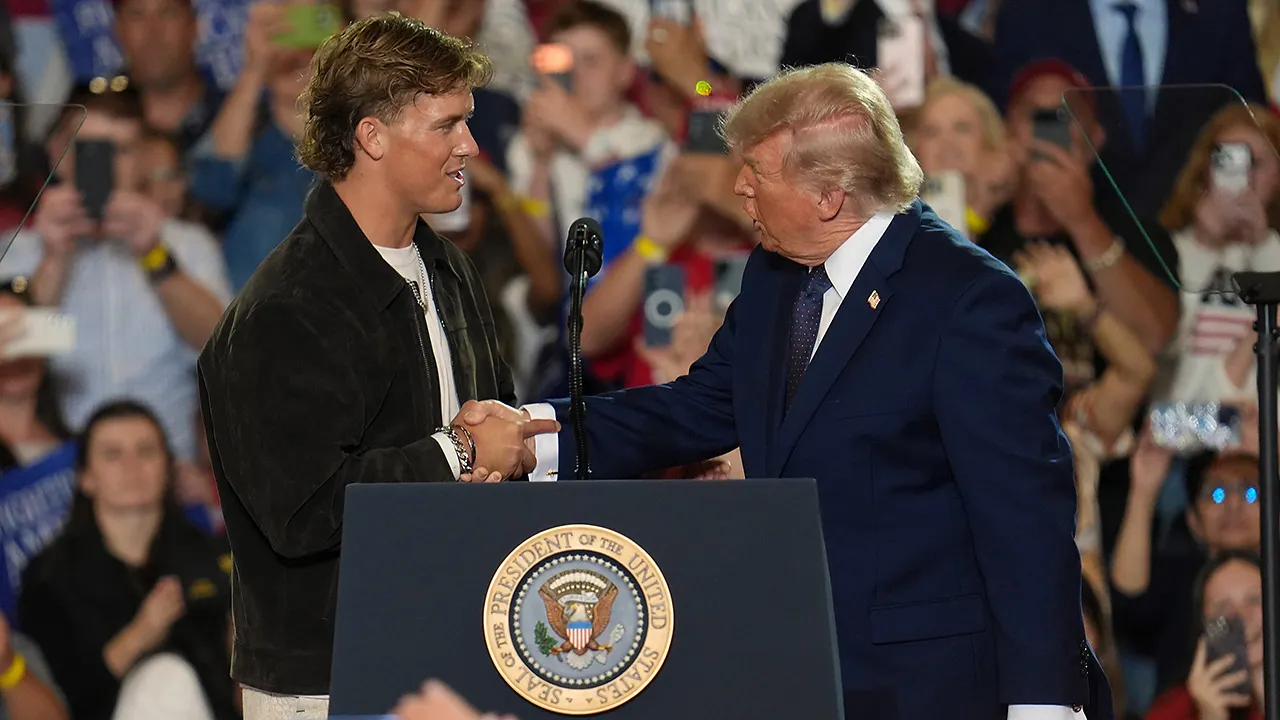
In the high-stakes, hyper-scrutinized arena of professional sports, the line separating an athlete’s life on the field from their personal choices off of it has never been thinner or more fragile. For New York Giants quarterback Jaxson Dart, this reality hit home with thunderous force following his recent appearance at a high-profile event in New York, where he was invited to introduce former President Donald Trump. To Dart, a young athlete navigating the immense responsibilities of being the public face of a historic NFL franchise, the invitation likely seemed like a rare, career-defining honor—a chance to stand before a crowd and participate in a momentous civic tradition. However, in today’s deeply polarized cultural landscape, no action exists in a vacuum, especially when it involves one of the most polarizing figures in modern history. Within minutes of his stage appearance, the digital world erupted into a storm of fierce debate, passionate criticism, and intense fan scrutiny that instantly breached the heavy doors of the Giants’ locker room. What started as an individual gesture of civic respect quickly transformed into a nationwide conversation about political alignment, team loyalty, and the complex expectations placed upon public figures who carry the hopes of diverse fanbases on their shoulders, transforming Dart’s moment of personal pride into a lightning rod for broader societal anxieties.
When the time came for Dart to step up to the press microphone and address the burgeoning controversy, he did so with the demeanor of a leader trying to de-escalate a rapidly spreading fire, seeking to reframe his actions through a lens of institutional reverence rather than political endorsement. Facing a wall of cameras and eager reporters, Dart earnestly defended his decision by characterizing it as a unique, non-partisan opportunity to show respect to the office of the President of the United States. He expressed a deep, foundational reverence for the American presidency itself, insisting that his intentions were rooted in honoring the office rather than aligning himself with any specific political ideology, party, or candidate. To many observers, Dart’s defense was a reflection of a traditional, old-school value system where the presidency is viewed as an institution deserving of honor regardless of the individual occupying the West Wing. Yet, this attempt to keep the moment purely apolitical immediately highlighted a profound, generational disconnect in a hyper-connected society where personal association is almost always interpreted as an explicit endorsement of policy. Dart’s explanation struggled to find a secure landing among a public that found it difficult to believe a public figure could introduce a major political candidate without making an inherently political statement, demonstrating the immense difficulty modern athletes face when trying to walk the tightrope of public life.
The backlash was swift and unforgiving, particularly from prominent media voices who rejected Dart’s apolitical framework as a convenient evasion of a highly sensitive topic. Chief among these critics was Pro Football Talk’s seasoned analyst Mike Florio, who used his platform on “Pro Football Talk Live” to dissect Dart’s press conference with surgical precision, accusing the young signal-caller of “punting” on the most critical question of all: did he truly understand why his appearance was so deeply controversial in the first place? Florio argued passionately that in the contemporary cultural landscape, it is intellectually dishonest and practically impossible to view an introduction of Donald Trump as a neutral, apolitical act. From this perspective, merely sharing a stage with such a figure is an act of advocacy, a gesture loaded with meaning that cannot be sanitized by simply referring back to prepared, diplomatic statements. The ripples of the controversy extended far beyond sports talk radio, reaching into the wider realms of political commentary, as exemplified by former MSNBC host Joy Reid publicly declaring the end of her lifelong allegiance to the New York Giants. This severe response highlighted a painful reality for modern sports franchises, showing how deeply intertwined team loyalty has become with the personal values and political leanings of the individuals who wear the uniform.
Within the sanctuary of the Giants’ locker room, the controversy assumed a much more intimate and human dimension, raising vital questions about brotherhood, trust, and shared experience among teammates of vastly different backgrounds. The friction became palpable when star defensive player Abdul Carter took to social media to express his genuine shock and disbelief upon seeing footage of his quarterback standing alongside Trump. Carter’s initial reaction—publicly questioning if the video was created by artificial intelligence and asking “What are we doing man?”—captured the visceral sense of alienation and bewilderment that many young Black athletes feel when confronted with political realities that directly impact their communities. For Carter, the situation was not a theoretical debate about the dignity of the office of the presidency; it was a deeply personal matter of values, representation, and the collective identity of a team that relies heavily on absolute unity to survive the grueling physical and mental demands of an NFL season. The public nature of Carter’s reaction could have easily fractured the locker room, driving a permanent wedge between the offense and the defense, and fueling media narratives of a team in chaotic disarray. It put on display the delicate ecosystem of a modern professional sports team, where young men from entirely different walks of life, cultural upbringings, and political spectrums are forced to co-exist, cooperate, and protect one another on the field while navigating profound moral differences off of it.
Rather than allowing the media firestorm to dictate the terms of their relationship, Dart and Carter chose a path of radical honesty and direct communication, demonstrating a level of emotional maturity that often eludes the broader political discourse. The two players sat down behind closed doors, away from the prying eyes of reporters and the toxic noise of social media, to have a raw, face-to-face conversation about their respective viewpoints, fears, and identities. When they eventually emerged to speak to the media together, the tension had visibly dissipated, replaced by an authentic warmth and mutual understanding that culminated in a genuine embrace. Carter reflected on the encounter with remarkable clarity, asserting that while everyone has a fundamental right to stand firmly upon their own personal beliefs, it is equally important to extend that same grace and freedom of conscience to one’s teammates without harboring resentment. Dart echoed this sentiment, pointing out their shared history as athletes who entered the organization together, endured the punishing highs and lows of professional football, and had repeatedly proven their willingness to sacrifice their bodies for one another on the field. This powerful scene of reconciliation stood as a profound testament to the unifying power of shared adversity, proving that genuine human connections forged through sweat, pain, and mutual reliance can survive even the most volatile cultural storms when people choose empathy over ideological purity.
The resolution of this potentially divisive incident was further solidified by the veteran leadership of backup quarterback Jameis Winston, who stepped forward to offer a broader, incredibly wise perspective on the entire ordeal and the lessons it holds for the team moving forward. Winston spoke of how immensely proud he was of both young men for having the courage to confront the issue head-on, to speak their truths publicly, and to model a constructive path through conflict for the rest of the locker room. He commended the Giants as a cohesive unit for recognizing that they did not have to succumb to external pressures to pick a side, divide themselves into factions, or let a national political debate erode the foundation of their brotherhood. Winston’s words underscored an important, humanizing truth: that a locker room is not a monolith, but rather a vibrant, living microcosm of society itself, where diversity of thought is not a threat to unity but an opportunity for deeper connection. In a world that often demands instantaneous condemnation and rigid conformity, the journey of Jaxson Dart and Abdul Carter serves as a beautiful reminder of the power of listening, of humanizing those with whom we disagree, and of finding common ground in our shared humanity and common goals. Ultimately, as the Giants transition back to the daily grind of the football season, they do so not as a team fractured by the cultural wars of today, but as a more resilient brotherhood that has learned to weather the storm together, proving that what unites them under the helmet is far stronger than the politics that seek to tear them apart.