



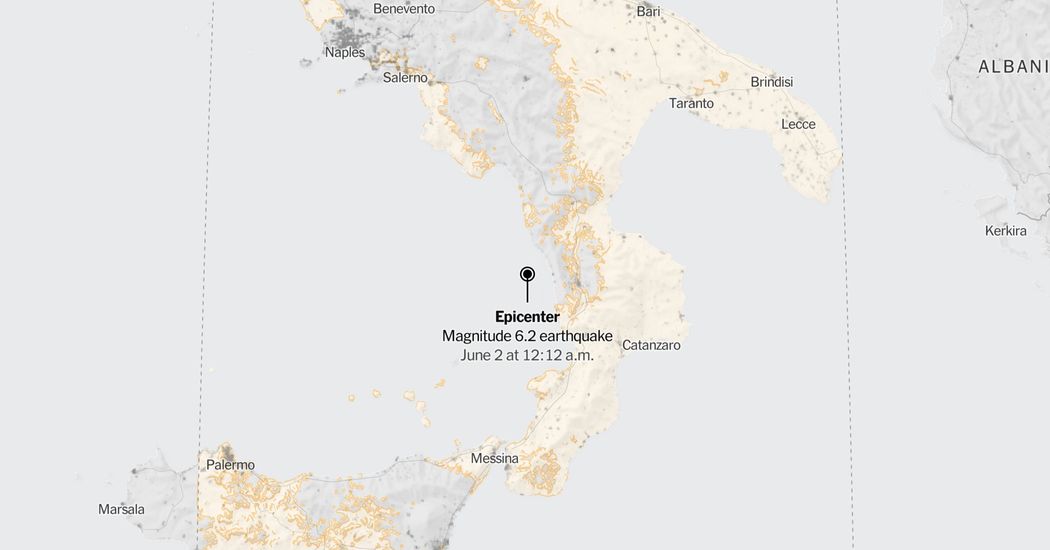
Deep Beneath the Tyrrhenian Sea: A 6.2-Magnitude Earthquake Awakes Southern Italy
Midnight Awakening: A Powerful Tremor Rocks the Tyrrhenian Sea
The midnight silence of the southern Mediterranean was abruptly shattered early Tuesday morning when a powerful 6.2-magnitude earthquake struck deep beneath the waters of the Tyrrhenian Sea. According to reports compiled by the United States Geological Survey (USGS), the seismic event occurred at precisely 12:12 a.m. Central European Time (CET), with its epicenter located approximately 11 miles southwest of the coastal town of Scarcelli, Italy. Though the initial shockwaves originated far below the seabed, the energy rippled outward across the marine basin, sending subtle but perceptible vibrations through coastal communities along the Calabrian peninsula and adjacent islands. Local residents, accustomed to the gentle ebb and flow of the sea, were suddenly confronted with the unmistakable, low-frequency hum of tectonic movement, a reminder of the volatile forces sleeping beneath the scenic Italian coastline. While early diagnostic instruments categorized the terrestrial shaking within mainland communities as relatively weak—registering around a level 3 or lower on the Modified Mercalli Intensity scale—the sheer magnitude of the 6.2-magnitude earthquake immediately grabbed the attention of seismologists worldwide, prompting emergency response networks to quickly assess potential damages. Fortunately, because the rupture occurred at a significant depth beneath the ocean floor, the immediate physical impact on the surface was diminished, preventing the widespread devastation often associated with land-based earthquakes of similar magnitude. Nonetheless, the unexpected midnight tremor serves as a stark reminder of the dynamic, ever-shifting geology that defines life along the Italian peninsula, sparking both scientific curiosity and heightened vigilance among local disaster response authorities.
   [TYRRHENIAN SEA BASIN]
             |
    (Epicenter: 12:12 AM)  <--- 11 Miles SW of Scarcelli, Italy
             |
             v
[6.2-Magnitude Shock Transmission]
/
v v
[Deep Seabed Absorption] [Weak Shaking felt in Calabria/Sicily]
(Saves Coastal Cities) (Mercalli Scale: 3)
Anatomy of a Tectonic Junction: Why Southern Italy Remains Seismically Active
This latest subterranean disruption is far from an isolated geological anomaly; rather, it represents the ongoing, slow-motion collision of giant tectonic plates that has shaped the geography of Southern Italy and the wider Mediterranean region for millions of years. The Tyrrhenian Sea itself acts as a complex back-arc basin, caught in a geological vice between the northward-drifting African plate and the overriding Eurasian plate, creating a dynamic system of subduction zones and deep fault lines. As the African plate sinks deeper into the Earth’s mantle beneath the Calabrian arc, it generates intense thermal pressure and mechanical stress that periodically releases in the form of deep-focus earthquakes. Historically, this delicate slice of Southern Europe has bore witness to some of the continent’s most devastating natural disasters, including the catastrophic Messina earthquake of 1908 and the recurring unrest of nearby volcanic systems like Mount Etna, Stromboli, and the Campi Flegrei. By studying the precise depth and orientation of Tuesday’s offshore rupture, geophysicists hope to map the intricate web of hidden slip-strikes and thrust faults that snake through the marine crust, thereby deepening our understanding of how stress accumulates and dissipates along these volatile marine frontiers. What makes this region particularly fascinating to geoscientists is the high-velocity subduction rate of the Ionian lithosphere, which creates a highly active but deeply buried laboratory of tectonic activity that constantly reshapes the sea floor and presents an ongoing challenge for those tasked with mapping European seismic risks.
Scientific Revision and the Mechanics of Seismic Measurement
In the immediate aftermath of any significant seismic event, the dissemination of accurate scientific data becomes a race against time, requiring agencies like the USGS and Italy’s National Institute of Geophysics and Volcanology (INGV) to continuously refine their preliminary readings. The initial designation of a 6.2-magnitude earthquake is calculated using complex automated algorithms that analyze compressional and shear waves captured by global seismographic networks; however, these figures are frequently subject to revision as human analysts review raw waveforms and integrate data from local monitoring stations. Similarly, mapping the exact reach of the shake-severity zone is an evolving science, reliant not only on physical instruments but also on crowdsourced “Did You Feel It?” reports submitted by citizens living along the Tyrrhenian coast. Because underwater earthquakes disperse their kinetic energy through miles of water and dense oceanic crust before reaching populated shores, the felt intensity in towns like Scarcelli may register as a “weak” vibration even when the subterranean release of energy is objectively immense. As international geochemists and seismologists continue to process satellite data, oceanic pressure sensors, and seismogram readings, their updated models will provide a clearer picture of whether the seafloor itself underwent permanent displacement or if the event was merely a deep-seated shudder of the upper mantle. This persistent loop of data correction and map updating is crucial for civil engineers, who rely on exact peak ground acceleration figures to refine building codes for the future.
Raw Waveforms Captured -> Automated USGS Algorithms -> Human Analysis (INGV) -> Magnitudes Refined
|
v
Structural Action Plans
Coastlines on Edge: The Human and Structural Vulnerability of Calabrian Towns
For the fragile coastal municipalities of Calabria, such as Scarcelli and its neighboring communes, the sudden occurrence of a major offshore earthquake evokes a deep-seated historical anxiety regarding structural safety and community resilience. Italy’s picturesque southern coast is characterized by ancient stone masonry, historic churches, and cliffside architecture that, while visually spectacular, possesses elevated vulnerability to prolonged seismic vibrations. Although early indications suggest that Tuesday’s late-night tremor did not trigger widespread damage or casualties, the psychological toll of living on the edge of an active subduction zone remains a defining feature of daily life in these seaside communities. Local authorities, operating under the guidance of Italy’s Civil Protection Department (Protezione Civile), immediately initiated precautionary checks on critical infrastructure, including regional transport corridors, coastal bridges, and historical monuments, to ensure no micro-fissures had compromised their structural integrity. This proactive approach underscores the persistent challenge faced by southern European officials: balancing the economic development and historic preservation of ancient seaside villages with the constant, modern requirement for strict seismic retrofitting and emergency preparedness. In towns where generations have walked the same cobblestone streets, a 6.2-magnitude event serves as a call to action, forcing a conversation on how public funds are allocated to preserve heritage without sacrificing human safety.
   [Calabrian Coastal Communes]
                |
      (Historical Masonry)
                |
 +--------------+--------------+
 |                             |
 v                             v
[Protezione Civile Inspection] [Community Retrofitting Initiatives]
- Coastal Bridges Checked – Shock-Absorbing Engineering
- Historic Churches Monitored – Modern Structural Standards
The Hidden Dynamics of Deep-Sea Earthquakes and Tsunami Mitigation
Unlike their terrestrial counterparts, marine earthquakes occurring in the Tyrrhenian Sea present a unique set of oceanographic variables, most notably the complex interaction between shifting tectonic plates, massive columns of displaced seawater, and the potential propagation of maritime hazards. When a 6.2-magnitude earthquake ruptures the ocean floor, the sudden vertical displacement of the seabed can occasionally trigger tsunamis, depending heavily on the depth of the epicenter and the specific style of faulting involved in the rupture. Fortunately, deep-focus earthquakes—those originating tens or hundreds of kilometers beneath the seabed—are far less likely to generate destructive tidal waves than shallow, thrust-fault events, though they still warrant immediate monitoring by the Mediterranean Tsunami Warning System. By monitoring real-time data from deep-ocean tsunameters and coastal tide gauges, oceanic researchers can rapidly determine if a sudden surge of water is traveling across the basin toward the low-lying coastlines of Sicily, Sardinia, or mainland Italy. Understanding these underwater slip mechanisms not only safeguards local shipping lanes and coastal tourist hubs but also helps global scientists refine computer models that predict how marine basins absorb and redirect massive seismic shocks. This branch of oceanography has grown increasingly critical as growing coastal populations and marine transport corridors require zero fail rates in early detection systems.
Building a Resilient Future Across the Restless Mediterranean Basin
Ultimately, the midnight tremor off the coast of Scarcelli serves as a powerful reminder of the relentless force of continental drift and the critical importance of investing in cutting-edge seismic monitoring and resilient civil infrastructure. As urbanization continues to expand along Italy’s breathtaking shorelines, the intersection of human population density and geological vulnerability demands a forward-thinking approach to hazard mitigation that transcends national borders. This involves everything from upgrading local school buildings and healthcare facilities with advanced shock-absorbing technologies to expanding the density of regional seismometer networks that can provide precious seconds of early warning before destructive waves hit the surface. Furthermore, the collaborative efforts between international geological societies and local municipalities ensure that scientific discoveries are directly translated into actionable emergency protocols and public awareness campaigns. By looking deep into the restless heart of the Tyrrhenian Sea, researchers, policymakers, and ordinary citizens alike are working together to transform our relationship with the Earth’s natural cycles, turning potential catastrophes into manageable events through preparation, science, and collective resilience. Through these ongoing efforts, Italy hopes to set a safety standard for the rest of the Mediterranean, ensuring that its rich history can stand secure against the unpredictable movements of the Earth.