


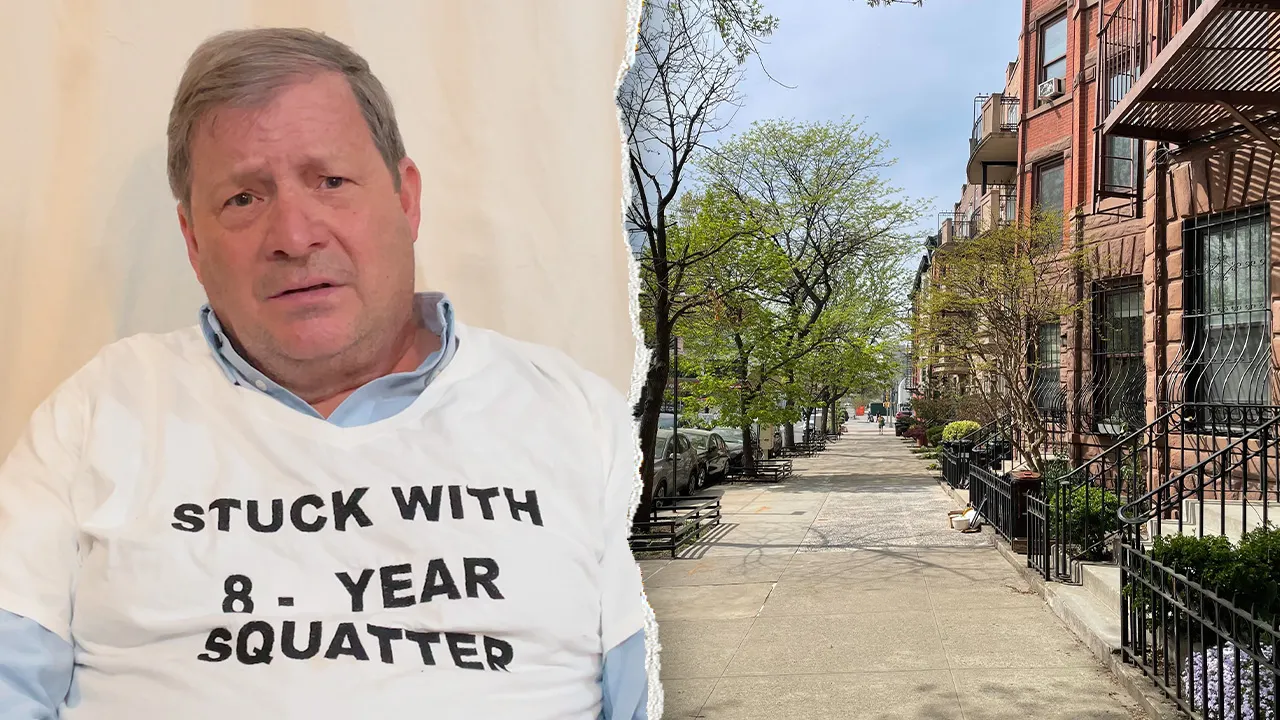
Thomas Diana never anticipated that the modest eight-unit apartment building he bought in the vibrant, tree-lined neighborhood of Park Slope, Brooklyn, would eventually become the source of an existential financial and emotional crisis that would consume nearly a decade of his life. As a small-scale landlord, Diana represents a segment of property owners who are often overlooked in mainstream real estate narratives: working-class individuals who rely on their properties not for massive corporate dividends, but to build a modest foundation of security for their families and fund their children’s futures. Instead, Diana has spent the last nine years trapped in what he describes as a harrowing, never-ending legal nightmare that has thoroughly drained his resources, forced him to deplete his daughter’s college savings fund, and pushed his mental health to its absolute limits. Wearing a custom-printed T-shirt emblazoned with the words “Stuck with 8-year-squatter”—now a bitter, outdated testament to an ongoing ordeal that has officially entered its ninth consecutive year—Diana spoke of a domestic housing system that he believes has entirely abandoned small housing providers. The crisis began innocently enough back in 2014 when Diana posted a Craigslist advertisement seeking a live-in companion to assist an elderly, disabled tenant residing in one of his building’s rent-stabilized units. A woman answered the ad and moved into the apartment to assume caregiving responsibilities. However, when the elderly tenant passed away in 2016, the caregiver did not vacate the premises or transition to a standard lease. Instead, her presence transformed into a prolonged legal gridlock, sparking an agonizing multi-court battle that Diana estimates has cost him between $275,000 and $325,000 in uncollected rent and monumental legal expenses. This financial hemorrhage has fundamentally altered his family’s trajectory, converting his pride in property ownership into a daily struggle to borrow tuition money and keep his head above water. People often mistakenly believe that landlord-tenant disputes and eviction cases in major metropolitan areas are resolved in a matter of weeks, akin to a fast-paced television drama, but Diana’s grueling ordeal stands as a stark warning of the bureaucratic reality that many small property owners face.
The core of the dispute lies in the legally murky water surrounding New York’s complex, highly protective rent-stabilization laws, which govern how apartments are leased, inherited, and deregulated. Following the primary tenant’s death in 2016, a maze of conflicting claims emerged regarding the companion’s legal right to occupy the Park Slope apartment, her exact tenant status, and whether the landlord had complied with New York’s strict housing regulations. Diana maintains that the occupant’s presence became unauthorized from the moment her caregiving duties naturally concluded with the tenant’s passing, viewing the situation as a clear-cut case of unlawful holdover by someone who has effectively bypassed standard rental obligations. On the other hand, the occupant chose to fight back vigorously through the judicial system, asserting that the apartment had been illegally deregulated years prior and that she was entitled to the robust protections, rent controls, and leases associated with a rent-stabilized home. This stark division of perspectives has created a legal impasse where every single detail of the living arrangement, from historic unit registration to current utility bills, has been fiercely litigated. While Diana views her prolonged stay as an egregious form of squatting enabled by a backlogged, biased court system, the tenant and her advocacy attorneys view her fight as a justified defense against what they characterize as an aggressive, unfair attempt to displace a working tenant from affordable housing. The resulting friction has created a deep emotional chasm, highlighting the intense human conflict that occurs when a landlord’s personal property rights clash directly with an occupant’s claim to stable shelter.
To navigate this daunting legal labyrinth, Diana has had to contend with a judicial process that he describes as highly susceptible to systemic manipulation through continuous delays and strategy shifts. He claims that the occupant has cycled through at least eight different attorneys over the nine-year period, a tactic he believes is deliberately designed to reset the litigation clock and prolong her rent-free residence indefinitely. Each change of counsel inevitably brings new court dates, requests for adjournments, and fresh reviews of the voluminous case files, stalling any progression toward a final judgment and forcing Diana to repeatedly hire representational support of his own. Diana recalls the intense frustration of the deposition phase, a critical juncture where his attorney challenged the occupant’s assertions with empirical evidence, including vintage emails, photograph archives, detailed rent records, and eyewitness testimony. According to Diana, the occupant’s initial eighteen claims—which included assertions that the deceased tenant was never actually disabled and that she had been an official co-signatory on the lease—crumbled under scrutiny, only for her legal team to pivot to entirely new theories of defense as soon as the old ones lost credibility. This shifting legal landscape has created a sense of despair for Diana, who points out that while public perception of eviction proceedings suggests a brisk, two-week courtroom affair similar to televised dramas, the reality in New York’s housing court is an agonizingly slow, multi-year process where motion after motion can delay justice for nearly a decade, leaving small property owners to absorb the compounding collateral damage of a stagnant case that refuses to resolve itself despite overwhelming counter-evidence.
The legal defense presenting the occupant’s side of the story paint an entirely different picture of the situation, shifting the blame back onto Diana’s management practices and past deregulation efforts. Casey Gilfoil, an attorney representing the tenant through Brooklyn Legal Services, has publicly accused Diana of distorting the fundamental facts of the case to perform a public relations campaign aimed at harassing a vulnerable client out of her rightful rent-stabilized home. According to Gilfoil, the court has already issued a ruling indicating that Diana improperly deregulated the apartment years ago, and she argues that the primary remaining tasks for the court are simply to establish the legal stabilized rent and calculate any potential financial damages owed to her client. Furthermore, the tenant’s legal team asserts that their client has not simply been living rent-free, but has instead been diligently putting her rent money aside into an escrow account pending the final, definitive ruling of the court. Diana, however, vehemently disputes this assertion of an escrow fund, arguing that based on court records regarding her erratic employment history and limited income, it is mathematically impossible for her to have accumulated anywhere near the hundreds of thousands of dollars in back rent that are currently outstanding. He also defends his past compliance with state laws, asserting that the court did not find any evidence of fraud in his actions, but rather concluded that he had incorrectly followed old guidelines provided directly by the New York State Division of Housing and Community Renewal when he deregulated the apartment years before. He notes that while court stipulations had once required use-and-occupancy payments of roughly $835 a month, even those limited payments ceased years ago.
The financial structure of operating an eight-unit building means that the loss of rent from just a single apartment for nearly a decade does not simply reduce profits; it completely decimates them, leaving the owner to cover structural costs out of pocket. For a small landlord like Diana, properties of this scale exist on incredibly thin margins, meaning that the monthly income from paying tenants must immediately be funneled back into paying high property taxes, municipal water bills, building insurance, heating fuel, and ongoing structural upkeep. When one-eighth of that vital revenue stream vanishes for a hundred consecutive months, the landlord is forced to subsidize the non-paying unit with personal income, personal credit, or, in Diana’s tragic case, funds that had been carefully set aside for his children’s future. He expressed deep frustration with the prevailing bureaucratic attitudes of housing court officials who seem to operate under the assumption that all landlords possess infinite cash reserves and can easily withstand years of non-payment. This frustration is compounded by what Diana describes as a deeply hypocritical regulatory system that aggressively penalizes small landlords for minor administrative or structural infractions, such as microscopic paint drips or historic building quirks, while simultaneously allowing occupants to withhold hundreds of thousands of dollars in rent without facing any immediate consequences. He feels that the system actively encourages landlords to simply capitulate to bad-faith actors by advising them to sell their properties at a loss or pay massive “cash-for-keys” buyouts to occupants who already owe them a fortune, which he views as a form of legalized theft that systematically destroys honest, self-reliant housing providers who are labeled as slumlords over minor violations while tenants live completely rent-free.
As the winter of their discontent transitioned into spring, any hope for a swift and equitable resolution to this modern-day housing saga was dashed once again during an April court session when the presiding judge adjourned the proceedings until the summer. This latest delay guaranteed that the legal battle would officially cross the threshold into its tenth year, converting what should have been a straightforward landlord-tenant dispute into an endless, circular marathon of legal procedures that Diana compares to an episode of The Twilight Zone. Out of options and struggling to stay afloat under the weight of mounting legal debt, Diana has even resorted to launching a crowdfunding page on GoFundMe in a desperate attempt to solicit financial help from the public to preserve his building and protect his family’s livelihood. The prolonged battle serves as a stark, cautionary tale about the unintended consequences of well-intentioned tenant protection laws when they lack the necessary administrative safeguards to prevent systemic exploitation. It highlights a painful vulnerability in New York’s housing ecosystem, where the balance of justice has shifted so far toward delay and bureaucracy that a single, unresolved dispute can quietly dismantle a family’s financial security over the course of a decade. For Thomas Diana, the ongoing wait for a summer court date represents far more than just a legal routine; it is a desperate search for accountability in a system that seems to have forgotten the human beings on both sides of the courtroom door, leaving people suspended in an endless cycle of litigation with no resolution in sight.