

The Tehran Divide: How Hard-Line Resistance Threatens Hostility-Ending Diplomacy Between Iran and the United States
A High-Stakes Gambit on the Brink of Peace
As negotiators from Tehran and Washington edge closer to a historic defense of diplomacy that could theoretically end decades of bitter regional hostility, a profound domestic crisis in Iran threatens to derail the fragile process before an pen ever touches paper. The geopolitical stakes could not be higher: both nations are attempting to navigate the complex, blood-soaked aftermath of a devastating conflict that erupted in late February, seeking a path toward strategic stabilization that has eluded them for generations. Yet, this high-stakes endeavor remains dangerously suspended in a state of political paralysis, hindered by deep-seated institutional mistrust, localized skepticism, and unresolved strategic disputes. While President Donald J. Trump convened an intensive, highly scrutinized two-hour session with his top national security team and cabinet members in the secure confines of the White House Situation Room on Friday, he ultimately deferred a definitive resolution on the proposed diplomatic framework, illustrating the immense domestic political risks inherent in any diplomatic overtures toward the Islamic Republic. On the other side of this diplomatic chasm, Iran’s chief negotiator, the highly influential General Mohammad Bagher Ghalibaf, injected a sharp dose of realistic skepticism into the international arena by declaring on social media that Tehran possesses zero institutional or historical trust in Washington’s long-term commitments. Ghalibaf’s uncompromising public insistence that “no step would be taken before the other side acts first” underscores the classic security dilemma that has historically neutralized bilateral diplomatic efforts, reinforcing the reality that the success of these negotiations rests not just on the strategic pragmatism of international players, but on a fraught, highly volatile domestic power struggle churning within the corridors of the Islamic Republic itself.
The Internal Rebellion of Tehran’s Hard-Line Faction
+————————————————————-+
| IRAN’S DOMESTIC POWER PLAY |
+————————————————————-+
| [ MODERATE EXECUTIVE BRANCH ] [ ULTRACONSERVATIVE FRINGE ] |
| – Led by Pres. Pezeshkian – Loud minority in Majlis |
| – Backed by Mojtaba Khamenei – Backed by IRIB (State TV) |
| – Seeks diplomatic reset – Demands total defiance |
+————————————————————-+
This domestic friction is primarily driven by an unyielding, ideologically rigid hard-line faction inside Iran that views any potential diplomatic compromise with the West as a catastrophic capitulation. Though they represent a minority segment of the classical Iranian political spectrum, this ultraconservative, fiercely nationalistic group wields disproportionate systemic leverage through their entrenched positions in the Islamic Consultative Assembly (Parliament) and their strategic presence on the Supreme National Security Council. Unwavering in their hostility toward Western powers, these hard-liners have systematically mobilized their vast political, paramilitary, and religious networks to sabotage the fragile consensus being cultivated by the current moderate executive administration. They rely on a potent mix of highly coordinated public rallies, state-sanctioned media platforms, and aggressive private lobbying to delegitimize the peace talks, arguing that any concessions made to Washington would dishonor the sacrifices of the nation’s martyrs and permanently weaken Iran’s regional deterrent posture. To these ideologues, the concept of compromise with the United States is not merely a pragmatic foreign policy option; it is an existential threat to their domestic political survival and their ideological purity, both of which rely on maintaining a status of perpetual confrontation with external adversaries to justify the militarization of the state and the preservation of conservative social control. By positioning themselves as the sole defenders of national sovereignty and the legacy of the Axis of Resistance, they are daring the current political leadership to bypass them, thereby threatening to spark a domestic crisis that could unravel the regime from within if their demands are sidelined in favor of an agreement.
Sowing Discord: The Information War of State Television
A critical, highly visible battlefield in this fierce domestic confrontation is the state-run broadcasting monopoly, Islamic Republic of Iran Broadcasting (IRIB), which operates under the direct control of an ultraconservative director who has consistently used the airwaves to undermine the diplomatic efforts of the presidency. Nightly broadcasts have systematically framed the diplomatic overtures to the United States as a strategic failure, utilizing highly partisan commentators to portray the negotiation team as naive victims of Western deception while selectively reporting on administrative hesitancy in Washington to fuel public anxiety. This deliberate media campaign recently triggered an extraordinary and highly public confrontation between the moderate President Masoud Pezeshkian and the senior leadership of the state television apparatus in Tehran. During a tense, closed-door meeting that was later leaked to the public, Pezeshkian delivered a stern rebuke to IRIB executives, accusing them of actively sowing national discord at a moment when the country desperately requires strategic unity and cohesion to navigate its economic and security crises. To dismantle their ideological arguments, Pezeshkian made the rare and bold move of invoking the name of the late Supreme Leader, Ayatollah Ali Khamenei—who was tragically killed on the very first day of the brief but intense war starting in late February—revealing that even the revered former leader had explicitly agreed that Iran must return to the negotiating table to secure its survival. Pezeshkian’s pointed critique—”but now, we are advertising that we should not negotiate”—exposes the deep ideological hypocrisy of a faction that claims to uphold the sacred legacy of the supreme leadership while actively sabotaging the strategic pragmatism that the leadership itself authorized prior to its demise.
“But now, we are advertising that we should not negotiate.”
— President Masoud Pezeshkian, addressing state television executives
The Street and the Senate: Defiance as Political Currency
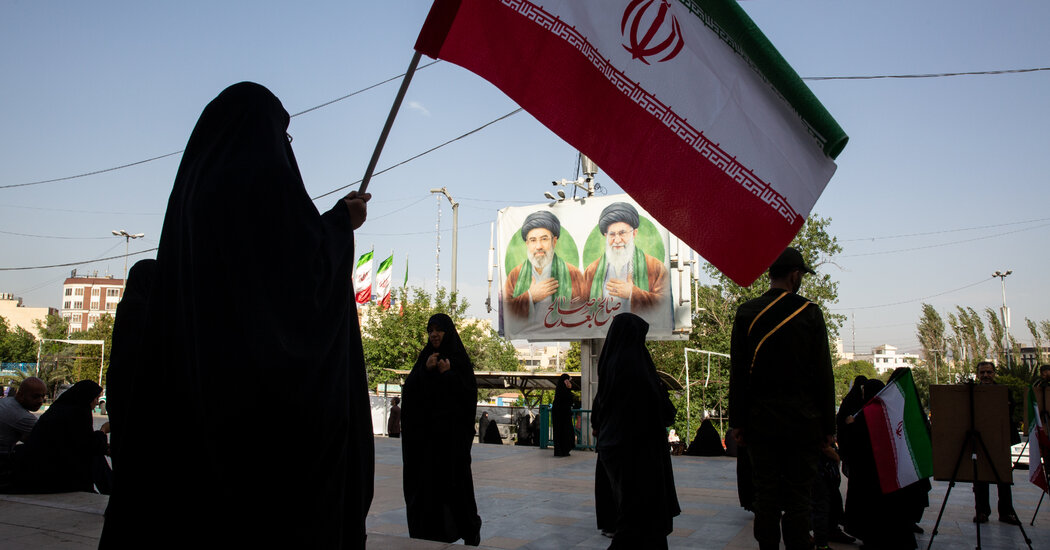
On the concrete plazas of Tehran, this ideological war takes a physical, highly emotional form, as demonstrated by a massive, tightly packed rally of hard-line loyalists who converged on Friday to demand an end to all diplomatic engagements with Western powers. Under a sea of waving flags and amidst rhythmic, thunderous chants of defiance, attendees expressed an unyielding desire for military confrontation over diplomatic compromise, illustrating the deep chasm between the pragmatic executive branch and the ideological grassroots. When questioned by a state media reporter about whether Iran should de-escalate or double down on its resistance against the United States and Israel, the crowd’s responses reflected an uncompromising, zero-sum worldview, with one female attendee demanding that the state “punish them good” and another man swearing eternal fidelity “until our last drop of blood.” This street-level fervor is directly reflected and validated in the highest halls of parliament by powerful conservative elites, such as Ebrahim Azizi, the influential lawmaker who currently heads the National Security and Foreign Policy Committee. In a defiant social media post that captured the triumphalist narrative of his faction, Azizi warned that Washington must understand that Iran stands as the indisputable “victor and conqueror of the field,” and therefore possesses the sole authority to dictate the terms of any future geopolitical arrangement. This rhetoric of total triumph creates an impossible, highly dangerous standard for Iranian negotiators, as it frames any realistic diplomatic compromise—which inevitably requires mutual concessions—as an unacceptable surrender of a hard-won military victory.
              +-----------------------------------------+
              |    TEHRAN'S STRATEGIC DILEMMA           |
              +-----------------------------------------+
                                   |
               Isolate the Hard-Line Minority?
                                   |
              +--------------------+--------------------+
              |                                         |
             YES                                        NO
              |                                         |
 - Smooth nuclear negotiations             - Maintain internal stability
 - Reduced international sanctions         - Protect loyalist military base
 * RISK: Domestic uprising/instability     * RISK: Permanent economic isolation
The Dilemma of the Regime’s Loyal Base
Political analysts closely aligned with the political establishment in Tehran caution that while this ultra-conservative faction represents a distinct minority view within both the broader Iranian public and the upper echelons of the governing apparatus, the state cannot simply crush or dismiss them without facing catastrophic consequences. This segment of the population, despite its small numbers, represents the highly mobilized, ideological, and passionately loyal core that has historically defended the Islamic Republic during times of acute political upheaval, street protests, and economic crises. To alienate this demographic by pushing forward with an unpopular diplomatic compromise with the United States risks stripping the regime of its most dedicated defenders at a time of extreme vulnerability. In a detailed telephone assessment, Mehdi Rahmati, a prominent Tehran-based political analyst, noted that while the hard-line faction has been successfully marginalized from the core decision-making loop regarding the active nuclear negotiations, their capacity to act as spoilers remains dangerously high. Rahmati warned that the ruling establishment must proactively construct a comprehensive strategic plan to manage, pacify, and contain these radical elements; failure to do so, he argued, could transform this vocal minority into a highly destabilizing force capable of fracturing the state’s internal security apparatus at the worst possible moment. The state is thus caught in a paralyzing paradox: it must secure an international agreement to rescue its crashing economy, yet the domestic cost of that agreement could search the very foundations of the regime’s security state.
A Shadow Leadership and the Crisis of Succession
The ferocity of this internal rebellion has reached such unexpected heights that even the newly appointed Supreme Leader, Ayatollah Mojtaba Khamenei—who ascended to the position following the tragic assassination of his father, the late supreme leader, at the outbreak of the war in late February—is no longer shielded from the public attacks of the hard-line fringe. Operating from secure, undisclosed locations since the conflict began due to severe security threats, the younger Khamenei has consistently issued written directives signaling his support for the current diplomatic endeavors, attempting to lend his religious and political legitimacy to the negotiating team. However, this has not deterred radical critics like the hard-line cleric and member of parliament Hamid Rasaee, who took an unprecedented, highly calculated swipe at the new leader on Thursday by publishing a provocative social media post insolently titled, “Who is worthy of the supreme leadership?” This direct, public challenge to Mojtaba Khamenei’s religious authority and leadership credentials reveals that the current battle over US-Iran diplomacy is intrinsically tied to a much larger, highly volatile struggle for the very soul and future leadership of the Islamic Republic itself. As foreign diplomats race against the clock to draft an agreement that could avert another devastating regional escalation, they are forced to contend with a sobering political reality: the ultimate fate of any international accord between Washington and Tehran will not be decided solely by the pen of diplomats, but by who emerges victorious from the ruthless, internecine political warfare currently raging behind the closed doors of Tehran.
| Key Player | Core Position on US-Iran Relations | Source of Political Leverage |
|---|---|---|
| President Masoud Pezeshkian | Advocates for diplomatic negotiations to lift sanctions and stabilize the economy. | Executive powers, moderate electorate, backing of the Supreme Leader. |
| Gen. Mohammad Bagher Ghalibaf | Skeptical of US intentions; demands verifiable reciprocal actions before conceding. | Chief negotiator status, military influence, moderate-conservative alliance. |
| Ayatollah Mojtaba Khamenei | Supports the negotiations via written decrees from undisclosed secure locations. | Ultimate religious/political authority, successor to his assassinated father. |
| Ebrahim Azizi (MP) | Rejects concessions; argues that Iran, as the “conqueror,” must dictate all terms. | Chairmanship of Parliament’s National Security and Foreign Policy Committee. |
| Hamid Rasaee (Cleric/MP) | Uncompromising opposition; challenges the strategic legitimacy of Mojtaba Khamenei. | Hard-line street mobilization, influence within conservative religious seminaries. |