


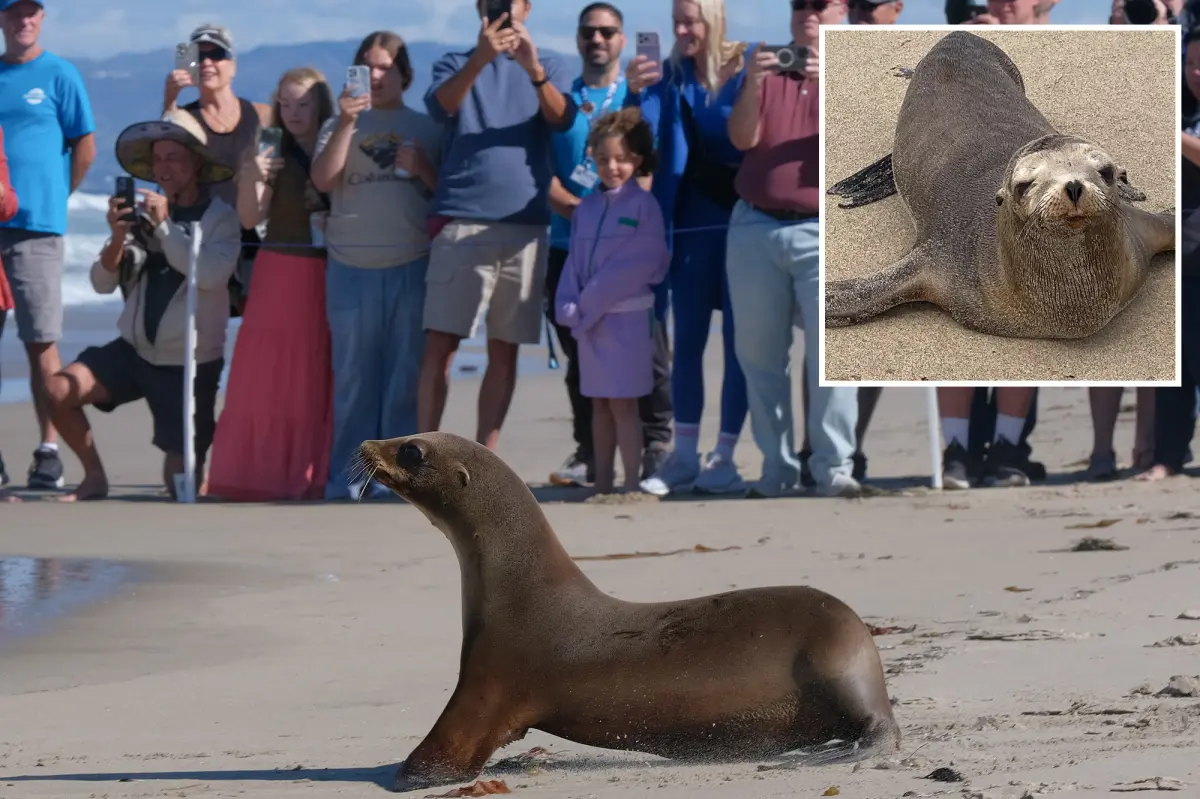
On a picture-perfect Friday morning at Manhattan Beach, the air was thick with the scent of salt water and the undeniable electricity of shared human joy. As the golden California sun began to burn through the early fog, dozens of local community members, conservationists, and civic leaders—including Manhattan Beach Mayor Joe Franklin—gathered on the shoreline, their eyes locked on three large wooden travel crates resting on the damp sand. Inside those enclosures were Tortellini, Rotini, and Cavatappi: three pint-sized wild sea lion pups who, just weeks prior, were mere hours away from a tragic and lonely demise on the highly populated beaches of Los Angeles. The atmosphere was charged with a palpable sense of triumph, transforming the popular public beach into an open-air sanctuary where the boundaries between human society and the wild natural world temporarily dissolved. Guided by the dedicated hands of their rescuers, the crates were carefully aligned with the rolling Pacific waves, and the crowd held its collective breath in anticipation of a moment that once seemed entirely impossible. These three innocent animals had become symbols of hope, resilience, and the profound impact of collective human empathy, proving that even in our bustling, concrete-dominated modern world, we still possess the capacity to pause, care for, and heal the fragile species with whom we share this coastline.
To truly appreciate the magic of their return to the wild, one must look back to the dark, heartbreaking days of early April, when the first of the trio was discovered clinging to survival. On April 12, a female pup whom rescuers would affectionately name Tortellini was found washed ashore at Dockweiler State Beach, looking less like a vibrant marine mammal and more like a ghost of the tides. When the rescue team from the Marine Mammal Care Center first approached her, they were deeply shocked by her skeletal condition; her thick, insulating layer of blubber was completely gone, leaving her delicate backbone and ribs protruding sharply against her dull, matted fur. During her initial medical examination, veterinary experts discovered a laundry list of debilitating ailments: her jaw was severely swollen from an unknown trauma, and her left eye was clouded with a thick, painful discharge that forced her to squint constantly in the harsh coastal sunlight. She was profoundly dehydrated, cold, and too weak to lift her head, representing a textbook case of severe emaciation that would have surely claimed her life within days had she not been spotted by compassionate beachgoers. The veterinary team immediately leaped into action, administering aggressive anti-inflammatory medications to soothe her swollen jaw and a suite of specialized ophthalmic nutrients to save her failing eyesight, all while formulating a delicate plan to restart her shut-down digestive tract.
Not far away, two other young sea pups were fighting their own silent, desperate battles against starvation along the heavily trafficked shores of Los Angeles County. Rotini, another female pup, was discovered huddled on the very same stretch of Dockweiler State Beach, eventually spotted by a vigilant volunteer beach cleanup crew who noticed her abnormally lethargic behavior amid the coastal debris. She was dangerously dehydrated and malnourished, her small body shivering on the sand as hundreds of beachgoers passed by, unaware of her desperate plight. Shortly thereafter, a young male pup named Cavatappi was rescued from nearby El Segundo after a concerned citizen reported a tiny, listless sea lion pup who refused to return to the safety of the ocean waves. Like his pasta-named counterparts, Cavatappi was severely underweight and lacked the vital energy reserves required to hunt for fish in the cold, unforgiving currents of the Pacific Ocean. Separated from their mothers prematurely—likely due to shifting environmental conditions, warming ocean waters, or scarcity of prey—all three pups had reached a critical juncture where their natural survival instincts were simply no match for their failing physical bodies, leaving them entirely dependent on the intervention of human strangers.
The road to recovery for these three dynamic pups was paved with absolute dedication, scientific expertise, and a heavy dose of smelly, labor-intensive love at the Marine Mammal Care Center in San Pedro. Because the pups were initially too weak to chew or digest solid food, caregivers had to simulate the nourishing milk they would have received from their mothers by preparing a highly specialized, calorie-dense liquid formula known fondly as “fish smoothies.” This mixture, consisting of blended herring, heavy vitamins, water, and essential electrolytes, had to be carefully delivered directly into their stomachs via a delicate tube-feeding process several times a day. As the weeks slowly ticked by, the intensive care began to yield beautiful results; Tortellini’s eye infection completely cleared, her squinting vanished, and her jaw swelling subsided, allowing her to transition from the liquid mush to eagerly chasing down and swallowing whole, raw fish. This crucial milestone signified that her wild hunting instincts were returning, and she, Rotini, and Cavatappi began socializing and swimming together in the center’s rehabilitation pools, playfully competing for food and building up the crucial muscle mass they would need to survive in the wild. By the end of their six-week stay, all three sea lions had miraculously doubled their body weights, transforming from skeletal, helpless infants into sleek, muscular, and incredibly spirited young predators ready to claim their rightful place in the marine ecosystem.
This remarkable triumph highlights the vital, year-round effort of the Marine Mammal Care Center (MMCC), which stands as the only dedicated, full-service marine mammal hospital operating 24/7 within Los Angeles County. Operating along one of the most heavily populated and highly utilized coastal regions in the entire world, the MMCC bears the monumental distinction of rescuing more marine mammals per mile of urban coastline than any other conservation organization in the United States. The center serves as a critical buffer zone between fragile ocean wildlife and the encroaching pressures of human development, pollution, climate change, and overfishing, which continuously threaten the delicate balance of Southern California’s marine ecosystems. Supported by a passionate army of volunteers, marine biologists, and veterinary specialists, the MMCC works tirelessly to educate the public about ocean health while simultaneously managing high-stress rescue missions that give thousands of seals and sea lions a second chance at life. The successful rehabilitation of Tortellini, Rotini, and Cavatappi is a beautiful testament to this organization’s enduring legacy, showcasing how science-driven conservation and deep community support can turn the tide for species that are increasingly vulnerable to the rapidly changing conditions of our global oceans.
On that unforgettable Friday morning at Manhattan Beach, all of those weeks of sleepless nights, scientific calculations, and emotional investment culminated in a beautiful moment of pure, unbridled freedom. When the handlers finally unlatched the heavy crate doors, the three pups paused for a fleeting, breathless moment, lifting their sleek noses into the ocean air and feeling the familiar cool breeze of the Pacific on their whiskers. Then, with a sudden burst of wild energy that delighted the cheering crowd, they scrambled eagerly across the wet sand, their flippers propelling them forward into the breaking white foam of the incoming tide. Watching them bob effortlessly in the surf, dive under the rolling waves, and pop their heads up to look back at the shore one last time, it was impossible to recognize them as the same dying creatures that had washed up on the sand just weeks prior. For the teary-eyed rescuers, the cheering children, and the local officials who stood watching until the pups vanished into the vast blue horizon, the moment was a powerful reminder of our shared duty to protect the natural world. Tortellini, Rotini, and Cavatappi were finally home, leaving behind a beach filled with inspiration and a community deeply committed to ensuring that the wild shores of California remain a safe, thriving sanctuary for generations to come.