




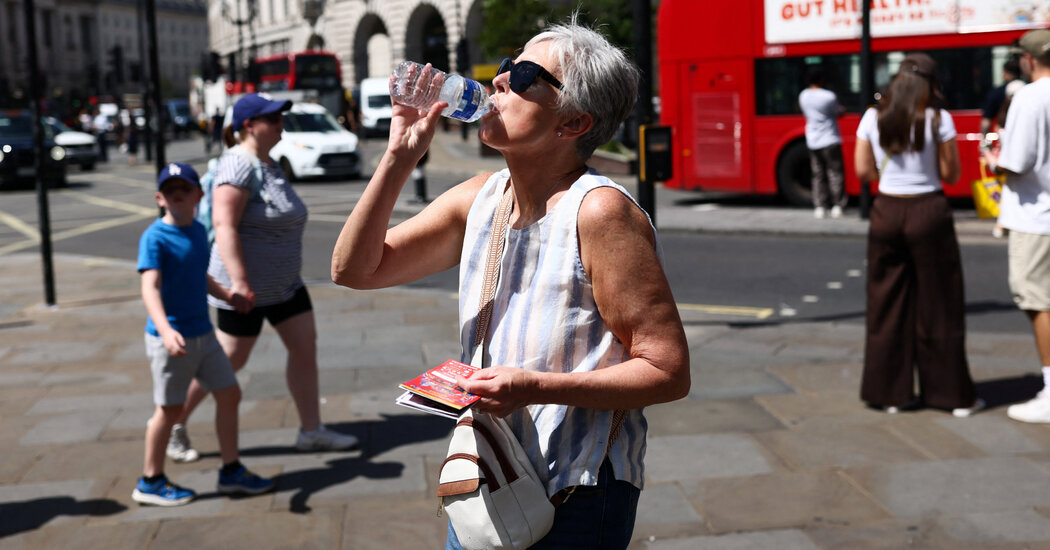
The Unseasonable Crucible: Western Europe Swelters Under Premature Summer Heat
Lines of anxious Londoners snaking outside public pools and historic swimming ponds; dense, cool mists of water dousing tennis spectators at the French Open under a blazing Parisian sky; commuters packed like cargo into stifling, un-air-conditioned public transportation networks across the continent. Although the calendar indicates that meteorological summer has not yet officially commenced, Western Europe is already baking under a historic, record-breaking heat wave that has descended upon the region far earlier than normal. This premature thermal onslaught has caught metropolitan infrastructures off guard, forcing local authorities and national governments to issue urgent public health alerts as temperatures soar to heights typically reserved for the absolute peak of July or August. The suddenness and intensity of this early-season weather anomaly have once again thrust the stark realities of our changing climate into the daily lives of millions. Climatologists and environmental scientists who have closely monitored this week’s extraordinary temperature spikes have concluded that these events are not mere statistical aberrations, but are primarily attributed to human-driven climate change. The burning of coal, oil, and natural gas continues to insulate the Earth in a self-inflicted greenhouse, modifying atmospheric currents and locking high-pressure ridges—frequently termed heat domes—over highly populated urban areas.
British Baselines Shattered: Historic Highs and the Struggle of Modern Infrastructure
METEOROLOGICAL SPRING TEMPERATURES (UK)36°C |====================================================== [35.1°C – Tuesday]
35°C |========================================= [34.8°C – Monday]
34°C |
33°C |======================= [32.8°C – Historical Record: 1922 & 1944]
32°C |
15°C |======= [Average May High]
+———————————————————————-
In the United Kingdom, a nation historically characterized by its temperate, damp spring weather, the atmospheric shift has been nothing short of historic. On Monday, meteorologists at the Royal Botanic Gardens in Kew, Greater London, recorded an astonishing 34.8 degrees Celsius (nearly 95 degrees Fahrenheit), provisionally setting a new record for the highest temperature ever documented during Britain’s meteorological springtime, which spans from March to May. That newly minted milestone, however, survived for less than twenty-four hours; on Tuesday, the mercury climbed even higher, peaking at a blistering 35.1 degrees Celsius (95.2 degrees Fahrenheit). This sudden spike completely shattered the previous seasonal record of 32.8 degrees Celsius, a benchmark that had stood undisturbed for decades after being recorded during the springs of 1922 and 1944. As the majority of England and Wales officially entered heat wave territory, the human impact became immediately visible. For everyday citizens like Sam Worth, a 34-year-old London resident waiting in a sprawling, slow-moving queue at a municipal lido, the weather was simply “too hot for me.” The timing of the heat wave coincided with a planned midterm school holiday across the United Kingdom, offering a brief reprieve for educators like Phoebe Thomson. Thomson remarked that she was incredibly relieved not to be teaching, noting that children would have severely struggled in standard classrooms, which are almost entirely devoid of climate control systems. She noted that if these unprecedented temperatures persist into the state testing season, school administrations will be forced to urgently rewrite institutional policies, potentially altering rigid school uniform requirements and arranging for external cooling units in exam halls.
The Silent Emergency: Health Alerts and the Vulnerability of an Unprepared Population
The structural design of Northern European housing, historically optimized to capture and retain warmth during long, damp winters, has suddenly become a dangerous liability. Unlike southern climates, the vast majority of residential homes, public schools, and public transit systems in the United Kingdom do not possess air conditioning, rendering indoor spaces stifling thermal traps. With average high temperatures for May typically hovering around a comfortable 15 degrees Celsius (59 degrees Fahrenheit), the public has had virtually no time to physiologically adjust to the current extreme conditions. Public health authorities warn that sudden, unseasonable heat waves can trigger severe physiological distress, including heat exhaustion and heatstroke, with particularly elevated risks for individuals living with pre-existing, chronic conditions such as high blood pressure and kidney disease. In response to these acute environmental dangers, the U.K. Health Security Agency quickly issued an amber heat health alert—the second-highest warning level in its emergency framework. This alert signaled to the public and the National Health Service that significant disruptions were imminent across medical and social care services, alongside a projected rise in mortality rates, specifically among vulnerable elderly communities. For 72-year-old Londoner Lucia Daniels, managing the heat required deep personal caution; after a refreshing dip in her local outdoor pool, she carefully navigated her journey home by walking exclusively through shaded areas. Back in her flat, Daniels explained her strategy of staying indoors “like a lizard,” keeping all curtains drawn and windows shut to trap the cooler morning air, a survival tactic that is gradually becoming a standard routine for Europe’s aging demographic.
Tragedy and Tension in France: Lethal Waters and Suffocating Commutes
EARLY-SEASON CASUALTIES & IMPACTS+————————————-+————————————-+
| FRANCE | UNITED KINGDOM |
+————————————-+————————————-+
| 7 heat-linked deaths | 3 teenage drownings |
| 5 accidental drownings | Amber Heat Health Alert issued |
| Temperatures 13°C above norm | Record 35.1°C in Greater London |
| High transit & commuter distress | Broad infrastructure vulnerability|
+————————————-+————————————-+
Across the English Channel, the French Republic is grappling with a similarly volatile mixture of extreme meteorology and human tragedy. Government officials confirmed that at least seven deaths have been directly or indirectly linked to the arrival of the heat wave, highlighting the lethal consequences of sudden environmental shifts. Five of those casualties occurred due to accidental drownings, as individuals rushed to unmonitored rivers, lakes, and coastal waters to seek relief, unaware of the profound physiological shock that cold open water can inflict on a overheated body. Maud Bregeon, speaking on behalf of the French government on national television, urged citizens to exercise extreme vigilance, noting that temperatures over the weekend soared as much as 13 degrees Celsius (23.4 degrees Fahrenheit) above established seasonal norms. This early spike is particularly dangerous because municipal safety systems, such as designated lifeguards at public beaches, are not yet fully operational for the summer season. Meanwhile, the professional sports world was forced to confront the harsh atmospheric reality; at the prestigious French Open in Paris, elite athletes found themselves struggling through oppressive air on the clay courts of Roland Garros, while spectators crowded around cooling stations and misting machines to avoid collapse. In the crowded corridors of the Paris transport system, the heat produced an atmosphere of shared exhaustion. Celine Yahiaoui, a 49-year-old administrative clerk working at a central Paris courthouse, described her daily commute on a packed, poorly ventilated regional train as “suffocating,” expressing her deep frustration with rigid corporate structures that refuse to permit remote work during severe climate anomalies. She noted that the heat has severely disrupted her sleep patterns and made basic hydration a constant uphill battle.
Spain’s Cultural Evaporation: How Climate Change Redefines Mediterranean Life
In the Kingdom of Spain, a country accustomed to hot summer conditions, the sheer earliness andintensity of this spring heat wave has caught communities unprepared and altered traditional social patterns. In southwestern provinces, regional weather forecasts warn of temperatures rapidly approaching 40 degrees Celsius (104 degrees Fahrenheit), an extreme threshold that usually stays confined to midsummer. In the historic central city of Valladolid, the traditional vibrant outdoor cafe culture was quiet; vast seas of empty outdoor tables lined the plazas as locals sought refuge in darkened indoor spaces to avoid the punishing mid-day sun. Meanwhile, in the capital city of Madrid, the urban heat island effect turned pavement and stone buildings into massive radiators, leaving residents braced for a long, grueling summer. Seeking shelter in the shade of an empty Plaza de Olavide, 60-year-old pediatric nurse Ángeles Ruiz watched over her two young grandchildren while contemplating the profound changes occurring in her homeland. Ruiz pointed out that the worsening climate crisis has rendered a beloved, generations-old Spanish idiom completely obsolete: “Hasta el cuarenta de mayo, no te quites el sayo”—a traditional piece of cultural advice warning citizens not to pack away their winter coats until the “fortieth of May,” which corresponds to the ninth of June. Looking out across the deserted, sun-bleached plaza, Ruiz remarked with a quiet sigh that the ancient saying no longer makes any sense in a world where spring now bears the punishing heat of mid-July.
                  TRADITIONAL SPANISH CALENDAR

   [ Jan ] -> [ Feb ] -> [ Mar ] -> [ Apr ] -> [ May ] -> [ June ]
                                                  |          |
                                                  |          +-- 40th of May (June 9)
                                                  |              "No te quites el sayo"
                                                  |              (Keep winter clothes on)
                                                  V
                                          [ REALITY TODAY ]
                                      Temperatures reach 40°C
                                       Idiom rendered obsolete
A Global Canopy of Fire: Connecting Europe’s Spring to Global Climatological Shifts
This anomalous European heat wave does not exist in isolation, but is part of a broader, interconnected global pattern of intensifying summer extremes. Thousands of miles away, vast swaths of South Asia have been locked in a prolonged struggle against record-breaking, life-threatening temperatures that began weeks ago. Across central and northern India, daytime temperatures have consistently hovered above a punishing 45 degrees Celsius (113 degrees Fahrenheit), while neighboring Pakistan faces forecasts predictive of temperatures rising up to six degrees Celsius above historical averages. These parallel climate emergencies demonstrate that the atmospheric systems regulating our planet’s weather are drifting into highly unstable territory. What was once classified as a rare, generation-defining weather event has now transitioned into a regular, highly destructive seasonal expectation. As Western Europe struggles to adapt its historical architecture, public transport networks, and public health systems to this new, hotter era, the events of this week serve as a reminder of a changing world. The early arrival of these extreme temperatures is a warning: without rapid, systemic changes to reduce carbon emissions and transition away from fossil fuels, the unseasonable heat will become our permanent, global summer.