


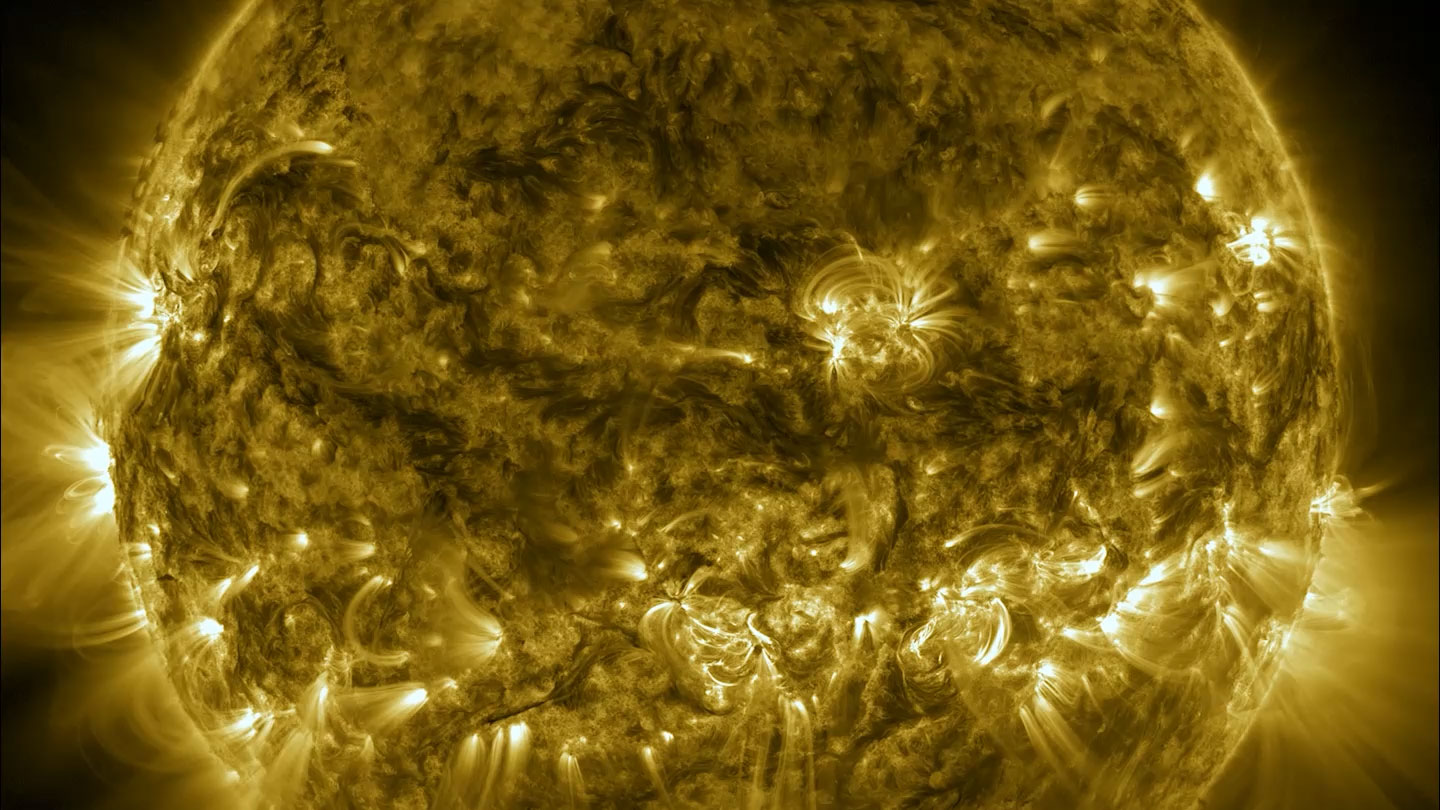
Parents are painfully familiar with the subtle, warning shifts in a toddler’s facial expressions just moments before a full-blown tantrum erupts—the quiet tensing of the jaw, the far-off stare, or a sudden, localized hush that signals a dramatic emotional tempest is imminent. In a fascinating display of cosmic poetry, our own sun seems to behave in a remarkably similar way before unleashing its most violent energetic outbursts upon the solar system. According to a pioneering study submitted to the arXiv pre-print repository on May 8, researchers have discovered that the solar surface undergoes distinct, detectable physical alterations up to three hours before a massive solar flare bursts into the void. For a modern human civilization that operates on a highly delicate, completely interconnected web of digital technology, these quiet structural changes are of existential importance. Throughout history, humanity viewed the sun as a static, dependable disk of golden light, but we now know it to be a tempestuous magnetic machine capable of catastrophic disruptions reminiscent of the famous 1859 Carrington Event, which crippled global telegraph networks. A modern-day equivalent of that historic solar superstorm could absolutely devastate Earth’s infrastructure by inducing massive, uncontrolled electrical currents that could permanently melt power grid transformers, fry the delicate circuitry of orbiting communications satellites, disable GPS navigation, and expose astronauts traveling through deep space to lethal, unshielded bursts of radiation. The identification of a reliable, three-hour countdown clock at the solar surface represents an monumental leap forward in our planetary defense strategy, introducing a paradigm shift from reactive panic to proactive shelter. By learning to decode the faint, pre-eruption changes in our star’s complex “face,” solar physicists are finally paving the way toward a predictive space-weather forecasting system that could give tech operators the vital hours needed to shield Earth’s lifeblood before the storm arrives.
Historically, the quiet, tense hours leading up to a solar storm have been largely neglected by scientists, a blind spot that solar physicist Louis Seyfritz of the New Jersey Institute of Technology attributes directly to human curiosity: researchers naturally prefer to study the sensational spectacle of the explosion itself rather than the patient, invisible buildup. The sheer, awe-inspiring violence of an erupting solar flare—defined by blinding flashes of radiation and titanic, looping eruptions of superheated gas—has historically locked the focus of solar observatories onto the moment of release. However, Seyfritz and his colleagues recognized that to truly prevent disaster, they had to understand the quiet prelude, choosing to scrutinize an active, highly volatile region of the sun that had recently shown signs of extreme restlessness. On October 3, 2024, this temperamental zone produced a legendary X-class solar flare, which represents the absolute highest, most energetic category of solar explosion, boasting an energy yield equivalent to millions of hydrogen bombs detonating simultaneously. Because solar flares frequently occur in tight chronological groups, similar to earthquake aftershocks, other solar scientists had proactively trained NASA’s Interface Region Imaging Spectrograph (IRIS) space telescope on this exact, ticking time bomb in the days leading up to the eruption. This strategic scientific stakeout was incredibly successful, allowing the instrument to capture the delicate, high-resolution atmospheric forewarnings of the impending explosion in real-time, giving humanity a rare, unprecedented front-row seat to the slow burning of the stellar fuse.
To pierce through the blinding glare of the sun’s outer layers and extract these subtle precursors, the IRIS space telescope focused its sensitive spectrographic instruments on a highly specific thermal marker: the light signature emitted by silicon IV ions. These highly charged, superheated particles serve as exceptional tracer elements within the sun’s transition region, which is a thin, extremely chaotic atmospheric boundary layer sandwiched between the relatively cool solar surface and the unimaginably hot, whispering outer atmosphere known as the corona. This dynamic region is ruled entirely by gargantuan magnetic field loops that twist, turn, stretch, and tangle as the sun rotates, storing massive amounts of potential energy like tightly coiled steel springs. As solar physicist Emily Mason of Predictive Science Inc. explains, one of the most fundamental and persistent questions in all of heliophysics operates around what triggers these flares, especially since physical systems in nature instinctively strive to maintain internal stability and resist sudden, catastrophic reorganizations. Discovering exactly what finally causes these tightly bound, highly organized magnetic structures to destabilize to the point of a runaway, explosive energy release—a process known as magnetic reconnection—is the ultimate goal of solar science. The detailed spectral measurements captured by IRIS during this critical pre-flare slide provide unprecedented empirical data, allowing scientists to witness this delicate physical threshold being crossed in real-time and showing the precise thermodynamic path our star takes as stability collapses into chaotic eruption.
By meticulously unpacking the complex stream of light data collected by the space telescope, Seyfritz’s team began to piece together a detailed, minute-by-minute countdown of the three hours leading up to the massive October eruption. They focused their analytical efforts on tracking three vital variables of the transition region’s churning plasma: its temperature, its localized turbulence, and its physical velocity as it moved either toward or away from the solar surface. To their surprise, all three of these parameters began a gradual, synchronized climb exactly three hours before the actual flare erupted, showing that the solar atmosphere was actively groaning and storing immense amounts of energy long before any visible flash occurred. More intriguing still was the discovery of a rhythmic, breathing-like cycle within the plasma, which oscillated with consistent ups and downs in precise 8-minute and 20-minute waves over the course of the three-hour countdown. As the final hour arrived, these previously separate variables of temperature and turbulence began to lock into perfect sync, rising and falling in unison like a single, coordinated wave of stellar energy, indicating a profound, systemic shift in the region’s physical behavior. Then, approximately twenty minutes before the final eruption, the quiet rhythm of the sun shattered completely: local temperatures surged, plasma turbulence spiked to extreme levels, and the outward velocity of the solar material lunging away from the surface accelerated violently, representing the final, explosive snap of the solar magnetic tethers.
These distinct, periodic oscillations have sparked intense fascination among space weather researchers because they provide vital clues to the deep, hidden physical mysteries operating within the heart of our parent star. Emily Mason notes that these rhythmic patterns seemed to change systematically depending on the specific wavelengths of light being measured by the telescope, showing that shorter light wavelengths displayed the rapid, 8-minute heartbeat while longer wavelengths demonstrated the slower, 15-to-20-minute cycle. This notable divergence strongly implies that we are not just observing a single, simple phenomenon, but rather two entirely separate and highly distinct physical mechanisms—such as acoustic pressure waves and magnetic tension adaptations—operating in tandem within the boiling solar plasma. However, before this incredible piece of stellar physics can be transformed into an active, globally trusted emergency alert system for Earth’s infrastructure, the scientific community must subject these findings to rigorous statistical validation. Researchers will need to carefully analyze historical solar datasets to determine if these same rhythmic, pre-flare warning oscillations show up in otherwise active solar regions that ultimately quiet down without ever erupting, or if they are exclusive signatures of an impending explosion. Correctly distinguishing between a benign solar murmur and a true cosmic warning siren is an absolutely essential step if we hope to build an early warning system that power operators and satellite controllers can confidently rely on to make critical operational decisions.
While the discovery of these structural pre-flare oscillations represents a monumental scientific breakthrough, translating this theoretical stellar physics into a practical, planetary-scale defense system presents formidable engineering and funding challenges. To turn this research into a functional early warning system, humanity must design, build, and deploy a specialized orbital space mission capable of observing the entire disk of the sun continuously, rather than just staring at a small, pre-selected active region. Such a space-based constellation would also require advanced, onboard artificial intelligence systems capable of processing these complex multi-wavelength oscillations in real-time, instantly calculating flare probabilities and broadcasting warnings to Earth within minutes to bypass transmission delays. Fortunately, as space weather experts eagerly point out, this is not an impossible, far-fetched science fiction vision; the actual sensor, telescope, and onboard computing technology required to build such an warning system already exists today. The ultimate barrier to protecting our modern, tech-dependent civilization from a potentially catastrophic solar storm is not a lack of scientific or technological capability, but a matter of securing the global political will and funding necessary to put these essential eyes in the sky. By learning to read the subtle body language of our star, we are finally stepping into an era where we can coexist safely with its immense power, turning an ancient threat into a predictable element of modern life.