


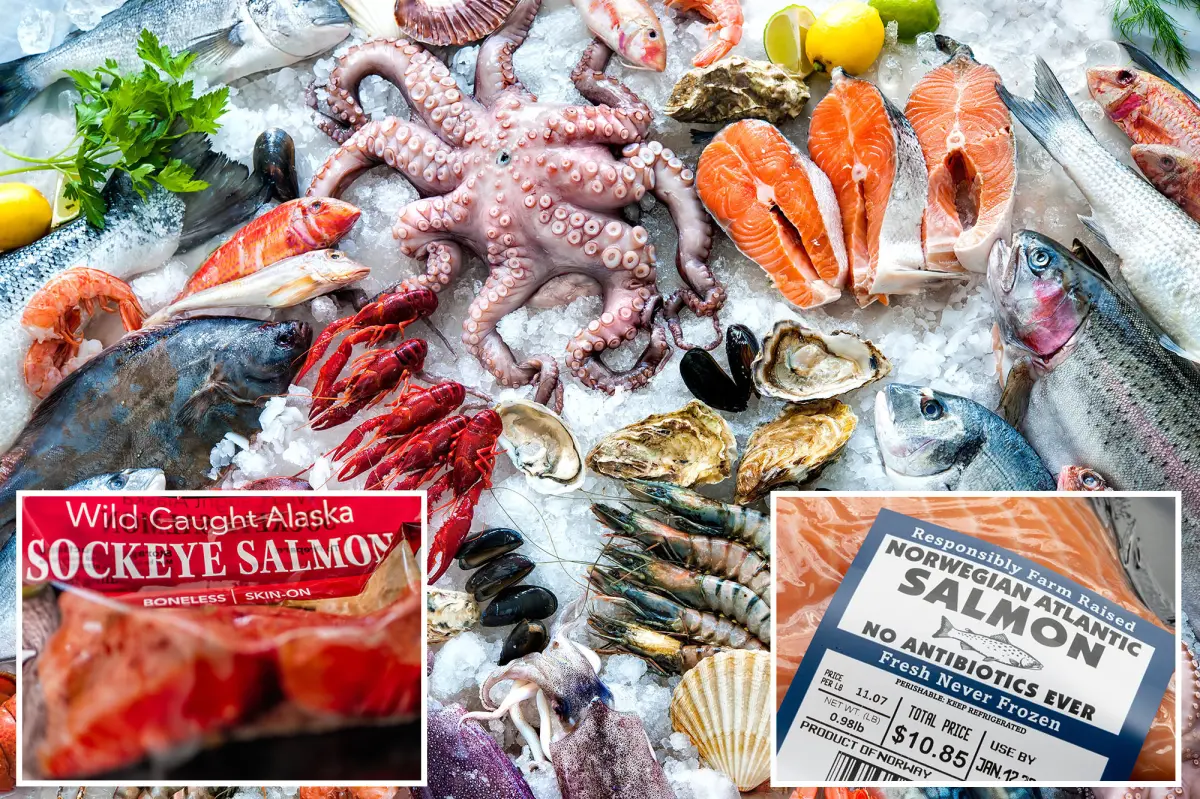
Imagine standing in front of your local supermarket’s seafood counter on a busy weekday evening, the cool, briny mist from the display rising up as you ponder what to prepare for dinner. On one side, gorgeous, deep-crimson fillets of wild-caught salmon rest on a bed of crushed ice, their premium price tags whispering promises of pure, untouched nature and superior health benefits. Right next to them sits a neat, colorful mountain of farm-raised fillets, boasting a uniform, pale-pink aesthetic and a significantly more accessible price tag that feels much kinder to your hard-earned budget. For many of us, this routine shopping trip quickly transforms into a quiet, stress-inducing cross-examination of our values: Are we compromising our family’s health and the future of our oceans by choosing the more affordable, farm-raised option, or is the steep price of wild-caught seafood just a clever marketing ploy designed to capitalize on our nutritional anxieties? This everyday scenario perfectly captures the modern consumer’s struggle, a psychological tug-of-war wrapped in clingfilm, where “natural” is instinctively equated with good, and “farmed” is often unfairly dismissed as inferior. Yet, when we peel back the layers of marketing and dive into the actual science of our food supply, we find that the debate between wild-caught and farm-raised seafood is incredibly nuanced, deeply human, and far less black-and-white than the simplistic labels would lead us to believe.
To truly understand this complex landscape, we have to look past the common, paralyzing binaries of the grocery aisle and realize that the world of fish farming, or aquaculture, is not a monolith. Mark Frisch, a veteran of the food industry and the Florida-based executive vice president of seafood distributor BSF, explains that one of the most significant hurdles for consumers is the sweeping misconception that all farm-raised seafood is either completely pristine or inherently toxic. In reality, aquaculture is just as diverse and stratified as any other form of farming on dry land. There are highly conscientious, ecologically responsible fish farms that go to extraordinary lengths to ensure clean water, high-quality nutrition, and ethical animal welfare standards, just as there are facilities that prioritize speed and high yields at the expense of quality. Frisch emphasizes that instead of viewing all farmed fish through a single, negative lens, we should approach our seafood buying with the same curiosity we apply to other parts of our diet: it ultimately comes down to finding trusted providers, asking the right questions, and taking the time to educate ourselves on where our food originates. By understanding that responsible fish farming is not only safe but also a vital tool for feeding a growing global population without exhausting our wild oceans, we can move away from knee-jerk skepticism and toward informed, empowered choices.
Part of what makes navigating the seafood counter feel so uniquely exhausting for the average shopper is the distinct lack of a clear, standardized grading system. Frisch invites us to compare our seafood shopping experience with how we purchase terrestrial proteins like beef or poultry, where decades of heavily regulated marketing have simplified our options. When you walk down the meat aisle, your brain instantly recognizes and decodes familiar terms like “USDA Choice,” “Prime,” “grass-fed,” or “organic”—labels that carry a government-backed seal of approval and immediately signal a specific level of quality, taste, and animal husbandry. In stark contrast, the seafood section offers no such easy equivalents; there is no federal USDA organic standard for domestic fish, leaving consumers to navigate a chaotic sea of self-reported marketing terms, private eco-badges, and confusing geographic origins. This regulatory vacuum forces the everyday shopper to act as an amateur marine biologist and supply chain investigator just to buy a simple dinner, creating an environment of decision fatigue where we are left to guess whether we are purchasing highly sustainable food or merely paying a premium for clever brand packaging.
When we shift our focus from the retail display to the actual biology of what goes onto our plates, the nutritional differences between wild and farmed fish come down to the fundamental law of nature: you are what you eat. Dr. Kristin Struble, an Arizona-based pediatrician who looks at food through the vital lens of child development and family wellness, points out that wild-caught fish generally offer a superior, highly anti-inflammatory omega-3 to omega-6 fatty acid ratio, which they naturally accumulate from their rich, wild diets of smaller fish, ocean vegetation, and algae. Farm-raised-fish, on the other hand, are fed commercial diets consisting of corn, soy, and other plant-based feeds, which can subtly shift their nutritional profile and result in a different fat distribution. Furthermore, because farmed salmon do not have access to the krill and shrimp that naturally turn wild salmon’s flesh a deep, beautiful red, farmers often add a food supplement called astaxanthin to their feed to give them that familiar, appealing pink color. While the synthetic version of this powerful antioxidant is completely approved and deemed safe for consumption by the Food and Drug Administration, it serves as a vivid reminder of the synthetic interventions required to make farmed seafood look like its wild counterpart.
However, choosing wild-caught fish is not a foolproof golden ticket to perfect health, because our vast oceans face environmental challenges that directly affect the safety of the marine life living within them. Dr. Struble advises consumers to remain mindful of heavy metals and environmental toxins, most notably mercury, which naturally climbs up the marine food chain and can accumulate to hazardous levels in long-lived, predatory wild fish like swordfish and bigeye tuna. This risk is particularly critical for vulnerable populations, including pregnant mothers and young children, whose developing nervous systems are highly sensitive to heavy metal exposure. Fortunately, there is a comforting, accessible middle ground that bypasses much of this biochemical anxiety: salmon. Dr. Struble highlights salmon as a phenomenal nutritive option because, whether it is harvested from wild Pacific currents or carefully raised in a well-managed farm, it remains consistently low in mercury and packed with incredible health benefits. This reassurance means families do not have to bankrupt themselves on expensive, hard-to-source wild delicacies to enjoy a safe, delicious, and deeply nourishing seafood dinner that supports their long-term health.
Ultimately, learning how to buy seafood is not about striving for a standard of flawless ethical perfection or spending beyond your means; it is about finding a practical balance between budget, nutrition, and environmental stewardship. By releasing the heavy guilt that often accompanies our food purchases, we can begin to see that both wild-caught and responsibly farmed seafood have a valuable, complementary place at our dinner tables. The most productive path forward is to build a trusting relationship with your local fishmonger, look for third-party certifications like the Aquaculture Stewardship Council (ASC) or the Marine Stewardship Council (MSC) on packages, and remember that eating a well-managed farmed fish is infinitely healthier than skipping fish altogether out of fear. Food is more than a collection of scientific data points or a test of consumer morality; it is a way to nourish our bodies, show love to our families, and share comfort at the end of a long day. With a little bit of knowledge and a healthy dose of perspective, you can stand confidently at the seafood counter, knowing that the choices you make can be good for your wallet, safe for your family, and respectful of the planet.