


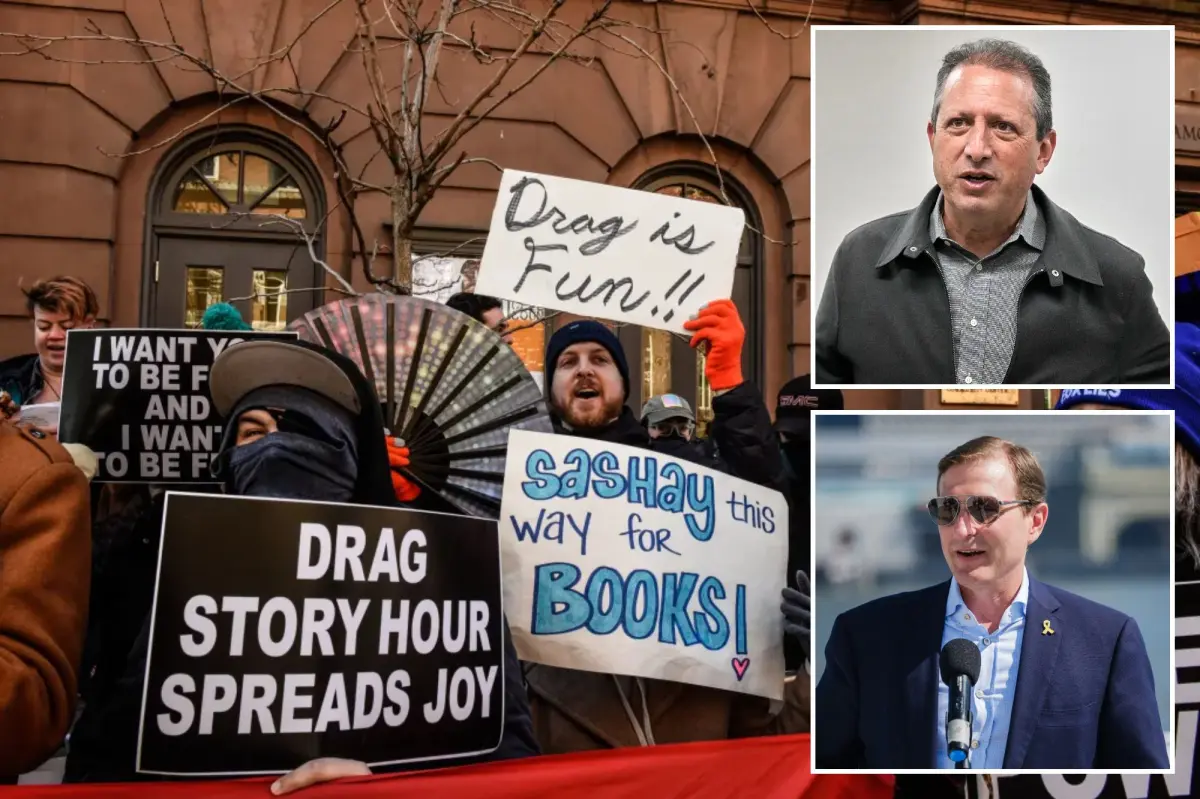
In the hyper-competitive arena of New York politics, a congressional primary has transformed into a vibrant battleground where the boundaries of public funding, progressive values, and community representation are being intensely debated. Incumbent Representative Dan Goldman and his challenger, former New York City Comptroller Brad Lander, have both firmly aligned themselves with local LGBTQ+ advocates by pledging their support for federal funding to back “Drag Story Hour.” This program, which features drag performers reading stories to young children in public schools and libraries, has become a focal point of cultural solidarity in the city. By responding to a detailed questionnaire from the influential Jim Owles LGBT Liberal Democratic Club, both candidates signaled how crucial the support of progressive organizations is in capturing the hearts of local primary voters. This political calculation occurs against a highly publicized backdrop: official records reveal that local and state taxpayers have already contributed nearly $700,000 to sustain the program over the past decade. The unfolding race highlights a deeper local effort to normalize and institutionalize queer culture within the public framework, reflecting a distinct urban identity that prides itself on trailblazing social acceptance. For these Democratic contenders, backing the program is not merely a policy position but a moral imperative, symbolizing an active defense against a national conservative wave that seeks to restrict the visibility of LGBTQ+ individuals. However, as local leaders double down on their support, they find themselves navigating a delicate balance between fulfilling the expectations of their deeply progressive base and addressing the broader public’s questions about how civic funds are distributed. This intersection of local political ambition and grassroots activism showcases how municipal topics can rapidly escalate into defining elements of a candidate’s national profile, reflecting the complex human dynamics of representation. As neighborhoods throughout Manhattan and Brooklyn become the backdrop for these political maneuvers, the conversation shifts from simple policy disagreements to deep, emotional debates about the kind of environment we want to create for our children, highlighting how deeply personal politics has become for families on all sides of the demographic spectrum.
Examining the candidates’ specific declarations reveals the depth of their commitment to this cultural initiative, as well as their visions for a future under federal leadership. Representative Dan Goldman, who is currently seeking a third term in Congress, expressed frustration with the political landscape in Washington, noting that the current Republican majority prevents members from directing federal community project funding toward LGBTQ+ programs. In his written response to the progressive advocacy club, Goldman emphasized his eagerness to reclaim the House majority, declaring that he “cannot wait” to direct federal dollars toward Drag Story Hours and other inclusive public programs, even expressing a personal desire to host an event himself in the future. His challenger, Brad Lander, boasts an equally deep connection to the initiative, pointing to his tenure as a city council member representing Brooklyn, during which he actively supported and helped fund drag storytelling events at various public library branches within his district. To clarify his legislative vision, a spokesperson for Lander expanded on his platform, explaining that if Lander is elected to the House, he plans to advocate for a comprehensive package of federal investments that addresses both systemic social needs and local cultural programs. This vision spans essential services such as affordable housing, comprehensive healthcare, subsidized child care, international aid through USAID, and public libraries, while ensuring that vibrant, community-based arts and cultural initiatives—explicitly including Drag Story Hour—are not left behind. By framing these storytelling events alongside essential human services like healthcare and housing, the candidates are making a broader argument: that a community’s emotional and cultural well-being is just as vital to its survival as its physical infrastructure. They seek to prove that true community development requires investing not just in the bricks and mortar of a neighborhood, but in its artistic soul and its capacity for empathy and inclusion.
To truly understand the human dimension of this controversy, one must look closely at the mechanics and mission of Drag Story Hour itself, which is managed by a nonprofit organization known as Drag Artists for Expression NYC. Formerly operating under the name Drag Story Hour NYC, this group works intimately with a vast network of 128 public and private schools alongside more than 90 public libraries scattered across the city’s five boroughs. The scale of their outreach is remarkable; in the year 2025 alone, the organization successfully hosted 165 reading sessions that reached upwards of 5,000 young people, including dozens of specialized programs in public classrooms, libraries, and specifically designed bilingual events, alongside targeted outreach to children navigating the foster care system. Advocates and performers describe these events as places of joy, color, and imagination, where the simple act of reading a book becomes a lesson in empathy and self-expression. According to the organization’s mission statement, the primary goal of these sessions is to celebrate gender diversity and human differences through fun, fabulous, and deeply educational experiences. By providing kids with positive, creative role models who defy traditional gender norms, the organizers hope to build a more tolerant generation, dismantle discrimination early in life, and give children the confidence to express their unique identities in whatever way they feel most comfortable. For the drag performers involved, many of whom faced isolation or bullying during their own childhoods, these story hours represent a profound opportunity to offer today’s youth the kind of unconditional acceptance and community support that they themselves were denied when they were growing up, turning their personal struggles into a source of inspiration. By transforming the traditional library space into a stage of vibrant storytelling, these artists aim to bridge cultural gaps, using the universal medium of children’s literature to foster a gentle curiosity about the diverse world we inhabit, hoping that early lessons in acceptance will blossom into lifelong values of kindness and mutual respect.
Yet, despite the inclusive aspirations of its supporters, Drag Story Hour has encountered significant friction, demonstrating that even within a historically liberal metropolis like New York, the intersection of childhood education and gender expression remains deeply sensitive. The program has faced vocal protests, community boycotts, and occasionally, alarming security threats, including bomb scares that have disrupted neighborhoods and required police intervention. Many parents, even those who generally support progressive policies, have voiced frustrations regarding a perceived lack of transparency and communication from school administrators and library coordinators. Some argue that they were never properly notified or given the opportunity to opt their children out of these specific events, raising fundamental questions about parental consent and the role of public institutions in introducing complex social concepts to young minds. This tension represents a genuine human conflict between parents who wish to guide their children’s exposure to sensitive topics at their own pace, and educators who believe that fostering diversity in public spaces must be universal and proactive. The resulting gridlock has sometimes transformed cozy community libraries—ordinarily quiet sanctuaries for learning—into tense battlegrounds characterized by shouting matches, security guards, and heavy political rhetoric. These emotional confrontations demonstrate how deeply people care about the education and emotional development of the next generation, showing that behind the political talking points lie very real, deep-seated anxieties about family values, parental rights, and the rapidly shifting cultural landscape of modern parenting. As families navigate these tumultuous debates, the desire to protect children’s innocence remains a powerful, unifying instigator of parental passion, even as communities differ wildly on how that protection is best achieved. This disconnect reveals a growing gap in public trust, where parents feel increasingly sidelined by institutional decision-makers, leading to a pervasive vulnerability and a demand for more direct engagement in the curricula and extracurricular activities that shape their children’s daily school experiences.
The debate becomes even more volatile when state and city finances are brought to the forefront, as public records trace the substantial cash flows that have enabled the program’s expansion. Over the course of the past ten years, municipal and state agencies have directed around $700,000 toward these programs, with $367,000 coming through city agencies such as the Department of Youth and Community Development, and another $204,500 administered through the New York State Council on the Arts. For Republican campaign strategists, this financial trail represents a powerful political tool that they intend to leverage heavily on the campaign trail to appeal to moderate and conservative voters nationwide. GOP pollster John McLaughlin, who has worked closely with national figures like Donald Trump, argues that the vast majority of ordinary citizens, regardless of their political affiliation, do not want their tax dollars used to promote gender ideology to young children. McLaughlin describes the progressive push to direct federal funds toward these programs as a stark example of an extreme and out-of-touch cultural agenda that he believes will alienate mainstream voters if Democrats regain control of Congress. The strategy of weaponizing cultural issues in federal elections is a proven blueprint; during the high-stakes 2024 presidential election cycle, Donald Trump’s campaign successfully ran aggressive television advertisements focusing on taxpayer-funded gender transition procedures for prisoners, demonstrating how cultural anxiety can be converted into potent electoral energy. By framing these expenditures as a misuse of public resources, conservative strategists hope to present themselves as the rational guardians of taxpayer money and childhood innocence, drawing a stark contrast with what they describe as the progressive establishment’s preoccupation with identity politics. This tactical maneuvering positions the financial debate as one of the central pillars of the upcoming election, transforming a localized cultural program into a high-stakes proxy war over federal spending priorities.
Ultimately, this local primary conflict serves as a microcosm of a much larger, ongoing struggle to define the moral and cultural identity of the United States. New York State Conservative Party Chairman Gerard Kassar pointedly warned that while progressive policies might enjoy overwhelming support in the most liberal districts of New York City, they are highly unlikely to find acceptance across the broader American landscape, calling the use of public funds for such programs an inappropriate endorsement of ideological extremism. This cultural polarization has even paralyzed federal legislative efforts, as seen recently when House Democrats voted en masse against a bill to construct a new museum honoring women’s history because Republicans had inserted provisions prohibiting the inclusion of transgender individuals in the exhibits. This legislative gridlock underscores how completely identity politics has permeated every level of American governance, turning even non-partisan endeavors like historic preservation and childhood literacy into zero-sum ideological conflicts. As the nation prepares for future elections, the debate over initiatives like Drag Story Hour forces communities to grapple with fundamental questions about the purpose of public institutions, the limits of government-funded speech, and the delicate balance between celebrating diversity and respecting traditional family boundaries. It is a human struggle played out in school boardrooms, library hallways, and legislative chambers, where both sides are driven by a profound care for the future, yet hold vastly different visions of what a healthy, inclusive, and cohesive society should look like. In this environment, the search for common ground seems increasingly elusive, leaving citizens to ponder whether our shared civic spaces can ever truly unite us, or if they are destined to remain permanent platforms for our deepest cultural divisions. As we move forward, the challenge will be to discover ways of coexistence that honor individual differences without fracturing the foundational trust that binds our communities together, ensuring that our public squares remain places of genuine connection rather than ideological combat.