

Rewrite the following content into a 2000-word, SEO-optimized article in English. Write it in the style of a professional journalist or news reporter. The article should be fully humanized, natural, and engaging — not robotic or repetitive.
Focus on clarity, flow, and storytelling while preserving the meaning of the original. Structure the article into 6 well-developed paragraphs with smooth transitions, strong headlines, and a professional tone. Use varied vocabulary, sentence lengths, and natural phrasing to make it read like human-written journalism.
Avoid keyword stuffing, but naturally integrate important SEO keywords throughout the article. Ensure the final article feels like it was written by a skilled reporter for a reputable news outlet.
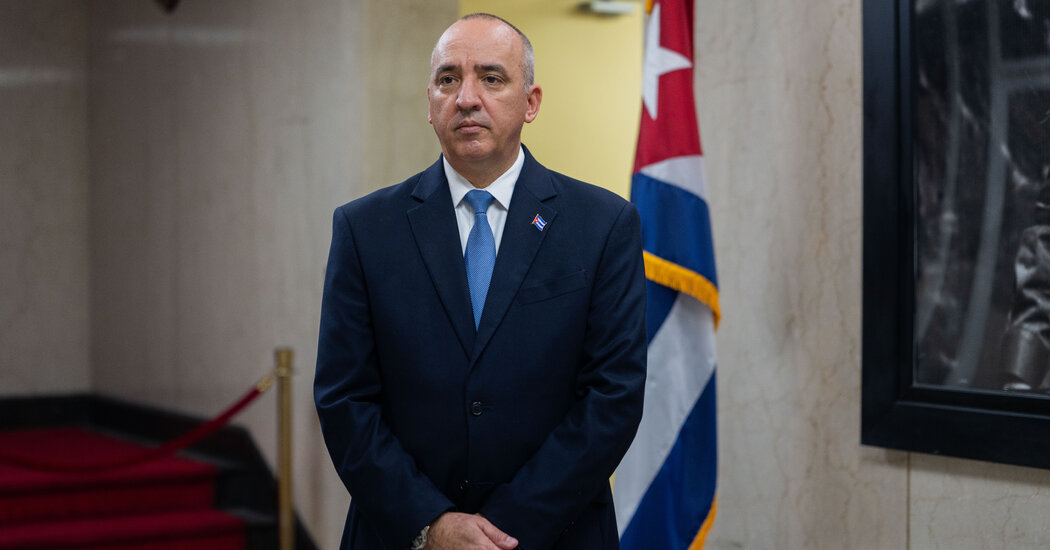
Cuba is open to changes to its economy and government, and eager to continue negotiations with the United States, but it does not believe Washington is participating in talks in good faith, Cuba’s ambassador to the United Nations told The New York Times.
“Cuba is willing to talk about everything with the United States. There is no taboo subject in our conversations — on the basis of reciprocity and equality,” Ernesto Soberón Guzmán, the Cuban ambassador, said in an interview on Wednesday.
But, he added, “obviously it does not help a climate of dialogue and trust that every other day there are statements like, ‘We are ready to take over Cuba,’” referring to recent comments by President Trump.
“Warmongering rhetoric does not help,” he said. “Building different pretexts for military aggression against Cuba, which is what they are building, does not help.”
The hourlong conversation was the first time in years that a sitting Cuban government official had granted an on-the-record interview to The Times.
Mr. Soberón Guzmán said the government had decided to do so in an effort to tell the American public that Cuba wants peace and cooperation with the United States, despite the Trump administration’s intensifying pressure campaign against the island.
That pressure increased on Wednesday when U.S. prosecutors formally accused Raúl Castro, the former Cuban president and perhaps still the nation’s most powerful figure, of ordering the Cuban military to shoot down two civilian planes over Cuba in 1996, killing four people, including three American citizens.
It was one of the most aggressive steps yet in a monthslong U.S. campaign to squeeze the Cuban government into giving up power or making significant political and economic concessions.
The Trump administration has enforced an effective oil blockade on the island, with a few exceptions, that has helped lead to food shortages, health care failures, black-market gas prices over $40 a gallon and electricity blackouts that can last 22 hours a day.
Secretary of State Marco Rubio said in a video addressed to the Cuban people on Wednesday — the day in 1902 the United States ended its military occupation of Cuba — that the United States was not responsible for those issues.
“The real reason you don’t have electricity, fuel or food is because those who control your country have plundered billions of dollars, but nothing has been used to help the people,” Mr. Rubio said in Spanish, referring to GAESA, a Cuban military-run conglomerate that controls, by some estimates, up to 70 percent of Cuba’s economy.
“President Trump is offering a new relationship between the U.S. and Cuba. But it must be directly with you, the Cuban people, not with GAESA,” Mr. Rubio added.
Mr. Soberón Guzmán said Mr. Rubio’s comments were, “for anyone who has a minimum of common sense, an insult to human intelligence.” It was the United States that stopped the flow of Venezuelan oil that once supported Cuba, he said, and it was the United States that threatened other nations to halt their own oil shipments to the island.
Mr. Soberón Guzmán reiterated recent comments from Cuban officials that the island has depleted its fuel reserves and was propping up its energy grid solely with domestic oil production and renewable energy, mostly from solar panels.
“You don’t need to be a Nobel Prize-winning mathematician to realize that when you keep taking and taking without putting anything back, you run out,” he said.
The Trump administration has offered Cuba $100 million in food and medicine to ease the effects of the energy crisis, though it has mandated that the aid be distributed via the Catholic Church or other trusted groups, and not the Cuban government.
Mr. Soberón Guzmán said that Cuba planned to accept the aid but also called it an “insult.” He blamed the U.S. trade embargo and oil blockade for causing many of the island’s economic problems, though its state-planned economy has also long contributed to widespread poverty.
“Now suddenly they come to say they want to help us,” he said. “We hope it isn’t just another political manipulation — appearing as the supposed saviors of the very people they’re strangling.”
Amid the increasing tensions, the United States and Cuba have been engaged in talks for months. John Ratcliffe, the C.I.A. director, traveled to Havana last week to demand that Cuba make significant economic overhauls and block Russian and Chinese intelligence operations on the island.
The C.I.A. said in a statement that Mr. Ratcliffe told Cuban officials “that the United States is prepared to seriously engage on economic and security issues, but only if Cuba makes fundamental changes.”
Mr. Soberón Guzmán said that Cuban officials see a variety of areas of cooperation that could be mutually beneficial for the two countries, including migration, tourism, agriculture, medicine production and combating drug trafficking.
He declined to offer specifics about potential changes to Cuba’s economy or its political system, which has essentially one political party and no free press. But he said that Havana was not eager to take lectures from Washington on democracy, criticizing several aspects of the U.S. system, including the electoral college, redistricting and the influence of wealthy political donors. “Is that the democracy they want for Cuba? It doesn’t interest us,” he said.
He added that the United States has positive relations with a number of nations that lack democratic systems. “Thus democracy in Cuba is not the reason why the United States is applying this policy,” he said of the pressure campaign.